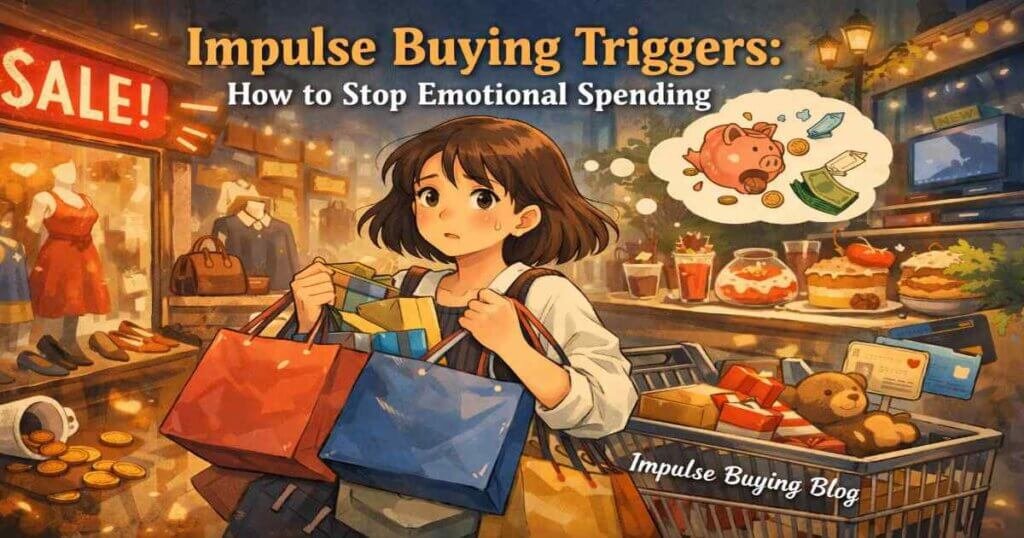
Impulse buying triggers are the hidden psychological cues that push you to spend money in the moment, often without realizing why you’re doing it.
You’ve done it again. You went to Target for laundry detergent and walked out with $87 worth of stuff you didn’t plan to buy. You opened your phone to check the weather and somehow ended up checking out with three items in your Amazon cart. You were “just browsing” online and now there’s a charge on your credit card that you’ll regret tomorrow.
If this sounds familiar, you’re not alone. According to a 2024 study by Slickdeals, the average American spends $314 per month on impulse purchases—that’s $3,768 per year on things they didn’t plan to buy. For some people, it’s even higher. A separate study by CreditCards.com found that 73% of Americans have made an impulse purchase in the past year, and nearly half say they’ve bought something they later regretted.
But here’s what most people don’t understand: impulse buying isn’t a character flaw. It’s not about willpower or self-control. Impulse buying is a predictable response to specific psychological triggers—and once you understand what those triggers are and how they work, you can take back control.
This guide will help you identify your personal impulse buying triggers, understand why they’re so powerful, and give you practical strategies to stop impulse buying for good. Whether you’re trying to save money, pay off debt, or just stop wasting money on things you don’t need, understanding your triggers is the key.
Plain-English Summary
Impulse buying triggers explain why emotional spending happens and why willpower alone isn’t enough to stop impulse buying.
Impulse buying is when you purchase something you didn’t plan to buy, often driven by emotion rather than need. It happens when certain psychological, environmental, or emotional triggers override your rational decision-making.
Understanding impulse buying triggers is the first step toward taking control of your spending habits and building financial stability.
These triggers are different for everyone. Maybe you impulse buy when you’re stressed. Maybe it’s when you see a sale. Maybe it’s when you’re scrolling social media. Maybe it’s when you’re with certain friends. The triggers vary, but the pattern is the same: something activates an emotional response, and you buy something to satisfy that feeling.
In this guide, I’m going to walk you through the most common impulse buying triggers, help you identify which ones affect you most, explain the psychology behind why they work, and give you specific, actionable strategies to break the cycle.
This isn’t about deprivation or never buying anything again. It’s about understanding why you buy things you don’t need so you can make intentional choices instead of reactive ones.
This guide identifies the specific impulse buying triggers that affect most people and provides practical strategies to overcome them.
Table of Contents
1. What Is Impulse Buying? (The Real Definition)
Let me start with a clear definition so we’re on the same page.
Impulse buying is purchasing something without prior planning or intention, typically driven by emotion or external stimuli rather than rational need.
Here’s what that means in plain English:
You didn’t wake up that morning planning to buy it. You didn’t need it. You weren’t looking for it. But something—a feeling, a situation, an advertisement, a moment—triggered the desire to buy, and you acted on it immediately without much thought.
Impulse buying is characterized by:
- Little to no planning or forethought
- Quick decision-making (often within seconds or minutes)
- Emotional rather than logical reasoning
- Immediate gratification seeking
- Often followed by regret or guilt
What impulse buying is NOT:
- Buying something small or inexpensive (you can impulse buy expensive items too)
- Treating yourself occasionally (planned treats aren’t impulses)
- Buying something on sale that you actually need
- Making a purchase after considering it thoughtfully, even if it’s quick
Recognizing impulse buying triggers in real-time allows you to pause before making purchases you’ll later regret.
The key distinction: Impulse buying bypasses your rational decision-making process. Your emotional brain takes over and makes the decision before your logical brain can evaluate whether it’s a good idea.
Think of it this way: planned purchases involve your prefrontal cortex (the part of your brain responsible for logic, planning, and decision-making). Impulse purchases are driven by your limbic system (the emotional, reward-seeking part of your brain). When you impulse buy, emotion wins over logic.
2. Why Impulse Buying Matters (The Financial and Emotional Cost)
You might be thinking, “So what? So I buy a few things I don’t need. It’s not that big a deal.”
Let me show you why it matters.
The financial cost is bigger than you think.
Remember that statistic from the introduction? The average American spends $314 per month on impulse purchases. Let’s do the math:
- $314/month × 12 months = $3,768 per year
Most people encounter impulse buying triggers multiple times daily without recognizing them.
- Over 10 years: $37,680
- Over 20 years: $75,360
And that’s just the average. If you’re spending more—say $500/month—that’s $6,000 per year, $60,000 over 10 years.
Now imagine if that money went into savings, debt payoff, or investments instead. According to a compound interest calculator, $314 per month invested with a 7% annual return would grow to approximately $100,000 in 15 years.
That’s the opportunity cost of impulse buying.
The emotional cost is even higher.
Beyond the money, impulse buying creates:
Guilt and shame. You feel bad about spending money you know you shouldn’t have. This erodes your self-esteem and makes you feel out of control.
Financial stress. Impulse purchases add up, leaving you with less money for bills, savings, or things you actually care about. According to the American Psychological Association, 72% of Americans report feeling stressed about money at least some of the time.
Clutter. All those impulse purchases pile up in your home. Studies show that clutter increases cortisol (stress hormone) levels and reduces overall life satisfaction.
Relationship tension. If you share finances with a partner, impulse buying can create conflict, resentment, and trust issues.
Prevents progress toward goals. Every dollar spent on impulse is a dollar not going toward your emergency fund, debt payoff, down payment, or retirement.
Reinforces the cycle. Impulse buying often creates temporary relief from negative emotions, which reinforces the behavior. You feel bad, you buy something, you feel better briefly, then you feel worse, so you buy again.
The bottom line: Impulse buying isn’t harmless. It’s costing you money, peace of mind, and progress toward the life you want.
3. The Psychology Behind Impulse Buying
Before we dive into specific triggers, you need to understand why impulse buying is so powerful and why it’s so hard to resist.
Your brain is wired for immediate rewards.
Thousands of years ago, humans survived by seeking immediate gratification. If you found food, you ate it immediately because you didn’t know when you’d find more. That instinct is still hardwired into your brain.
When you see something you want, your brain releases dopamine—a neurotransmitter associated with pleasure and reward. This creates a feeling of anticipation and excitement. Your brain says, “Get that thing! It will make you feel good!”
The problem is, your brain doesn’t distinguish between things you actually need and things that just look appealing in the moment. It just wants the dopamine hit.
The financial damage from uncontrolled impulse buying triggers can derail even well-planned budgets and savings goals.
Your emotional brain overrides your logical brain.
Your brain has two systems for decision-making:
System 1 (Emotional brain): Fast, automatic, emotional, impulsive. This is the limbic system.
System 2 (Logical brain): Slow, deliberate, rational, analytical. This is the prefrontal cortex.
When you impulse buy, System 1 takes over before System 2 can engage. The emotional brain sees something it wants and acts immediately. By the time your logical brain catches up, you’ve already swiped your card.
Research from behavioral economics shows that emotional arousal significantly impairs decision-making. When you’re stressed, excited, sad, or even just mildly stimulated, your ability to think rationally decreases.
Marketers and retailers exploit this.
Retailers spend billions of dollars studying consumer psychology to trigger impulse purchases. They know exactly which buttons to push:
- Scarcity: “Only 2 left in stock!”
The cumulative effect of small impulse buying triggers over time often exceeds single large purchases.
- Urgency: “Sale ends tonight!”
- Social proof: “12,000 people bought this in the last 24 hours”
- Authority: “Recommended by experts”
- Anchoring: “Was $99, now $49!” (even if it was never really $99)
Stores are designed to maximize impulse purchases. That’s why candy and magazines are at the checkout counter. That’s why grocery stores put milk in the back—so you have to walk past hundreds of products to get to it.
Online shopping makes it even worse with one-click purchasing, personalized recommendations, and endless scrolling that keeps you in a state of mild arousal.
Impulse buying is a coping mechanism.
For many people, impulse buying is a way to manage uncomfortable emotions. You’re not really buying the thing—you’re buying the feeling you think it will give you.
Common emotional drivers:
- Stress relief: “I’ve had a hard day. I deserve this.”
- Boredom: “I’m bored. Let me browse online.”
- Sadness: “I’m sad. This will cheer me up.”
- Anxiety: “Buying this will solve this problem I’m worried about.”
- Emptiness: “I feel unfulfilled. Maybe this will fill the void.”
The purchase creates a brief spike of pleasure or relief, but it doesn’t address the underlying emotion. So the feeling comes back, and the cycle repeats.
Understanding this psychology is the first step to breaking the pattern. You can’t stop impulse buying through willpower alone—you have to address the triggers and mechanisms that drive it.
4. The 12 Most Common Impulse Buying Triggers
Now let’s get specific. Here are the 12 most common triggers that lead to impulse purchases. As you read through these, pay attention to which ones resonate with you.
Trigger 1: Emotional distress (stress, sadness, anxiety)
When you feel bad, buying something feels like a quick fix. The anticipation and act of purchasing releases dopamine, temporarily improving your mood. This is sometimes called “retail therapy.”
What it looks like: You had a terrible day at work. You stop at Target on the way home and buy things you don’t need because it makes you feel better.
Understanding the psychology behind impulse buying triggers helps you see why willpower alone rarely succeeds.
Trigger 2: Boredom
When you’re understimulated or have nothing to do, browsing and buying gives your brain something to focus on. It creates artificial excitement.
What it looks like: You’re sitting on the couch scrolling through your phone. You open Amazon or Instagram and start browsing. Within minutes, you’ve added things to your cart.
Trigger 3: Sales and discounts
Seeing something marked down triggers a fear of missing out on a good deal. Your brain perceives the discount as “saving money,” even though you’re actually spending money.
What it looks like: “This is 50% off! I’m saving $30!” (Even though you’re spending $30 you weren’t planning to spend.)
Trigger 4: Scarcity and urgency
Brain chemistry plays a significant role in how powerfully impulse buying triggers affect our decision-making.
When something is limited in quantity or time, your brain perceives it as more valuable. You feel pressure to buy now or miss out.
What it looks like: “Only 3 left in stock!” or “Flash sale ends in 2 hours!”
Trigger 5: Social comparison and FOMO
Seeing what others have—especially on social media—triggers feelings of inadequacy or missing out. Buying the same thing feels like a way to keep up.
What it looks like: Your friend posts about their new gadget. Suddenly you feel like you need it too, even though you were fine without it yesterday.
Trigger 6: Feeling deprived
If you’ve been restricting yourself too much—whether with budgeting, dieting, or anything else—you eventually rebel. The pendulum swings the other way and you overspend.
What it looks like: You’ve been on a strict budget for weeks. You feel deprived and resentful. One day you snap and go on a spending spree.
Trigger 7: Celebratory mood
Positive emotions can trigger impulse buying too. When something good happens, you want to reward yourself or enhance the good feeling.
What it looks like: You got a raise or finished a big project. You “treat yourself” by buying things you don’t need.
Trigger 8: Hunger or physical discomfort
Studies show that hunger, fatigue, and physical discomfort impair decision-making. When you’re uncomfortable, you’re more likely to make impulsive choices.
What it looks like: You go shopping while hungry. You buy way more groceries than you need, plus random non-food items.
Trigger 9: Peer pressure or social situations
Being around friends or family who spend money can pressure you to do the same, even unconsciously. You don’t want to be the only one not participating.
What it looks like: Your friends suggest going shopping or out to eat. You go along and spend money you didn’t plan to spend because everyone else is.
Trigger 10: Identity and self-image
Sometimes you buy things to reinforce who you want to be or how you want others to see you. The purchase is about identity, not the actual item.
These twelve impulse buying triggers represent the most common patterns that lead to unplanned purchases.
What it looks like: “I’m the kind of person who has nice things” or “I need this to look professional/successful/put-together.”
Trigger 11: Convenience and ease
When buying is too easy—one-click purchasing, saved payment info, fast checkout—the friction that would normally slow you down is removed.
What it looks like: Amazon’s “Buy Now” button. You click without thinking because it’s so easy.
Trigger 12: Overwhelm and decision fatigue
When you’re mentally exhausted from making decisions all day, your ability to make good financial choices deteriorates. You take the path of least resistance, which is often buying.
What it looks like: After a long day of work and life decisions, you’re too tired to think clearly. You buy something just to end the mental effort of deciding.
Retailers invest millions studying and exploiting the most effective impulse buying triggers.
Most people have 2-4 primary triggers. Understanding which ones affect you most is critical to stopping impulse buying.
4A. Understanding Consumer Behavior and the Psychology of Impulse Buying
When examining impulse buying triggers, it’s essential to understand the broader context of consumer behavior and how buying behaviors develop over time. The psychology of impulse buying reveals that impulse purchases aren’t random—they follow predictable patterns influenced by psychological triggers, emotional state, and consumer behaviour conditioning. Understanding these buying behaviors helps you recognize when you’re about to impulse buy and interrupt the pattern before making an unplanned purchase.
Research in environmental psychology and consumer research shows that impulse buying behavior stems from complex interactions between psychological factors and external cues. A retailer understands that certain spending triggers can drive impulse buying by creating specific conditions in the shopping environment. When you understand the psychology behind impulse purchases, you gain power over your purchase decision process and can build healthier shopping habits that align with your financial goals rather than responding to every trigger you encounter.
How Buying Behaviors Form and the Factors Influencing Impulse Purchases:
Your buying behaviors aren’t fixed—they’re learned patterns that develop through repeated experiences with impulse buying triggers. Every time you engage in impulse buying and experience temporary relief or pleasure, your brain strengthens the connection between the trigger (stress, boredom, seeing a sale) and the response (making an impulsive purchase). This conditioning process explains why impulse buyers often feel an urge to buy before they’ve consciously decided to make a purchase—the buying impulse activates automatically when they encounter familiar impulse buying triggers.
The factors influencing your vulnerability to impulse buying triggers extend beyond individual psychology to include cultural factors, social influence, and learned consumer behavior patterns. According to research published in Frontiers in Psychology, individuals prone to impulse purchases often share certain characteristics: difficulty delaying gratification, heightened sensitivity to marketing strategies, and specific emotional state patterns that trigger impulse buying. However, recognizing these triggers of impulse buying represents the first step toward change—once you understand what influences on impulse purchases affect you most, you can implement targeted strategies to encourage more thoughtful buying decisions.
| Behavior Type | Key Characteristics | Primary Impulse Buying Triggers |
| Habitual Buying | Routine purchases, low involvement | Convenience, habit, store layout |
| Variety-Seeking | Trying new products, novelty focus | New product displays, samples, limited editions |
| Emotional Buying | Mood-driven, seeking feeling | Stress, boredom, excitement, reward mentality |
| Complex Buying | High involvement, extensive research | Flash sales on researched items, time pressure |
5. Emotional Triggers: Stress, Boredom, and Mood
Let me dive deeper into emotional triggers because they’re the most common and the most powerful.
Stress and anxiety
Stress triggers the body’s fight-or-flight response, flooding you with cortisol and adrenaline. In this state, your brain seeks immediate relief. Shopping provides that relief through distraction and the temporary pleasure of buying.
A 2023 study published in the Journal of Consumer Psychology found that people under stress are 43% more likely to make impulse purchases than those in a calm state.
Why it works: Buying something gives you a sense of control when life feels out of control. It creates a moment of pleasure in an otherwise difficult day.
How to recognize it: Notice if your impulse purchases cluster around stressful periods—tight work deadlines, relationship problems, family stress, financial worry.
What to do instead:
- Identify healthier stress relief: exercise, talking to a friend, meditation, journaling
- Set a 24-hour rule: if you want to buy something while stressed, wait 24 hours
- Leave your wallet at home or delete saved payment methods so there’s friction between impulse and purchase
Sadness and depression
When you feel sad or down, your brain seeks dopamine to counteract the low mood. Shopping provides a quick hit.
Research from the University of Michigan found that people who are sad are willing to pay up to 30% more for items than people in a neutral mood, because they’re seeking the mood boost more than the actual product.
Why it works: The act of buying—not owning—provides temporary relief. Anticipation of receiving something new creates hope and excitement.
How to recognize it: You impulse buy after bad news, disappointments, or during periods of general sadness or loneliness.
Emotional impulse buying triggers like stress and boredom are among the most powerful drivers of unplanned spending.
What to do instead:
- Address the sadness directly: reach out to someone, do something that genuinely makes you happy, practice self-compassion
- Create a “things that help when I’m sad” list that doesn’t involve spending money
- Recognize that the relief from buying is temporary—the sadness will still be there plus guilt from overspending
Boredom and understimulation
When you’re bored, your brain craves stimulation. Shopping provides novelty, excitement, and something to do.
Why it works: Browsing online stores or wandering through Target gives your brain new information to process. It’s entertaining and requires no real effort.
How to recognize it: You impulse buy when you’re sitting around with nothing to do, often while scrolling your phone.
What to do instead:
Learning to identify your emotional impulse buying triggers creates opportunities to address root causes rather than symptoms.
- Keep a list of free or cheap activities you genuinely enjoy
- Delete shopping apps from your phone
- Set time limits on social media apps where ads appear
- Find a hobby that genuinely engages you
Anxiety and seeking control
Anxiety makes you feel like things are uncertain and out of control. Buying something—especially something “practical” or “preparedness-related”—creates the illusion of control.
Why it works: “If I buy this [gadget, organizational system, backup supply], I’ll be prepared and safe.”
How to recognize it: You impulse buy items you think will solve problems or prevent future issues, especially during uncertain times.
What to do instead:
Stress-related impulse buying triggers tend to peak during specific times of day and week.
- Address the underlying anxiety through therapy, exercise, or stress management techniques
- Ask yourself: “Am I buying this because I need it, or because I’m anxious?”
- Create a list of what you actually need vs. what anxiety tells you to buy
6. Environmental Triggers: Sales, Marketing, and Store Design
Now let’s talk about external triggers—the things in your environment designed to make you spend.
Sales and discounts
Your brain perceives a discount as gaining money, not spending it. This is a cognitive bias called “anchoring.” The original price becomes the anchor, and the sale price looks like a bargain by comparison—even if the original price was inflated or meaningless.
According to research by the Journal of Marketing Research, consumers focus on the percentage saved rather than the actual dollar amount spent, which leads to irrational purchasing.
Common sales tactics:
- “50% off!” (even if you didn’t want or need it at 100%)
- “Buy one, get one free” (you buy two things instead of zero)
- “Limited time offer!” (creates urgency)
How to recognize it: You buy things just because they’re on sale, not because you need them.
What to do instead:
- Ask: “Would I buy this at full price?” If no, you don’t need it.
- Calculate the actual money leaving your wallet, not the “savings”
- Implement a 24-hour rule even for sale items
- Remember: You can’t save money by spending money you weren’t planning to spend
Store layout and design
Retail stores are carefully designed to maximize impulse purchases:
- Checkout displays: Candy, magazines, small items you grab while waiting
- End caps: Eye-level displays at the end of aisles that grab attention
Retailers deliberately design stores and marketing to activate environmental impulse buying triggers.
- Strategic product placement: Milk in the back, essentials spread out so you walk past everything
- Sensory manipulation: Music, scents, lighting designed to put you in a buying mood
Research shows that 60-70% of grocery store purchases are unplanned, largely due to store design.
How to recognize it: You went for one thing and left with 10.
What to do instead:
- Make a list before shopping and stick to it
- Avoid going to stores when you’re hungry, tired, or emotional
- Use curbside pickup or delivery so you only order what you planned
- Pay with cash—research shows people spend less with cash than cards
Being aware of environmental impulse buying triggers helps you shop more intentionally and resist manipulation.
Online shopping design
E-commerce sites are optimized to reduce friction and increase impulse purchases:
- One-click purchasing
- Saved payment information
- “Frequently bought together” suggestions
Store layouts are meticulously designed to maximize exposure to impulse buying triggers.
- Personalized recommendations
- Countdown timers (“Sale ends in 2 hours 37 minutes!”)
- Limited stock warnings (“Only 3 left!”)
- Free shipping thresholds (“Add $15 more for free shipping”)
A 2024 study found that online impulse purchases increased by 68% compared to 2019, largely due to improved UX design that makes buying effortless.
How to recognize it: You can’t remember what triggered you to start browsing, but suddenly you’re checking out.
What to do instead:
- Delete saved payment methods (adds friction back in)
- Remove shopping apps from your phone
- Use browser extensions that block shopping sites or add mandatory waiting periods
- Never shop while scrolling social media
- Unsubscribe from promotional emails
7. Social Triggers: FOMO, Peer Pressure, and Social Media
Social triggers are becoming more powerful every year, especially with the rise of social media and influencer culture.
Social media comparison
Instagram, TikTok, Facebook, and Pinterest constantly show you what others have, wear, use, and experience. This triggers social comparison—you evaluate your own life against others’ highlight reels.
When you feel like you’re falling short, buying similar things feels like a way to close the gap.
According to a 2023 study by Bankrate, 48% of Americans have made purchases they couldn’t afford to keep up with their peers, with social media being a primary driver.
What it looks like:
- You see an influencer with a product and immediately want it
- You compare your home, wardrobe, or lifestyle to others and feel inadequate
- You buy things to post about them, not because you actually want them
What to do instead:
- Take breaks from social media, especially when you notice it triggering spending
- Unfollow accounts that make you feel inadequate or trigger shopping
- Remember that what you see online is curated and often sponsored/paid
- Focus on your own values and goals, not others’ lives
Social impulse buying triggers have intensified dramatically with the rise of social media and influencer culture.
FOMO (Fear of Missing Out)
FOMO is the anxiety that you’re missing out on rewarding experiences others are having. In spending terms, it’s the fear that if you don’t buy something now, you’ll regret it later.
Retailers weaponize this with:
- “Limited edition”
- “Exclusive drop”
- “Only available today”
- “Selling fast”
What it looks like: You buy things because “everyone else has it” or “what if I can’t get it later?”
What to do instead:
- Remind yourself that there will always be another sale, another product, another trend
Recognizing social impulse buying triggers allows you to separate genuine needs from social pressure.
- Ask: “If this product disappeared forever, would my life actually be worse?”
- Practice JOMO (Joy of Missing Out)—finding contentment in what you already have
Peer pressure and social spending
When you’re with friends or family who spend money, there’s social pressure to participate. You don’t want to be the “cheap” one or miss out on shared experiences.
What it looks like:
- Your friends suggest shopping and you go along
- Everyone orders appetizers and drinks, so you do too even though you weren’t planning to
- You buy something because your friend bought one and you don’t want to feel left out
What to do instead:
Social comparison represents one of the oldest yet most persistent impulse buying triggers.
- Suggest free or low-cost activities when planning with friends
- Be honest: “I’m trying to save money right now, so I’m going to sit this one out”
- If you go, set a specific budget beforehand and stick to it
- Find friends who support your financial goals
8. Internal Triggers: Identity, Self-Worth, and Reward
Some of the deepest impulse buying triggers come from within—how you see yourself and what you think you deserve.
Identity-based buying
Sometimes you buy things not because you want them, but because they align with who you think you are or who you want to be.
Examples:
- “I’m a professional, so I need to dress a certain way”
- “I’m the kind of person who has nice things”
- “I’m a minimalist” (and you buy expensive minimalist items)
- “I’m a good parent” (so you buy your kids everything they want)
This is called identity-based consumption. The purchase reinforces your self-concept.
What to do instead:
- Separate your identity from your possessions
- Ask: “Am I buying this because it fits who I actually am, or who I wish I was?”
- Recognize that you can be that person without buying the thing
Low self-worth and compensatory buying
When you feel bad about yourself, buying something nice can temporarily boost your self-esteem. It’s a form of self-soothing.
Research shows that people with lower self-esteem are more likely to make impulse purchases to feel better about themselves.
What it looks like:
Internal impulse buying triggers related to identity and self-worth often operate below conscious awareness.
- “I don’t deserve good things, but maybe this one purchase will prove I’m worthy”
- Using purchases to fill emotional voids
- Buying things to impress others and gain approval
What to do instead:
- Work on building self-worth through therapy, self-compassion practices, and meaningful relationships
- Recognize that your worth isn’t determined by what you own
- Find validation in accomplishments, relationships, and personal growth—not purchases
Reward-seeking behavior
You work hard. You deserve rewards. And buying things feels like rewarding yourself.
Addressing internal impulse buying triggers requires honest self-reflection about what you’re truly seeking through purchases.
This isn’t inherently bad, but it becomes problematic when every accomplishment or difficult day “deserves” a purchase.
What it looks like:
- “I worked hard this week, I deserve this”
- “I met my goal, I’m going to treat myself”
- Using shopping as your primary reward system
What to do instead:
- Create a list of non-spending rewards (bubble bath, movie night at home, sleeping in, time with friends)
- Plan specific, budgeted treats rather than impulsive ones
- Celebrate accomplishments in meaningful ways that don’t involve spending
Self-worth impulse buying triggers often connect to deeper issues that deserve compassionate attention.
9. How to Identify Your Personal Impulse Buying Triggers
Everyone has different triggers. The key to stopping impulse buying is identifying your specific triggers so you can address them directly.
Exercise: The Impulse Buying Trigger Journal
For the next 30 days, every time you make an impulse purchase (or almost make one but stop yourself), write down:
- What did you buy (or almost buy)?
- Where were you? (Store, online, specific website, with friends)
- What time of day was it?
- How were you feeling emotionally? (Stressed, happy, sad, bored, anxious)
- What triggered the urge? (Saw an ad, got an email, was scrolling social media, saw someone else with it)
- Did you buy it? If yes, how do you feel now?
After 30 days, review your journal. Look for patterns:
- Do you impulse buy when you’re stressed?
- Do certain stores or websites trigger you more?
- Do specific emotions drive most of your purchases?
- Is social media a major trigger?
- Do certain times of day correlate with impulse buying?
Once you identify your top 2-3 triggers, you can create specific strategies to address them.
Impulse Buying Trigger Identification Worksheet
Use this worksheet to identify your personal impulse buying triggers:
IMPULSE BUYING TRIGGER IDENTIFICATION WORKSHEET
RECENT IMPULSE PURCHASES ANALYSIS
Everyone experiences different combinations of impulse buying triggers based on personality and circumstances.
List your last 5 impulse purchases:
Purchase 1: _______________________________
Date: __________ Amount: $__________
Where: _______________________________
Emotional state: _______________________________
What triggered it: _______________________________
Purchase 2: _______________________________
Date: __________ Amount: $__________
Tracking your personal impulse buying triggers over time reveals patterns you can then systematically address.
Where: _______________________________
Emotional state: _______________________________
What triggered it: _______________________________
Purchase 3: _______________________________
Date: __________ Amount: $__________
Where: _______________________________
Emotional state: _______________________________
What triggered it: _______________________________
The process of identifying your unique impulse buying triggers is itself a powerful intervention.
Purchase 4: _______________________________
Date: __________ Amount: $__________
Where: _______________________________
Emotional state: _______________________________
What triggered it: _______________________________
Purchase 5: _______________________________
Date: __________ Amount: $__________
Where: _______________________________
Emotional state: _______________________________
Keeping a journal of impulse buying triggers provides invaluable data for behavior change.
What triggered it: _______________________________
PATTERN IDENTIFICATION
Emotional triggers I notice:
□ Stress
□ Boredom
□ Sadness
□ Anxiety
□ Celebration/happiness
□ Anger/frustration
□ Loneliness
□ Feeling deprived
□ Other: _______________________________
Environmental triggers I notice:
□ Sales/discounts
□ Certain stores (which ones: _______________)
□ Online shopping sites (which ones: _______________)
□ Checkout displays
□ Email promotions
□ Specific times (when: _______________)
□ Other: _______________________________
Social triggers I notice:
The 30-second pause directly interrupts impulse buying triggers before they lead to completed purchases.
□ Social media scrolling
□ Seeing what friends have
□ Being with certain people (who: _______________)
□ FOMO
□ Comparison to others
□ Influencer content
□ Other: _______________________________
Internal triggers I notice:
□ Trying to reinforce identity
This simple technique works because most impulse buying triggers lose their power within moments of being recognized.
□ Seeking self-worth boost
□ Rewarding myself
□ Proving something to myself or others
□ Filling emotional void
□ Other: _______________________________
MY TOP 3 IMPULSE BUYING TRIGGERS:
1. _______________________________
2. _______________________________
3. _______________________________
FOR EACH TRIGGER, MY PLAN TO ADDRESS IT:
Trigger 1: _______________________________
The moment you name an impulse buying trigger, you reduce its power over your decisions.
What I’ll do instead: _______________________________
Specific action steps: _______________________________
Trigger 2: _______________________________
What I’ll do instead: _______________________________
Specific action steps: _______________________________
Trigger 3: _______________________________
What I’ll do instead: _______________________________
Specific action steps: _______________________________
EARLY WARNING SIGNS
I know I’m about to impulse buy when:
□ I feel a specific emotion: _______________________________
□ I start browsing certain sites: _______________________________
□ I’m in a specific situation: _______________________________
□ I tell myself: “_______________________________”
□ Other: _______________________________
Long-term strategies focus on preventing impulse buying triggers from arising rather than just resisting them.
COMMITMENT
I commit to pausing when I notice these warning signs and:
□ Wait 24 hours before purchasing
□ Ask myself the questions from this guide
□ Call my accountability partner
□ Address the underlying emotion directly
□ Other: _______________________________
7A. How Retailers and Marketing Strategies Drive Impulse Buying Behavior
Understanding how impulse buying triggers are deliberately engineered by retailers and marketing strategies helps you recognize manipulation when you encounter it. Every aspect of your shopping experience—from store design to limited-time offers to product placement—is carefully planned to encourage impulse buying and drive impulse purchases. The psychology behind impulse buying isn’t accidental; businesses invest heavily in consumer research to identify which impulse buying triggers work most effectively on different customer segments.
Modern marketing strategies use psychological triggers to create a sense of urgency that affects impulse buying by making you feel you must act immediately or miss out. Flash sales, limited-time promotions, and discount offers are specifically designed to trigger impulse purchases by activating fear of loss. When you see “Only 2 left in stock” or “Sale ends in 3 hours,” that’s not information—it’s a calculated trigger designed to influence impulse buying by bypassing your rational purchase decision process and generating an impulsive response.
The Role of Online Purchases and Digital Shopping Behavior:
The shift toward online purchases has introduced new impulse buying triggers that didn’t exist in traditional retail. Your shopping behavior online faces unique challenges: one-click buying, saved payment information, personalized recommendations, and 24/7 access to shopping all contribute to impulse purchases. The shopping environment online removes natural barriers like physically traveling to a store, standing in checkout lines, or handling cash—all factors that historically provided pause points to reconsider impulsive buying decisions.
Digital marketing strategies targeting online purchases use sophisticated algorithms to identify when you’re most prone to impulse buying based on your browsing patterns, time of day, and past buying behaviors. These systems know that certain impulse buying triggers work differently online than in-store purchases—for example, showing you items “other customers bought” or sending abandoned cart emails with additional discounts. According to consumer behaviour research, the likelihood of impulse purchases increases significantly when external factors like free shipping thresholds, countdown timers, and social proof (“327 people viewing this item”) are strategically combined to trigger impulse buying.
10. The 30-Second Impulse Control Technique
Building systems that automatically counteract impulse buying triggers creates sustainable behavior change.
When you feel the urge to impulse buy, use this 30-second technique to interrupt the pattern:
Step 1: Pause (5 seconds)
The moment you feel the urge, physically stop. Put down your phone. Step away from the computer. Stop walking toward the item.
Breathe. Just five seconds.
This interrupts the automatic response.
Step 2: Identify the trigger (5 seconds)
Ask yourself: “What triggered this urge?”
- Am I stressed?
The most effective defense against impulse buying triggers combines multiple strategies tailored to your situation.
- Am I bored?
- Did I just see an ad?
- Am I trying to keep up with someone?
Name it. Out loud if possible.
Step 3: Ask the three questions (15 seconds)
Question 1: “Did I plan to buy this?”
If no, it’s probably an impulse.
Question 2: “What emotion am I trying to satisfy with this purchase?”
Be honest. What feeling are you chasing or avoiding?
Systematic resistance to impulse buying triggers builds financial confidence and self-trust.
Question 3: “Will I still want this tomorrow?”
If you’re not sure, the answer is probably no.
Step 4: Choose your response (5 seconds)
You have options:
Option A: Walk away or close the tab right now.
Option B: Add it to a “maybe later” list and revisit in 30 days.
Option C: If it passes all three questions, budget for it and buy it intentionally later.
This 30-second pause is often enough to break the impulse. Research shows that delaying gratification—even briefly—significantly reduces impulsive behavior.
11. Long-Term Strategies to Stop Impulse Buying
Short-term techniques help in the moment, but long-term strategies change your relationship with spending permanently.
Strategy 1: Implement the 24-hour rule (or 30-day rule)
24-hour rule: For any non-essential purchase, wait 24 hours before buying.
30-day rule: For purchases over a certain amount (say, $50 or $100), wait 30 days.
Add the item to a list. If you still want it after the waiting period and it fits your budget, buy it.
Research shows that most impulse desires fade within 24 hours. This rule lets the emotional urgency pass.
Strategy 2: Delete saved payment information
Remove your credit card info from Amazon, Target, and every other online store. Unlink Apple Pay, Google Pay, and PayPal from shopping sites.
Why this works: Adding friction back into the buying process gives your rational brain time to catch up. Typing in your card number manually creates a pause.
Strategy 3: Unsubscribe from promotional emails and texts
Online shopping activates unique impulse buying triggers not present in physical retail environments.
Every marketing email is designed to trigger impulse purchases. Unsubscribe from all of them.
Use services like:
- Unroll.Me (consolidates subscriptions so you can unsubscribe in bulk)
- Your email provider’s unsubscribe function
Also:
- Turn off push notifications from shopping apps
- Opt out of SMS marketing
If you never see the promotion, you can’t be tempted.
Strategy 4: Delete shopping apps from your phone
Digital impulse buying triggers include one-click purchasing, saved payment information, and personalized recommendations.
If you want to shop online, do it intentionally from a computer. Don’t make it as easy as opening an app while you’re bored.
Apps to delete:
- Amazon
- Target
- Any clothing retailers
- Marketplace apps like Facebook Marketplace or OfferUp (if they trigger impulse buying)
Keep them deleted for at least 30 days and see how it affects your spending.
Strategy 5: Use cash for discretionary spending
Research consistently shows that people spend less with cash than with cards. Handing over physical money feels more painful than swiping a card.
Understanding online-specific impulse buying triggers is essential in today’s e-commerce-dominated landscape.
Set a weekly cash allowance for discretionary spending. When it’s gone, it’s gone.
Strategy 6: Build a “pause” ritual
Create a physical or mental ritual that you do every time before making a purchase.
Examples:
- Take three deep breaths
- Say out loud: “Is this planned or impulsive?”
- Text a friend: “Thinking about buying [item]. Talk me out of it if it’s dumb.”
- Take a photo of the item and wait 24 hours
The ritual creates space between urge and action.
Mobile shopping apps are specifically engineered to exploit impulse buying triggers.
Strategy 7: Replace the behavior
If impulse buying is how you cope with emotions, you need a replacement behavior.
Create a “Instead of buying, I will…” list:
- Call a friend
- Go for a walk
- Journal
- Exercise
- Read
- Meditate
- Do a hobby I actually enjoy
When the urge hits, do one of these instead. Over time, the new behavior becomes the default.
Strategy 8: Track your “almost purchases”
Keep a list of things you almost bought but didn’t. After 30 days, review the list. You’ll probably realize you don’t want most of them anymore.
This reinforces two things:
- The urge was temporary
- You didn’t actually need it
This builds confidence in your ability to resist.
Strategy 9: Address the underlying emotions
If your impulse buying is driven by stress, sadness, anxiety, or low self-worth, the buying is a symptom, not the problem.
Consider:
- Therapy or counseling
- Stress management techniques (meditation, exercise, journaling)
Even after succumbing to impulse buying triggers, you can take specific actions to minimize financial damage.
- Building healthier coping mechanisms
- Working on self-esteem and self-compassion
You can’t willpower your way out of emotional drivers. You have to address the root cause.
Strategy 10: Build a realistic budget with fun money
Impulse buying often happens when you feel too restricted. If your budget has no room for enjoyment, you’ll eventually rebel.
Include a “fun money” or “discretionary spending” category in your budget. Give yourself permission to spend that money on whatever you want, guilt-free.
When you have planned permission to spend, you’re less likely to spend impulsively.
12. How to Handle Online Impulse Buying (The Biggest Challenge)
Learning from situations where impulse buying triggers overcame your defenses strengthens future resistance.
Online shopping is the biggest impulse buying challenge of our time. It’s too easy, too convenient, and designed to bypass your rational decision-making.
Why online shopping is so dangerous:
Zero friction: One click and it’s done.
Endless options: You never run out of things to browse.
Personalization: Algorithms show you exactly what you’re likely to want.
Social integration: Instagram and TikTok let you shop without even leaving the app.
Delayed consequences: You don’t feel the pain of paying until the bill comes later.
Strategies specifically for online impulse buying:
Returning items bought under the influence of impulse buying triggers sends powerful psychological signals.
Use browser extensions:
- Icebox (Chrome): Forces a waiting period before you can check out
- MindfulCart (Chrome/Firefox): Adds items to a “later” list instead of cart
- Honey or Capital One Shopping: Ironically, these can help by showing you price history—often revealing the “sale” isn’t real
Remove shopping apps from your phone completely. If you need to buy something online, do it from a computer, which creates more friction.
Turn off “Buy Now” options. On Amazon, avoid the “Buy Now” button. Force yourself to add to cart, review cart, go through checkout. Each step is a chance to reconsider.
Never shop while scrolling social media. Instagram, TikTok, Pinterest, and Facebook are designed to blend content and shopping seamlessly. If you’re on social media, you’re in a vulnerable state.
Block shopping sites during vulnerable times. Use apps like Freedom or Cold Turkey to block shopping websites during times you’re most likely to impulse buy (evenings, weekends, lunch breaks).
Use the “save for later” feature. Most sites have this. Use it religiously. Things you save for later rarely get bought.
13. What to Do After You’ve Already Impulse Bought
Okay, you impulse bought something. Now what?
Step 1: Don’t beat yourself up.
Guilt and shame don’t help. They actually make the cycle worse because then you feel bad and want to soothe yourself… with more shopping.
Instead, acknowledge it: “I impulse bought. It happens. Let me learn from this.”
Step 2: Return it if you can.
Most retailers have generous return policies:
- Amazon: 30 days
- Target: 90 days with receipt
- Most clothing stores: 30-90 days
If you haven’t used it and still have the packaging, return it. Get your money back.
Don’t let embarrassment stop you. Retail workers don’t care. They process returns all day.
Building immunity to impulse buying triggers involves changing your fundamental relationship with spending.
Step 3: Analyze what happened.
Ask yourself:
- What triggered the purchase?
- What emotion was I feeling?
- What can I do differently next time?
Write it down. This is data for understanding your patterns.
Step 4: Adjust your environment or habits.
Based on what triggered this purchase, make a change:
- If it was an email, unsubscribe
A healthier spending mindset naturally reduces vulnerability to most impulse buying triggers.
- If it was a specific app, delete it
- If it was a certain store, avoid it for a while
- If it was an emotion, create a plan for addressing that emotion differently
Step 5: Move forward.
Don’t dwell. One impulse purchase doesn’t ruin your financial progress. Learn and keep going.
14. Building a Healthier Relationship with Spending
Ultimately, stopping impulse buying isn’t about restriction—it’s about building a healthier, more intentional relationship with money and spending.
Children absorb attitudes about impulse buying triggers by watching adult spending patterns.
Shift from “I can’t buy this” to “I choose not to buy this.”
Language matters. “Can’t” feels like deprivation. “Choose not to” is empowerment.
You’re not being denied. You’re making an intentional choice based on your values and goals.
Practice gratitude for what you have.
Research shows that gratitude significantly reduces materialism and impulse buying.
Daily practice: Each day, name three things you already own that you’re grateful for.
This shifts focus from what you lack to what you have.
Define your values and let them guide spending.
What actually matters to you? Not what society says should matter—what you genuinely value.
Examples:
- Freedom and flexibility
- Family and relationships
- Health and wellness
- Experiences over things
- Financial security
When a purchase aligns with your values, it feels good. When it doesn’t, it creates cognitive dissonance and regret.
Before buying, ask: “Does this align with my values?”
Understand the difference between wants and needs.
Needs: Things required for survival and basic functioning (food, shelter, healthcare).
Wants: Everything else.
Wants aren’t bad. But recognizing that something is a want, not a need, helps you make conscious decisions.
Ask yourself: “Is this a want or a need? If it’s a want, do I value it enough to trade money for it?”
These frequently asked questions address common concerns about managing impulse buying triggers.
Find fulfillment outside of consumption.
If shopping is your primary source of happiness, excitement, or self-worth, you’ll always be vulnerable to impulse buying.
Build a life you don’t need to escape from or compensate for:
- Invest in relationships
- Pursue meaningful hobbies
- Contribute to something bigger than yourself
- Practice self-care that doesn’t involve buying
When your life is full, you need less stuff to fill it.
Understanding which impulse buying triggers affect you most helps prioritize your intervention strategies.
11A. Distinguishing Between Impulse Buying and Compulsive Buying: Understanding Impulsive vs. Compulsive Behavior
While this guide focuses on impulse buying triggers, it’s important to distinguish between occasional impulse purchases and compulsive buying, which represents a more serious pattern. Impulse buying behavior involves unplanned purchases driven by momentary impulse and specific triggers, while compulsive buying reflects a persistent, uncontrollable urge to buy that causes significant distress and life disruption. Understanding this difference helps you assess whether your impulsive buying patterns require basic impulse control strategies or professional support.
Most people occasionally impulse buy without experiencing compulsive buying disorder. The psychology of impulse buying suggests that making an impulsive purchase once in a while—responding to an appealing discount or making an unplanned purchase that brings genuine joy—doesn’t indicate a serious problem. However, compulsive buying involves repeatedly engaging in impulse buying despite negative consequences, feeling unable to resist spending triggers, experiencing distress about shopping habits, and allowing impulse buying behavior to damage relationships, finances, or mental health.
When Impulse Shopping Becomes Problematic and How to Seek Support:
If your impulse buying triggers consistently overwhelm your ability to control spending despite genuine desire to change, you may be experiencing compulsive buying rather than simple impulse control challenges. Signs include: making unplanned purchases almost every shopping trip, hiding purchases from family, experiencing mounting debt from impulse spending, feeling shame or distress after impulsive shopping, and finding that impulse buying may be serving as your primary coping mechanism for difficult emotions.
The psychology behind impulse buying and compulsive buying overlap significantly—both involve psychological triggers, emotional state challenges, and difficulty with impulse control. However, compulsive buying requires specialized treatment beyond self-help strategies. If you recognize patterns of compulsive buying in yourself, consider consulting a therapist specializing in consumer behavior issues, joining support groups for compulsive buying, or exploring cognitive-behavioral therapy specifically designed for shopping addiction. Remember that seeking help for compulsive buying reflects strength and self-awareness, not weakness—these conditions involve real psychological factors and impulse buying triggers that respond to professional intervention.
15. Frequently Asked Questions About Impulse Buying
Q: Is all impulse buying bad?
A: No. Small, occasional impulse purchases that fit your budget and don’t derail your goals are fine. The problem is when impulse buying becomes a pattern that costs you hundreds of dollars a month, creates guilt, or prevents financial progress. The key is intentionality—even spontaneous purchases can be intentional if they align with your values.
Q: How do I stop impulse buying when I have ADHD or other executive function challenges?
A: Impulse control is harder with ADHD, but not impossible. Strategies that help: (1) Remove temptation entirely (delete apps, avoid stores), (2) Use external accountability (tell someone your goal, use blocking software), (3) Make it physically harder to buy (remove saved payment info, use cash), (4) Work with a therapist who specializes in ADHD and finances. Medication can also help regulate impulse control.
Q: What if my partner impulse buys and I don’t?
A: This is a common source of relationship tension. Have an honest, non-judgmental conversation about financial goals and values. Consider giving each person a “no questions asked” spending allowance where they can spend on whatever they want. For shared expenses and goals, agree on budgets together. If it’s causing serious conflict, consider couples therapy with a financial focus.
Different impulse buying triggers require different countermeasures, which is why self-knowledge matters.
Q: Can you ever truly stop impulse buying, or is it just human nature?
A: You can significantly reduce impulse buying and make it rare rather than constant. But yes, humans are wired for immediate gratification, so the urge will always exist to some degree. The goal isn’t perfection—it’s awareness and control. You want to get to a point where impulse purchases are occasional exceptions, not the default.
Q: How long does it take to break the impulse buying habit?
A: Research on habit formation suggests it takes an average of 66 days for a new behavior to become automatic. Give yourself at least 2-3 months of consistent practice with new strategies before expecting them to feel natural. The first few weeks are the hardest.
Q: What if I impulse buy to cope with serious mental health issues like depression or anxiety?
A: If impulse buying is a symptom of deeper mental health struggles, addressing the root cause through therapy, medication, or other treatment is essential. The buying is a coping mechanism—taking it away without addressing the underlying issue will either fail or cause you to find another unhealthy coping mechanism. Please seek professional mental health support.
The relationship between emotional states and impulse buying triggers becomes clearer through consistent tracking.
Q: Are there any purchases that are never impulse purchases?
A: True emergencies—like replacing a broken essential item immediately—aren’t impulse purchases even if they’re unplanned. But be honest with yourself about what’s truly an emergency vs. what just feels urgent in the moment.
Q: What are some common triggers of impulse buying?
A: Common triggers of impulse buying include emotional triggers (stress, boredom, sadness seeking relief), environmental triggers (sales, strategic product placement, store design that drives impulse purchases), social triggers (peer pressure, FOMO, influencer recommendations), and internal triggers (identity needs, reward mentality, self-worth shopping). Impulse buying triggers also include external spending triggers like flash sales that create a sense of urgency, limited-time offers that affect impulse buying by generating fear of missing out, and discount promotions strategically placed to encourage impulse purchases at checkout. Your emotional state when encountering these triggers significantly influences whether you’ll make unplanned purchases—tired, hungry, or stressed shoppers are particularly vulnerable. The shopping environment, whether physical stores or online purchases, deliberately combines multiple psychological triggers to drive impulse buying behavior. Even seemingly minor external factors like forgetting your shopping list or entering a store without a specific purchase plan increase your likelihood of impulse purchases substantially.
Q: What are buying triggers examples?
A: Buying trigger examples that commonly influence impulse buying include limited-time pricing (“Today only!”), scarcity messaging (“Only 3 left”), social proof (“Bestseller” labels), strategic product placement near checkout, free shipping thresholds, bundle offers, loyalty rewards, and personalized recommendations. Psychological triggers that affect impulse buying include anchoring (showing higher prices first), the endowment effect (“try before you buy”), authority (celebrity endorsements), reciprocity (free samples), and urgency (countdown timers). Impulse buying triggers work by bypassing rational purchase decision processes—a retailer might combine multiple triggers like “Limited edition! Only available this weekend! Already 500 sold!” to trigger impulse purchases. Environmental psychology research shows that sensory triggers also drive impulse buying: appealing scents, upbeat music, attractive displays, and strategic lighting all contribute to impulse purchases. The buying impulse strengthens when multiple triggers activate simultaneously, which is why marketing strategies often layer several techniques together to maximize the likelihood of impulse purchases during each shopping trip.
Q: What are the 4 types of buying behavior?
A: The four types of buying behaviors in consumer behavior theory are: (1) Complex buying behavior involving high involvement and significant differences between brands, where consumers research extensively before purchase decisions; (2) Dissonance-reducing buying behavior with high involvement but few perceived differences between options, often leading to post-purchase anxiety; (3) Habitual buying behavior characterized by low involvement and repeat purchases, where buying behaviors follow routine patterns; (4) Variety-seeking buying behavior with low involvement but frequent brand switching for novelty. Impulse buying behavior can occur across all four types but manifests differently—impulsive purchases during complex buying might involve suddenly purchasing a researched item when encountering a strong trigger like a major discount, while impulse purchases in habitual buying might mean grabbing additional items during routine shopping trips. Understanding which buying behaviors you typically exhibit helps you anticipate which impulse buying triggers will most strongly affect impulse buying in your case. The psychology of impulse buying operates differently depending on whether you’re making a spontaneous buying decision for a low-cost item versus an unplanned purchase of something expensive you’d been considering.
Q: What is the 1 rule for impulse buys?
A: The single most effective rule for managing impulse buying triggers is the 24-hour rule: when you feel an urge to buy something unplanned, wait 24 hours before completing the purchase. This simple pause interrupts the impulse buying behavior cycle by creating space between trigger and response, allowing your emotional state to stabilize and rational thinking to engage. Most impulse purchases lose their power within hours—the buying impulse that felt overwhelming in the moment often disappears entirely once you leave the shopping environment or close the online shopping tab. The 24-hour rule works because psychological triggers that drive impulse buying operate on immediate gratification; when you delay, you transform what would have been an impulsive purchase into a thoughtful purchase decision. According to consumer behavior research, implementing this one rule can reduce impulse spending by 50-70% because it prevents the most impulsive buying incidents. For smaller purchases, you might use a 1-hour rule; for larger items, extend to 48-72 hours. The key is creating any delay between encountering impulse buying triggers and acting on them—even brief pauses significantly reduce the likelihood of impulse purchases you’ll later regret.
16. Conclusion: Taking Back Control
You’ve learned a lot in this guide. Let me bring it all together.
Impulse buying isn’t a character flaw or a lack of willpower. It’s a predictable response to psychological, emotional, environmental, and social triggers. Once you understand what those triggers are and how they work, you can interrupt the pattern and make intentional choices instead.
Here’s what you now know:
You understand what impulse buying is: purchasing without planning, driven by emotion rather than logic, characterized by quick decisions and often followed by regret.
You know why it matters: it costs you thousands of dollars per year, creates financial stress, prevents progress toward goals, clutters your life, and reinforces unhealthy coping mechanisms.
You understand the psychology: your brain is wired for immediate rewards, your emotional brain can override your logical brain, and retailers exploit this with sophisticated marketing and design.
Mastering your response to impulse buying triggers is a skill that improves with practice and awareness.
You’ve learned the 12 most common triggers: emotional distress, boredom, sales, scarcity, social comparison, deprivation, celebration, hunger, peer pressure, identity, convenience, and decision fatigue.
You’ve explored emotional triggers (stress, sadness, anxiety, boredom), environmental triggers (sales, store design, online shopping), social triggers (FOMO, peer pressure, social media), and internal triggers (identity, self-worth, reward-seeking).
You have practical tools: the 30-second impulse control technique, the 24-hour/30-day rule, strategies for removing friction and temptation, replacement behaviors, and ways to address underlying emotions.
You know how to identify your personal triggers through journaling and pattern analysis.
You have specific strategies for online shopping, the biggest impulse buying challenge of our time.
And you understand that stopping impulse buying isn’t about deprivation—it’s about building a healthier, more intentional relationship with money based on your values and goals.
Your action plan:
This week:
- Use the trigger identification worksheet to analyze your recent impulse purchases
Taking control of impulse buying triggers represents one of the most impactful steps toward financial wellness.
- Identify your top 2-3 triggers
- Implement one environmental change (delete one shopping app, unsubscribe from promotional emails, remove saved payment info)
This month:
- Start using the 30-second pause technique every time you feel an impulse
- Implement the 24-hour rule for all non-essential purchases
- Track your “almost purchases” list
This quarter:
- Address underlying emotional triggers (start therapy, develop new coping mechanisms, work on self-worth)
- Build a budget that includes guilt-free fun money
- Establish new rituals and replacement behaviors
Remember that everyone faces impulse buying triggers—success comes from preparation and consistent practice.
Remember: You won’t be perfect. You’ll still impulse buy sometimes. That’s okay. Progress, not perfection.
The goal is to shift from unconscious, reactive spending to conscious, intentional spending. To move from “Where did all my money go?” to “I know exactly where my money is going, and I chose it.”
You have more control than you think. Your triggers are powerful, but they’re not unstoppable. Understanding them is the first step. Taking action is the second.
You’ve got this.
17. About FinanceSwami & Important Note
FinanceSwami is a personal finance education site designed to explain money topics in clear, practical terms for everyday life.
Important note: This content is for educational purposes only and does not constitute personalized financial advice.
18. Keep Learning with FinanceSwami
If this guide helped you understand your impulse buying triggers and how to overcome them, there’s so much more I want to share with you about building healthier money habits, creating sustainable budgets, and achieving your financial goals.
I write detailed, beginner-friendly guides on all aspects of personal finance here on the FinanceSwami blog. Every guide is designed to make complex topics simple and actionable for real people dealing with real financial challenges.
If you prefer learning by watching or listening, I also explain these concepts in my own voice on my YouTube channel. Sometimes it helps to hear someone walk through these ideas out loud, and I’d love for you to check it out.
This isn’t about selling you anything. It’s about giving you the tools, knowledge, and support to take control of your money and build the life you actually want—not the life advertisers and social media tell you to want.
You’re not alone in this. I’m here to help every step of the way.
Now go identify your triggers, implement one change today, and start taking back control. Your future self will thank you.
— FinanceSwami