Introduction: A Better Way to Budget
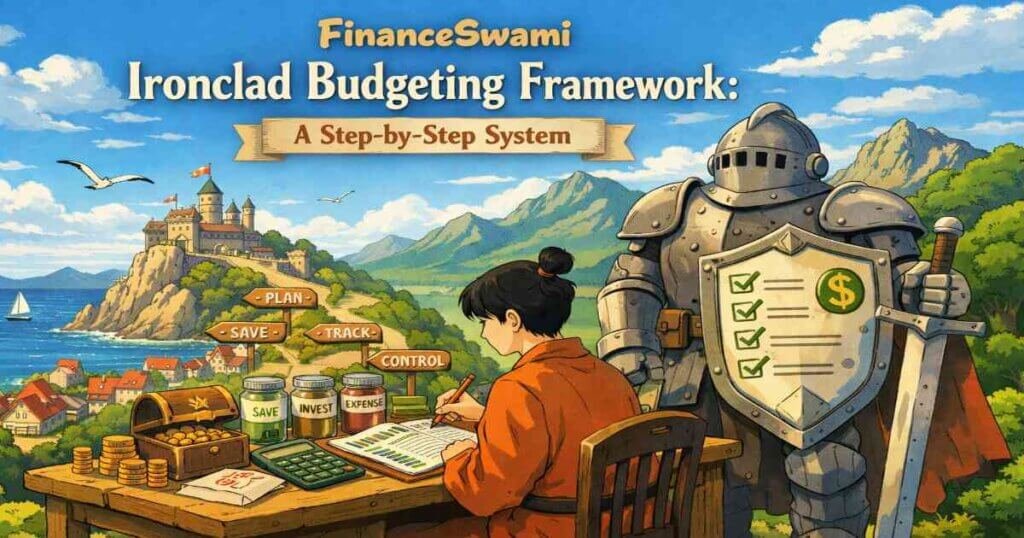
This budgeting framework is the exact system FinanceSwami uses to manage money intentionally and build savings that actually last.
If you’ve ever felt like budgeting advice doesn’t work in real life, you’re not alone.
Most budgeting guidance tells you to save 3-6 months of expenses, follow the 50/30/20 rule, or just track your spending and hope for the best. It sounds reasonable on paper, but when life actually happens—when your car breaks down, medical bills pile up, or your income fluctuates—those conventional approaches fall apart.
I created the FinanceSwami Ironclad Framework for Budgeting because I needed something that would actually hold up when things got messy. Not just in good times, but in bad times too. Not just when I was motivated, but when I was exhausted and stressed and barely keeping it together.
This framework is built on conservative principles that protect you. It doesn’t rely on best-case scenarios or assume everything will go smoothly. It assumes life will throw curveballs at you—because that’s what life does—and when those curveballs come, this framework keeps you standing.
Table of Contents
What Makes This Framework Different
The FinanceSwami Ironclad Framework is my step-by-step system for budgeting that actually builds financial security. It includes:
- 7 detailed steps that walk you through creating a budget that withstands reality
- 8 comprehensive templates you can use immediately (no guesswork, no figuring out what to track)
- Conservative approaches that protect you instead of leaving you vulnerable
- Real-world testing – I’ve used this myself and seen it work for many others
This isn’t theory. This isn’t what sounds good in a finance textbook. This is what actually works when you’re living paycheck to paycheck, dealing with irregular income, managing debt, and trying to build a better financial future for yourself and your family.
How This Framework Fits Into Your Budgeting Journey
This framework is designed to be comprehensive and actionable on its own, but it’s also part of a larger system for taking control of your money.
If you’re completely new to budgeting or want a broader understanding of why budgeting matters, how it fits into financial wellness, and what different budgeting approaches exist, I recommend starting with my complete guide: Ultimate Guide to Budgeting: How to Create a Budget and Manage Your Money. That guide walks you through the fundamentals of budgeting, explains different methods, covers budgeting for families and irregular income, and addresses the emotional side of managing money.
Think of it this way:
- The Ultimate Guide to Budgeting is your comprehensive education on budgeting—what it is, why it matters, and all your options
- The FinanceSwami Ironclad Framework (what you’re reading now) is my specific, battle-tested system that you can implement immediately
You can absolutely start here with the Ironclad Framework if you’re ready to jump straight into implementation. Everything you need is in this guide. But if you want the full context and want to understand the bigger picture of budgeting first, the Ultimate Guide gives you that foundation.
What You’ll Learn in This Framework
In this guide, I’m going to walk you through:
Step 1: Calculate Your Baseline Income – Why using your average income is dangerous, and how to set a realistic baseline that protects you
Step 2: Cover Essential Expenses First – The exact priority order for allocating your money, starting with true necessities
Step 3: Pay Yourself First – My savings ladder approach (10% minimum, 25% ideal, 40-50% goal) and why it matters
Step 4: Calculate Total Monthly Expenses – How to track your real expenses (pre-optimization) for proper emergency fund planning
Step 5: Build a 12-Month Emergency Fund – Why 3-6 months isn’t enough and how to calculate your true safety net
Step 6: Park Emergency Fund in High-Yield Savings – Where to keep your emergency fund safe and earning interest
Step 7: No Additional Debt Until Foundation Complete – The discipline commitment that protects your financial future
Each step includes detailed explanations written so clearly that someone with zero financial background can understand and implement them. And each step comes with practical templates—worksheets you can actually use to do the work, not vague suggestions about what you “should” track.
Who This Framework Is For
This framework is for you if:
- You’re tired of budgeting advice that doesn’t account for real-world chaos
- You want a conservative approach that builds actual financial security
- You need clear, step-by-step guidance with no guesswork
- You’re ready to commit to building a solid financial foundation
- You want templates and tools you can use immediately
This framework works whether you’re:
- Earning $30,000 or $150,000 a year
- Single or supporting a family
- Dealing with steady income or irregular paychecks
- Just starting out or recovering from financial setbacks
- Completely new to budgeting or experienced but frustrated with other systems
The principles are universal. The steps are clear. The templates make it actionable. And the results speak for themselves.
Let’s Get Started
What I’m about to share with you is conservative, comprehensive, and realistic. It won’t promise you overnight transformations or get-rich-quick schemes. What it will do is give you a solid foundation that withstands the test of real life.
This is the FinanceSwami Ironclad Framework for Budgeting. Let me walk you through each step.
Let me share something with you that I wish someone had told me years ago.
Most budgeting advice out there gives you the basics, but it misses the real-world messiness that makes budgeting fail. The conventional wisdom says “save 3-6 months of expenses” or “use the 50/30/20 rule” or “just track your spending and you’ll be fine.” And you know what? That advice sounds reasonable, but it doesn’t hold up when life actually happens.
I’m going to give you something different. Something that’s built on conservative principles, tested in the real world, and designed to work even when things get messy. This is what I call the FinanceSwami Ironclad Framework for Budgeting.
What Makes This Framework “Ironclad”
Here’s what “Ironclad” means: this framework is built to withstand reality.
It doesn’t rely on best-case scenarios. It doesn’t assume your income will stay steady, your expenses won’t spike, or that emergencies won’t happen. It assumes life will throw curveballs at you, because that’s what life does. And when those curveballs come, this framework keeps you standing.
This isn’t about being pessimistic. It’s about being prepared. It’s about building a budgeting system that works in good times and bad times, when you’re motivated and when you’re exhausted, when everything’s going smoothly and when everything’s falling apart.
The conventional budgeting wisdom is often inadequate, outdated, and doesn’t stand the test of reality. I’ve used this framework myself. I know it works because I’ve lived it, and I’ve seen it work for many others. This will work for you too, if you follow it consistently.
This is my step-by-step guide for budgeting that actually builds financial security. This includes detailed templates for your homework that you can use to implement each step. You don’t have to figure out what to include or what to track – I’ve done that work for you.
Let me walk you through each step.
Step 1: Calculate Your Baseline Income
Most budgeting advice tells you to use your average monthly income. That sounds logical, but it’s dangerous if your income varies at all.
Instead, I want you to calculate your baseline income – the amount you know you can count on, even in a slower month.
Here’s how to do it:
Look at your income for the last six months. Not your gross pay – your actual take-home pay after taxes and deductions. The money that hits your bank account.
Find the lowest month in those six months. That’s your baseline.
Why the lowest month? Because you’re going to build your budget based on that amount. You know you can count on at least that much. If you earn more in a given month, great – that’s extra money you can allocate. But you’re not building your daily life around income that might not show up.
This is conservative budgeting. It protects you. If you build your budget around your highest month and then have a low month, you’re in trouble. If you build it around your lowest month, you’re always covered.
Example:
Over the last six months, your take-home income was:
- January: $3,000
- February: $5,000
- March: $4,500
- April: $3,200
- May: $6,000
- June: $4,000
Your lowest month was January at $3,000. That’s your baseline. Your budget is built on $3,000 per month, even though you sometimes earn $5,000 or $6,000. The extra money in those higher months becomes buffer, savings, or debt payments – not lifestyle inflation.
Baseline Income Calculation Template
Use this template to calculate your baseline:
BASELINE INCOME WORKSHEET
Instructions: Gather your last 6 months of bank statements or paystubs. Record your actual take-home pay (after taxes, after deductions) for each month. Identify the lowest month – that becomes your baseline budgeting income.
Month 1 (________): Take-home income: $__________
Month 2 (________): Take-home income: $__________
Month 3 (________): Take-home income: $__________
Month 4 (________): Take-home income: $__________
Month 5 (________): Take-home income: $__________
Month 6 (________): Take-home income: $__________
BASELINE INCOME (Lowest Month): $__________
NOTES:
- This is the income amount you’ll use to build your entire budget
- Any income above this baseline in higher-earning months = extra funds for savings, debt payoff, or buffer
- Review and recalculate baseline every 6 months or when your income changes significantly
- If you have W-2 income with steady paychecks, your baseline might be the same every month (that’s fine – use that amount)
- If you’re self-employed or have variable income, this baseline approach is critical for stability
Step 2: Cover Your Essential Expenses First
Once you know your baseline income, the first money you allocate goes to essential expenses.
Essential expenses are the non-negotiables – the things you absolutely must pay to keep a roof over your head, food on the table, and the lights on.
This includes:
- Rent or mortgage
- Utilities (electricity, water, gas, trash)
- Groceries (not dining out – just the food you need to eat at home)
- Transportation to work (gas, public transit pass, or minimum car payment if you need a car to get to work)
- Minimum debt payments (credit cards, loans – you have to pay these or you default)
- Essential insurance (health insurance, car insurance if you drive)
Notice what’s not on this list: streaming services, gym memberships, dining out, entertainment, upgraded phone plans, or anything else that’s nice to have but not truly essential for survival.
The goal here is simple: make sure your baseline income covers your essentials. If it doesn’t, you have a serious problem that needs immediate attention – either your expenses need to come down, or your income needs to go up.
Essential Monthly Expenses Template
Use this template to calculate your total essential expenses:
ESSENTIAL EXPENSES WORKSHEET
Instructions: List only expenses that are absolutely necessary for survival and basic functioning. Be honest with yourself – wants don’t go here, only needs.
HOUSING:
- Rent/Mortgage: $__________
- Property tax (if not in mortgage): $__________
- HOA fees (if applicable): $__________
- Home/Renter’s insurance: $__________
UTILITIES:
- Electricity: $__________
- Water: $__________
- Gas/Heating: $__________
- Trash/Sewer: $__________
- Basic internet (if needed for work): $__________
- Basic cell phone (minimum plan): $__________
FOOD:
- Groceries (home cooking only): $__________
TRANSPORTATION:
- Car payment (if essential for work): $__________
- Car insurance: $__________
- Gas for work commute: $__________
- Public transit pass: $__________
- Car registration/annual fees (divided by 12): $__________
INSURANCE:
- Health insurance: $__________
- Dental insurance: $__________
- Vision insurance: $__________
- Life insurance (if supporting dependents): $__________
DEBT (MINIMUM PAYMENTS ONLY):
- Credit card 1 minimum: $__________
- Credit card 2 minimum: $__________
- Credit card 3 minimum: $__________
- Student loan minimum: $__________
- Personal loan minimum: $__________
- Medical debt minimum: $__________
- Other debt minimum: $__________
DEPENDENT CARE:
- Childcare/Daycare: $__________
- Child support (if court-ordered): $__________
- Elder care expenses: $__________
TOTAL ESSENTIAL MONTHLY EXPENSES: $__________
REALITY CHECK:
- Baseline income (from Step 1): $__________
- Total essential expenses: $__________
- Difference: $__________
If your difference is negative (expenses higher than baseline income), you have an emergency situation. You must either increase income immediately or drastically reduce expenses to survive.
If your difference is positive, this is the money available for Step 3 (savings), Step 4 (emergency fund), and everything else.
Step 3: Pay Yourself First – Minimum 10% Savings
This is where most budgeting advice goes wrong.
People say, “Save what’s left over at the end of the month.” But here’s the problem: there’s never anything left over. Life fills every available dollar. If you wait until the end of the month to save, you won’t save.
That’s why you pay yourself first.
This is purely about your after-tax, in-hand money – the money that actually hits your bank account after all deductions. Before you spend a single dollar on discretionary things, you put money into savings.
Minimum: 10% of your baseline income, regardless of your income level.
I don’t care if you’re earning $2,000 a month or $10,000 a month. You save a minimum of 10%. Not 10% of what’s left over. 10% off the top.
If I’m working 10-15 hours a day, busting my back to earn money, I pay myself first and contribute to my savings. That’s non-negotiable. Your future self deserves a share of every dollar you earn today.
But here’s the full FinanceSwami Ironclad budgeting recommendation, because 10% is just the starting point:
- Minimum: 10% – This is where you start, no exceptions
- Ideal: 25% – This is where you want to work toward as you optimize your budget and reduce unnecessary expenses
- Goal: 40-50% – This is where you want to be once you’ve built a solid financial foundation and framework
Think of it like a ladder. You start at 10%. As you get better at budgeting, as you increase your income, your expenses should NOT increase with your income. That’s the only way you climb the savings ladder from 10% to 25% and eventually to 40-50%.
The people who are at the top of personal finance, with solid foundations and frameworks, are saving 40-50% of their after-tax, after-deduction, in-hand salary. Not gross salary – the net salary that gets deposited in your bank account.
That’s how the compounding of savings starts. That’s how the compounding of investments kicks in. That’s how paying down debt aggressively becomes possible. That’s how you set yourself up on the path to achieving true financial freedom.
Savings Calculation Template
SAVINGS LADDER WORKSHEET
Instructions: Calculate your savings target at each level of the ladder. Your goal is to start at the minimum and work your way up as you optimize expenses and increase income.
Your baseline income (from Step 1): $__________
SAVINGS LADDER TARGETS:
Level 1 – Minimum (10%):
10% of baseline income = $__________
This is your non-negotiable starting point. Save this amount every month before spending on anything discretionary.
Level 2 – Ideal (25%):
25% of baseline income = $__________
Work toward this level as you reduce unnecessary expenses and optimize your budget. This is where financial stability really begins.
Level 3 – Goal (40-50%):
40% of baseline income = $__________
50% of baseline income = $__________
This is the ultimate target. At this level, you’re building serious wealth and have maximum financial flexibility.
YOUR CURRENT SAVINGS PLAN:
Currently saving each month: $__________
Current savings rate: ________% (divide current savings by baseline income, multiply by 100)
Current ladder level:
- Below 10% (urgent – need to get to minimum immediately)
- 10-24% (at minimum, working toward ideal)
- 25-39% (at ideal level, working toward goal)
- 40-50% (at goal level – maintain and celebrate)
- Above 50% (exceptional – you’re crushing it)
ACTION STEPS TO CLIMB THE LADDER:
Write 3 specific ways you can increase your savings rate:
1. __________________________________________________
2. __________________________________________________
3. __________________________________________________
CRITICAL REMINDER:
When your income increases, do NOT increase your expenses proportionally. Keep expenses stable or reduce them. Let your savings rate climb. That’s how you move up the ladder from 10% to 50%.
Step 4: Calculate Your Total Monthly Expenses (Pre-Optimization)
Now we’re going to calculate your total current monthly expenses using a comprehensive budgeting template.
This is important: this number has not been optimized yet. This number has not been reduced. This is basically your current average, usual monthly expense based on how you’re living right now.
Why are we calculating this if we haven’t optimized it? Because we’re going to use this number for something critical in Step 5: calculating your 12-month emergency fund.
I use a conservative approach here. We want to know how much you’re actually spending right now – the full, honest truth – because that’s what we’ll use to calculate how much you need to save for a true emergency fund that will actually cover 12 months. It should be on the higher side, not the best-case scenario, because best-case scenarios rarely materialize in real-world situations.
Obviously, as you follow the FinanceSwami steps on budgeting, you’ll reduce unnecessary expenses to ensure you’re increasing your savings and marching toward that 50% goal. But for emergency fund calculation purposes, we use the pre-optimized, pre-reduced monthly expense number.
This way, your emergency fund easily and effectively covers you for 12 months and works as a true emergency fund – not one that’s calculated using best-case scenarios that never actually happen.
Total Monthly Expenses Calculation Template
COMPREHENSIVE MONTHLY EXPENSES TRACKER
Instructions: Be brutally honest. Look at your last 3 months of bank and credit card statements. Record what you’re ACTUALLY spending, not what you think you should be spending.
FIXED EXPENSES:
- Rent/Mortgage: $__________
- Property tax (if separate): $__________
- HOA fees: $__________
- Home/Renter’s insurance: $__________
- Car payment: $__________
- Car insurance: $__________
- Health insurance: $__________
- Dental insurance: $__________
- Vision insurance: $__________
- Life insurance: $__________
- Disability insurance: $__________
- Phone plan: $__________
- Internet: $__________
- Cable/Streaming services: $__________
- Gym membership: $__________
- Storage unit: $__________
- Student loan payment: $__________
- Personal loan payment: $__________
- Credit card minimum payments (total): $__________
- Childcare/Daycare: $__________
- Child support payments: $__________
- Alimony: $__________
- Pet insurance: $__________
- Other subscriptions/memberships: $__________
TOTAL FIXED EXPENSES: $__________
VARIABLE EXPENSES:
- Groceries: $__________
- Household supplies (cleaning, toiletries, paper products): $__________
- Gas for car: $__________
- Public transportation: $__________
- Parking fees: $__________
- Electric bill: $__________
- Water bill: $__________
- Gas/Heating bill: $__________
- Trash/Sewer: $__________
- Doctor visits/Co-pays: $__________
- Prescriptions/Medications: $__________
- Medical supplies: $__________
- Therapy/Counseling: $__________
- Pet food: $__________
- Pet vet visits/Care: $__________
- Car maintenance/Repairs: $__________
- Car registration/Fees (annual ÷ 12): $__________
- Home maintenance/Repairs: $__________
- Clothing (adults): $__________
- Clothing (children): $__________
- Shoes: $__________
- Laundry/Dry cleaning: $__________
- Personal care items: $__________
TOTAL VARIABLE EXPENSES: $__________
DISCRETIONARY EXPENSES:
- Dining out/Restaurants: $__________
- Coffee shops: $__________
- Takeout/Delivery: $__________
- Fast food: $__________
- Entertainment (movies, concerts, events): $__________
- Hobbies: $__________
- Books/Magazines: $__________
- Apps/Games: $__________
- Shopping (non-essential): $__________
- Personal care services (haircuts, nails, spa): $__________
- Gifts (birthdays, holidays): $__________
- Charitable donations: $__________
- Alcohol: $__________
- Tobacco/Vaping: $__________
- Travel/Vacation fund: $__________
- Fun money/Miscellaneous: $__________
TOTAL DISCRETIONARY EXPENSES: $__________
DEBT PAYMENTS (BEYOND MINIMUMS):
- Extra credit card payments: $__________
- Extra student loan payments: $__________
- Extra car loan payments: $__________
- Other extra debt payments: $__________
TOTAL EXTRA DEBT PAYMENTS: $__________
ANNUAL/IRREGULAR EXPENSES (÷ 12):
- Car registration: $__________ ÷ 12 = $__________
- Annual insurance premiums: $__________ ÷ 12 = $__________
- Property taxes (if separate): $__________ ÷ 12 = $__________
- HOA annual fees: $__________ ÷ 12 = $__________
- Amazon Prime/Annual subscriptions: $__________ ÷ 12 = $__________
- Holiday spending: $__________ ÷ 12 = $__________
- Vacation budget: $__________ ÷ 12 = $__________
- School supplies/Fees: $__________ ÷ 12 = $__________
- Other annual expenses: $__________ ÷ 12 = $__________
TOTAL ANNUAL EXPENSES (MONTHLY AMOUNT): $__________
GRAND TOTAL CALCULATION:
Total Fixed Expenses: $__________
+ Total Variable Expenses: $__________
+ Total Discretionary Expenses: $__________
+ Total Extra Debt Payments: $__________
+ Total Annual Expenses (Monthly): $__________
TOTAL MONTHLY EXPENSES (PRE-OPTIMIZATION): $__________
This is the number you’ll use for your 12-month emergency fund calculation in Step 5.
Step 5: Build a 12-Month Emergency Fund (Not 3-6 Months)
This is where the FinanceSwami Ironclad Framework really diverges from conventional advice.
Most financial experts tell you to save 3-6 months of expenses in an emergency fund. That’s the standard recommendation you’ll hear everywhere.
I’m telling you that’s not enough. Not in today’s world.
You need a 12-month emergency fund.
Let me explain why.
Prices have gone up dramatically and will continue to rise. Groceries, medical care, doctor visits, car repairs, rent, homes, clothing, flights, hotels – everything has gotten significantly more expensive with inflation and will keep climbing. Your expenses five years from now will be higher than they are today.
Ad hoc expenses come up constantly. Your car breaks down and needs a $2,000 repair. Your roof needs to be replaced – that’s $8,000. Your health insurance premiums spike. You have a medical emergency. Your water heater dies. You need a plumber. You have to relocate for a family emergency. These things happen, and they cost real money.
Job loss takes longer to recover from than it used to. The average time to find a new job at similar pay can be 3-6 months or more, depending on your field and the job market. If you lose your job and only have 3 months of expenses saved, you’re already in crisis mode by month 2.
Three to six months goes by in a blink. When you’re in a real emergency, money disappears faster than you think. Unexpected expenses stack up. You blink, and it’s gone.
People underestimate their expenses. Without a proper budgeting template (like the one in Step 4), most people underestimate how much they actually need each month. They forget about annual expenses, irregular costs, and the little things that add up.
That’s why the FinanceSwami Ironclad Framework recommends working toward having 12 months of expenses in your emergency rainy day fund account.
This is a true emergency fund. It should only be used for emergencies – not for situations where your budget is out of control and you tap into it to fund overspending. Stick to the plan.
When an emergency happens and this fund gets used and depleted, your Goal #1 going back to the framework should be to refill it. Get it back to 12 months as quickly as possible.
Emergency Fund Calculation Template
12-MONTH EMERGENCY FUND CALCULATOR
Instructions: Use your Total Monthly Expenses from Step 4 to calculate your full emergency fund target. This is the amount that will give you true peace of mind and real protection.
Total Monthly Expenses (from Step 4): $__________
12-MONTH EMERGENCY FUND TARGET:
$__________ × 12 months = $__________
This is your emergency fund goal. This is what you’re working toward.
CURRENT EMERGENCY FUND STATUS:
Current emergency fund balance: $__________
Months of expenses currently saved:
Current balance ÷ Monthly expenses = __________ months
EMERGENCY FUND PROGRESS TRACKER:
- 0-1 months saved (critical – prioritize building this immediately)
- 1-3 months saved (vulnerable – keep building urgently)
- 3-6 months saved (conventional target – but keep going)
- 6-9 months saved (good progress – you’re getting there)
- 9-12 months saved (almost there – final push)
- 12+ months saved (goal achieved – maintain and celebrate)
MONTHLY CONTRIBUTION PLAN:
To reach 12 months of expenses, I need to save: $__________
Current monthly savings (from Step 3): $__________
Additional monthly contribution needed: $__________
Estimated time to reach 12-month emergency fund:
Remaining amount ÷ Monthly contribution = __________ months
EMERGENCY FUND RULES:
This money is for TRUE emergencies only:
- Job loss
- Major medical emergency
- Essential home repairs (roof, foundation, HVAC failure)
- Essential car repairs needed for work
- Family emergency requiring travel/support
- Unexpected relocation
This money is NOT for:
- Vacation
- New electronics or gadgets
- Non-essential shopping
- Dining out when budget is tight
- Covering overspending in other categories
- Investing opportunities
- Gifts or discretionary purchases
REFILL COMMITMENT:
If I need to use my emergency fund, I commit to:
1. Stop all discretionary spending immediately
2. Redirect all extra income to refilling the fund
3. Make refilling the emergency fund my #1 financial priority
4. Not take on any new debt while refilling
5. Return to 12 months of expenses as quickly as possible
Step 6: Park Emergency Fund in High-Yield Savings Account
Your 12-month emergency fund shouldn’t just sit in a regular checking account earning nothing. But it also shouldn’t be invested in the stock market where it could lose value right when you need it.
This money should be sitting in a high-yield savings account at a credible, well-recognized, established, capitalized bank.
I’m talking about banks like Ally Bank, Marcus by Goldman Sachs, and other reputable institutions – not some random bank you’ve never heard of where you could lose money if the bank goes down (remember Silicon Valley Bank in Santa Clara, CA collapsing in March 2023).
Depending on Federal Reserve interest rates, you’ll be earning roughly 2-4% annual interest on your emergency fund. This helps keep up with inflation so your purchasing power doesn’t erode as badly over time.
Let me be clear: the goal here is not return on investment. The goal is to keep your emergency fund liquid, accessible, and ready to be used when life throws you a curveball.
Earning 2-4% interest in a high-yield savings account is what I highly recommend. It’s not about growing wealth with this money – it’s about protecting yourself and being able to sleep like a well-fed baby knowing you’re covered for a full year if something goes wrong.
High-Yield Savings Account Setup Checklist
EMERGENCY FUND ACCOUNT SETUP GUIDE
Instructions: Use this checklist to set up your emergency fund account properly and safely.
STEP 1: Choose a High-Yield Savings Account
Research and compare these options (as of 2024-2025):
- Ally Bank – Online savings account
- Current APY: Check current rate (historically 2-4%)
- FDIC insured: Yes (up to $250,000)
- Minimum balance: None
- Monthly fees: None
- Accessibility: Easy transfers to/from external banks
- Marcus by Goldman Sachs – Online savings
- Current APY: Check current rate (historically 2-4%)
- FDIC insured: Yes (up to $250,000)
- Minimum balance: None
- Monthly fees: None
- Accessibility: Easy transfers to/from external banks
- American Express Personal Savings
- Current APY: Check current rate (historically 2-4%)
- FDIC insured: Yes (up to $250,000)
- Minimum balance: None
- Monthly fees: None
- Accessibility: Easy transfers to/from external banks
- Other reputable high-yield savings accounts:
- Bank name: __________________________
- Current APY: __________%
- FDIC insured: Yes / No
- Minimum balance: $__________
- Monthly fees: $__________
CRITICAL REQUIREMENTS:
- Must be FDIC insured (federal protection up to $250,000)
- Must be a well-established, reputable institution
- No monthly fees or minimum balance penalties
- Easy online access and transfers
- Competitive APY (compare current rates before choosing)
STEP 2: Open Your Account
- Complete online application (typically 10-15 minutes)
- Provide required documentation (ID, Social Security number, proof of address)
- Link to your primary checking account for transfers
- Set up automatic monthly transfers (automate your savings)
- Enable account alerts for large withdrawals
STEP 3: Set Up Automatic Transfers
Monthly automatic transfer amount: $__________
Transfer date each month: __________
(Choose a date shortly after your paycheck arrives)
- Automatic transfer activated
- Transfer amount aligns with Step 3 savings goal
STEP 4: Label This Account Correctly
- Name account “12-Month Emergency Fund” or “Emergency Only”
- Do NOT name it “Savings” or “Extra Money”
- Clear labeling reinforces that this is untouchable except for true emergencies
STEP 5: Monitor and Review
- Check balance monthly
- Confirm interest is being credited
- Review APY quarterly (rates change based on Federal Reserve policy)
- Consider moving to a different high-yield account if your current rate drops significantly below competitors
WHAT NOT TO DO:
- Do not keep emergency fund in checking account (too easy to spend accidentally)
- Do not invest emergency fund in stocks/bonds (too volatile, could be down when you need it)
- Do not keep it in a bank that’s not FDIC insured
- Do not use a bank with monthly fees that eat into your savings
- Do not keep more than $250,000 in one account (FDIC insurance limit)
- Do not link this account to a debit card (reduces temptation to spend)
EXPECTED RETURNS:
With $__________ in emergency fund at __________% APY:
Annual interest earned: $__________
Monthly interest earned: $__________
Remember: This interest is not “profit” – it’s protection against inflation. Your purchasing power stays closer to intact. That’s the goal.
Step 7: No Additional Debt Until Foundation Is Complete
This is the discipline step, and it’s non-negotiable.
Until you hit your 12-month emergency fund target, work your way to saving 40-50% of your after-tax pay, and pay off your existing high-interest debt, you need to follow your budgeting template strictly.
That means:
- Take care of essentials
- Hit your savings goal
- Build your emergency fund
- Pay off high-interest debt aggressively
- Use any leftover money for non-discretionary spending, additional debt payments, or increased savings
And here’s the hard part: you should not add any new debt to your name during this time. None.
No exceptions means:
- No new car loan
- No increase in credit card balance
- No new mortgage or home purchase
- No funding trips via loans from friends
- No funding trips on credit cards you can’t pay off immediately
- No personal loans
- No “0% financing for 12 months” deals (they’re still debt)
- No co-signing on anyone else’s loans
I know this sounds extreme. I know you might be thinking, “But what if I really need a car?” or “What if there’s a great opportunity?”
Here’s the truth: taking on new debt before you’ve built your financial foundation is like building a house on sand. It doesn’t matter how nice the house looks – it’s going to collapse when the ground shifts.
Once you’ve built your foundation (12-month emergency fund + consistent 40-50% savings rate + high-interest debt paid off), then you can make informed decisions about taking on strategic debt for things like a home or reliable transportation.
But until then, you live within your means. You make do with what you have. You delay major purchases. You get creative. You hustle to increase income if you need something you can’t afford.
This phase isn’t forever. But it’s necessary.
Debt-Free Commitment Tracker
NO NEW DEBT COMMITMENT
Instructions: Use this tracker to monitor your commitment to not taking on new debt while building your financial foundation.
MY FINANCIAL FOUNDATION STATUS:
Current emergency fund: $__________ / $__________ (target)
Months of expenses saved: __________ / 12 months
Current savings rate: __________%
Target savings rate: 40-50%
High-interest debt remaining:
- Credit card balances: $__________
- Other high-interest debt (above 7%): $__________
- Total high-interest debt to eliminate: $__________
FOUNDATION COMPLETION CHECKLIST:
- 12-month emergency fund fully funded
- Savings rate consistently at 40-50%
- All high-interest debt paid off
Until ALL three items above are checked, I commit to:
- No new car loans
- No new credit card debt
- No new personal loans
- No new mortgage/home purchase
- No financing plans (even 0% interest)
- No co-signing for others
- No borrowing from friends/family
TEMPTATION RESISTANCE PLAN:
When I’m tempted to take on new debt, I will:
1. Wait 30 days before making any decision
2. Review my Total Monthly Expenses (Step 4) to see current financial reality
3. Ask myself: “Does this purchase bring me closer to or further from my 12-month emergency fund goal?”
4. Calculate: “How many months will this set back my financial foundation?”
5. Identify alternative solutions:
- Can I save up and pay cash?
- Can I find a cheaper alternative?
- Can I do without this for now?
- Can I increase income instead of taking on debt?
SPECIFIC SCENARIOS I MIGHT FACE:
Scenario 1: My car breaks down and needs expensive repairs
My plan: Use emergency fund if truly necessary, then pause all discretionary spending to refill emergency fund immediately
Scenario 2: I see an amazing deal on something I want
My plan: If I can’t pay cash for it right now, I don’t buy it. The “deal” isn’t a deal if it comes with debt.
Scenario 3: Family/friends pressure me to spend money I don’t have
My plan: “I’m working on building my financial foundation right now. I can’t take that on, but I appreciate you thinking of me.”
Scenario 4: I want to buy a house but don’t have my foundation complete
My plan: Continue renting and building my emergency fund and down payment savings until foundation is complete. Rushing into homeownership with debt and no cushion is how people end up house-poor.
ACCOUNTABILITY:
I will review this commitment: □ Weekly □ Monthly
Progress check date: __________
If I break this commitment, I will:
1. Acknowledge it immediately
2. Identify what triggered the decision
3. Create a specific plan to pay off the new debt
4. Strengthen my boundaries for next time
Using These Templates Together: Your Complete Budgeting Homework
These seven steps work together as a complete system. Here’s how to use all the templates in order:
Week 1: Foundation Assessment
- Complete the Baseline Income Calculation (Step 1)
- Complete the Essential Expenses Worksheet (Step 2)
- Complete the Savings Ladder Worksheet (Step 3)
- Verify that your baseline income covers essentials + minimum savings
Week 2: Full Expense Analysis
- Complete the Comprehensive Monthly Expenses Tracker (Step 4)
- Be completely honest – use actual bank statements
- Calculate your true total monthly expenses
Week 3: Emergency Fund Planning
- Complete the 12-Month Emergency Fund Calculator (Step 5)
- Set your emergency fund target (12 × monthly expenses)
- Create your monthly contribution plan
Week 4: Account Setup and Commitment
- Complete the High-Yield Savings Account Setup Checklist (Step 6)
- Open your emergency fund account
- Set up automatic transfers
- Sign the No New Debt Commitment (Step 7)
Ongoing: Monthly Review
- Update all worksheets monthly
- Track progress toward 12-month emergency fund
- Monitor savings rate and work toward 40-50%
- Celebrate small wins along the way
Why This Framework Works When Others Fail
Let me tell you what makes this different from conventional budgeting advice.
It’s conservative. It doesn’t rely on best-case scenarios. It plans for reality, not fantasy. Your baseline income is the lowest month. Your emergency fund is 12 months, not 3-6. Your savings commitment is 10% minimum, with a goal of 50%. These aren’t optimistic numbers – they’re protective numbers.
It’s comprehensive. The templates I’ve given you cover everything. You don’t have to guess what to include or figure out what you’re forgetting. It’s all there.
It’s tested. I’ve used this framework myself. I’ve seen it work for many others. It holds up in real life, not just on paper.
It protects you during emergencies. Most budgets collapse the first time something unexpected happens. This framework is built specifically to handle the unexpected. That 12-month emergency fund? That’s what keeps you standing when life knocks you down.
It builds actual wealth. Saving 40-50% of your after-tax income isn’t just about having money in the bank. It’s about building the foundation for real financial freedom. It’s about creating options for yourself. It’s about getting to a point where money stress becomes a thing of the past.
It prevents lifestyle inflation. By building your budget on your baseline (lowest) income, you automatically avoid the trap of increasing expenses every time you get a raise or bonus. That extra money goes to savings and debt payoff, not lifestyle upgrades that lock you into higher spending forever.
This is the FinanceSwami Ironclad Framework for Budgeting. It’s conservative, it’s thorough, it’s realistic, and most importantly, it works.
Follow these seven steps. Use these templates. Commit to the process. Your future self will thank you.
About FinanceSwami & Important Note
FinanceSwami is a personal finance education site designed to explain money topics in clear, practical terms for everyday life.
Important note: This content is for educational purposes only and does not constitute personalized financial advice.
Keep Learning with FinanceSwami
If this guide helped you, there’s so much more I want to share with you.
I regularly write detailed, beginner-friendly guides like this one on topics like saving, investing, paying off debt, building credit, and planning for big life goals. You can explore all of those articles on the FinanceSwami blog.
If you prefer to listen or watch, I also explain personal finance topics in my own voice on my YouTube channel. Sometimes it helps to hear someone walk through these concepts out loud, and I’d love for you to check out the videos if that’s more your style.
This isn’t about selling you anything. It’s about giving you more ways to learn, more tools to build your financial confidence, and more support as you take control of your money.
You’re not alone in this. I’m here to help every step of the way.
Now go create your budget. Your future self will thank you.
— FinanceSwami