If you’re carrying multiple debts and you feel overwhelmed every time you look at your credit card statements, student loan balances, or medical bills, you need to know this: there’s a proven method for paying off debt that’s helped millions of people become debt-free, and it works not because of complex math, but because of simple human psychology. According to the Federal Reserve’s 2024 data, the average American household with credit card debt carries balances across 3.7 different cards, totaling approximately $7,951. Add in auto loans, student loans, personal loans, and medical debt, and many people are juggling 5-10 different debts simultaneously, each with its own balance, interest rate, minimum payment, and due date.
Here’s what research shows us: according to a 2016 study by the Kellogg School of Management at Northwestern University, people who use the debt snowball method – paying off their smallest debts first regardless of interest rate – are significantly more likely to eliminate all their debt than people who use mathematically “optimal” methods. The reason isn’t math. It’s psychology. The debt snowball method gives you quick wins that create momentum, reduces the number of bills you’re juggling, and provides visible progress that keeps you motivated through the long middle months of debt payoff.
But here’s the problem: most people have heard of the debt snowball method but don’t actually understand how to implement it correctly. They know it involves “paying smallest debts first,” but they don’t know how to set it up, how much to pay each month, what to do when they pay off the first debt, how to handle setbacks, or whether this method is actually right for their situation versus other approaches like the debt avalanche.
This comprehensive guide is going to give you everything you need to successfully implement the debt snowball method. I’m going to walk you through exactly how the debt snowball works and why it’s so effective psychologically, show you step-by-step how to set up your debt snowball plan, give you real examples with actual numbers so you can see it in action, explain how to find extra money to accelerate your snowball, teach you how to stay motivated as debts disappear one by one, help you understand when debt snowball is the right choice versus other methods, and give you the tools to track your progress and celebrate milestones.
Whether you have $5,000 or $50,000 in debt, whether your debts range from $300 to $15,000, whether you’ve tried to pay off debt before and given up or you’re starting fresh, this guide will show you exactly how to use the debt snowball method to become debt-free.
Plain-English Summary
The debt snowball method is a debt payoff strategy where you list all your debts from smallest balance to largest balance, regardless of interest rate, and focus on paying off the smallest debt first while making minimum payments on all others. Once the smallest debt is completely paid off, you take the money you were paying on it and add it to the minimum payment of the next-smallest debt, creating a “snowball” effect where your payment amounts get larger and larger as you eliminate each debt.
The power of the debt snowball isn’t in mathematical optimization – it’s in psychological momentum. When you pay off your first debt within a few months, you get an immediate win that proves you can do this. That victory motivates you to attack the next debt. Each debt you eliminate simplifies your financial life and builds confidence. By the time you reach your largest debts, you have both the momentum and the freed-up monthly payment amounts to attack them aggressively.
The debt snowball method works best for people who need quick wins to stay motivated, have several small debts that can be eliminated within 3-6 months, have tried to pay off debt before but given up partway through, or value psychological simplicity and visible progress over perfect mathematical optimization.
In this guide, I’m going to show you exactly how to implement the debt snowball method step by step, with real examples, templates you can use, and strategies to maximize your success. By the end, you’ll have a complete debt snowball plan ready to execute.
The debt snowball method has helped millions of people become debt-free. Now it’s your turn.
Table of Contents
1. What Is the Debt Snowball Method?
Before we dive into implementation, let me explain exactly what the debt snowball method is and how it works.
The Core Concept
The debt snowball method is a debt elimination strategy that prioritizes psychological wins over mathematical optimization. The fundamental strategy is to knock out the smallest debt as fast as possible, creating an early victory that proves your plan works and builds psychological momentum for attacking the next debt. When you focus all extra payment power on eliminating that smallest balance first – whether it’s a $650 medical bill or a $1,300 credit card – you typically see it disappear within 2-4 months, which is fast enough to feel like real progress and create motivation to keep going rather than feeling like you’re trapped in an endless payoff journey. Here’s the fundamental approach: you list all your debts by balance amount from smallest to largest, you make minimum payments on all debts, you put every extra dollar toward the smallest debt, once the smallest debt is paid off, you take that payment and add it to the next-smallest debt’s minimum, and you repeat this process until all debts are eliminated.
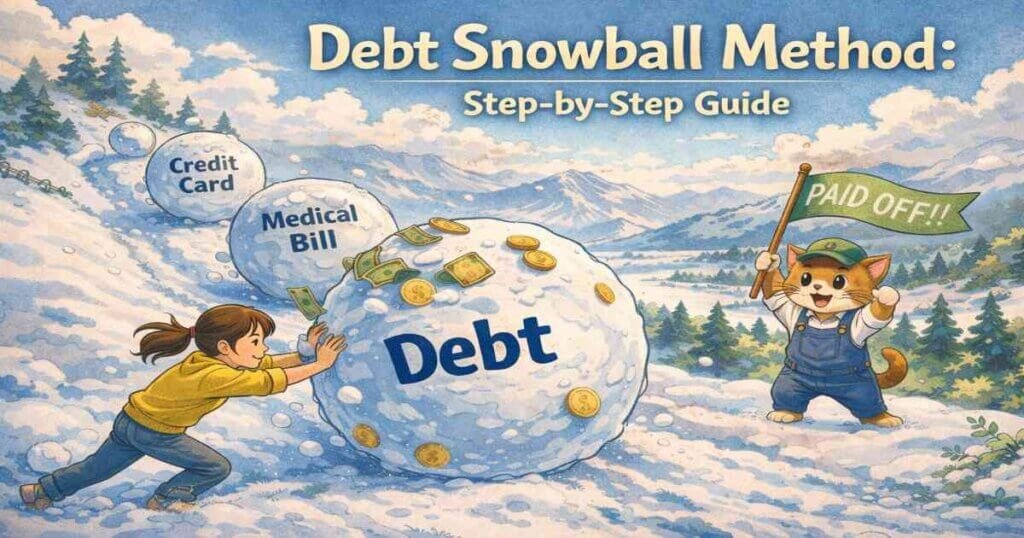
The “snowball” metaphor comes from the way a small snowball rolling down a hill picks up more snow and grows larger as it moves. Similarly, your debt payments grow larger as you eliminate each debt and roll that payment forward to the next one.
A Simple Example
Let’s say you have three debts:
- Medical bill: $800, $50 minimum payment
- Credit card: $2,500, $75 minimum payment
- Personal loan: $6,000, $180 minimum payment
Total minimum payments: $305 per month
You have $500 available for debt payments each month. That’s $305 in minimums plus $195 extra.
Debt Snowball Approach:
Months 1-5: Attack the medical bill
- Medical bill: $50 minimum + $195 extra = $245 payment
- Credit card: $75 minimum only
- Personal loan: $180 minimum only
- After about 4 months, the medical bill is paid off
Months 6-15: Attack the credit card
- Medical bill: PAID OFF
- Credit card: $75 minimum + $245 (freed from medical bill) = $320 payment
- Personal loan: $180 minimum only
- After about 9 months, the credit card is paid off
Months 16-29: Attack the personal loan
- Medical bill: PAID OFF
- Credit card: PAID OFF
- Personal loan: $180 minimum + $320 (freed from credit card) = $500 payment (everything!)
- After about 13-14 months, the personal loan is paid off
Total time to debt-free: Approximately 29 months
Notice how the payment on each successive debt gets larger. That’s the snowball effect in action.
What Makes It Different
The debt snowball ignores interest rates completely. You’re not paying the highest-interest debt first (that would be the debt avalanche method). You’re paying the smallest balance first, period.
This means you might pay a $500 debt at 8% interest before paying a $5,000 debt at 22% interest. Mathematically, this isn’t optimal – you’ll pay more total interest than the avalanche method. But psychologically, it’s powerful.
The Inventor: Dave Ramsey
While people have used variations of this approach for decades, Dave Ramsey popularized the debt snowball method through his Financial Peace University program and bestselling books. His framework and emphasis on “quick wins” made this method mainstream.
Ramsey’s philosophy is simple: “Personal finance is 20% head knowledge and 80% behavior. You need quick wins to change behavior.”
Whether you follow Ramsey’s other financial advice or not, the debt snowball method he popularized has proven effective for millions of people.
2. Understanding How the Snowball Method Works
To truly understand how the debt snowball method works, you need to grasp both the mechanical process (what you actually do) and the psychological design (why it’s structured this way to maximize your likelihood of success).
The Mechanical Process: What You Actually Do
At its core, the snowball method is a debt-reduction strategy with a specific sequence:
The sequence:
1. You organize debts from smallest balance to largest balance
2. You make minimum payments on all debts
3. You put all extra money toward the smallest debt
4. When the smallest debt is paid in full, you roll that payment to the next smallest
5. You repeat this process until all debts are eliminated
The rolling mechanism is key: As each debt disappears, you don’t reduce your total monthly payment to debt. Instead, you redirect that freed-up payment to the next target, which is why your payments grow like a snowball rolling downhill – they start small and get progressively larger as they absorb each eliminated payment.
Why It Works: The Psychological Design
The snowball method is a debt-reduction strategy specifically designed around human psychology rather than mathematical optimization. Here’s the psychological sequence that makes the method works:
Psychological Stage 1: Quick victory (months 1-4)
Your smallest debt is typically paid off within 2-4 months. This quick win proves to you that the plan works. You see a balance go from $800 to $0, and suddenly debt elimination feels achievable instead of impossible.
Psychological Stage 2: Momentum building (months 4-12)
You eliminate 2-3 more debts. Each elimination simplifies your life (fewer bills to track) and strengthens your belief that you can do this. You’re building the habit of consistent debt payoff.
Psychological Stage 3: Acceleration (months 12-24)
By now you’ve freed up substantial monthly payments through eliminations. Your payment power has grown significantly. You’re moving faster through larger debts than you did through small ones at the start.
Psychological Stage 4: Final push (final 25%)
You can see the finish line. Your last 1-2 debts are getting hit with massive payments. The end is in sight, which motivates extra effort.
This sequence – quick win → momentum → acceleration → finish – is like a snowball rolling down a hill. It starts with you pushing it, but gravity (psychological momentum) takes over and it rolls faster and faster on its own.
The Snowball Rolling Metaphor Explained
The name “snowball” captures three essential characteristics:
Characteristic 1: Small beginning
A snowball starts small – just a handful of snow you compress and shape. Similarly, your debt snowball starts small – just your minimum payments plus a small amount of extra money you direct to your smallest debt.
Characteristic 2: Gathering size through movement
As a snowball rolls down a snowy hill, it picks up more snow with each rotation, growing larger and larger. Similarly, as your debt snowball rolls forward through your debt list, each eliminated debt adds its payment to the growing payment hitting your next target.
Characteristic 3: Increasing momentum
A snowball rolling downhill accelerates – it moves slowly at first but builds speed as it goes. Your debt elimination accelerates too – your first debt might take 4 months, but your fourth debt might be eliminated in 6 months despite being twice as large, because the payment hitting it is much bigger.
This metaphor perfectly captures why the method works: like a snowball rolling downhill that naturally gains size and speed, your debt elimination naturally gains payment power and velocity as you progress.
Why Small Debts First Instead of High-Interest First?
The method works psychologically because small debts first gives you quick wins. Here’s the logic:
If you attack highest interest first (avalanche method):
- You’re mathematically optimizing
- But your first eliminated debt might take 8-12 months
- That’s a long time to wait for proof that your plan is working
- Many people lose motivation and quit before reaching that first victory
If you attack smallest debt first (snowball method):
- You’re psychologically optimizing
- Your first eliminated debt takes 2-4 months
- You get quick proof that the plan works
- That early win creates motivation to continue
Research shows that people using snowball have higher completion rates than people using avalanche, even though avalanche saves more money in interest. The method works because finishing an imperfect plan beats abandoning a perfect plan halfway through.
What Makes It Actually Work in Practice
Three factors determine whether the snowball method is a debt-reduction strategy that works in your life or just a theory you read about:
Factor 1: Consistent execution
The method only works if you actually make the payments month after month. One month doesn’t eliminate debt – 30 months of consistent effort does.
Factor 2: Immediate payment rolling
When a debt is paid off, you must immediately redirect that payment. If you let freed-up money disappear into general spending, the snowball never builds.
Factor 3: Sustainable intensity
The method works when you find a payment level you can maintain for years, not weeks. Extreme sacrifice for 3 months followed by burnout and quitting doesn’t work. Moderate sacrifice for 3 years does.
Common Misunderstandings About How It Works
Misunderstanding #1: “The snowball saves the most money”
No – it usually costs more in interest than the avalanche method. It works because of psychology, not because it’s mathematically optimal.
Misunderstanding #2: “You must pay off debts in exactly smallest-to-largest order”
The pure method says yes, but in practice, small variations (like paying off a $1,200 debt before a $1,150 debt) don’t break the system. It’s the general principle of small-to-large that matters.
Misunderstanding #3: “The snowball eliminates debt faster than other methods”
Not necessarily. The avalanche might eliminate your total debt 1-3 months faster. The snowball eliminates individual debts faster, but your last debt might take longer. The value is psychological (frequent wins), not speed.
Misunderstanding #4: “Once you start the snowball, you can’t change anything”
False. Life happens. If your income drops, adjust your payment amount. If you get a raise, increase payments. The core principle (smallest first, roll payments forward) stays the same, but the specifics can flex with your reality.
The Bottom Line on How and Why It Works
The snowball method is a debt-reduction strategy that works not through mathematical magic but through behavioral design. It’s structured to give you frequent wins, build momentum naturally, simplify your life progressively, and keep you motivated through a multi-year journey.
Like a snowball rolling downhill, it starts with you pushing it forward, but eventually the momentum takes over and it rolls faster on its own power. That natural acceleration combined with psychological wins is why millions of people have successfully used this method to eliminate debt even faster and become debt-free, even though it’s not the mathematically cheapest option.
The method works because it’s designed around how humans actually behave, not how we theoretically should behave.
3. The Psychology Behind Why Debt Snowball Works – Explained
The debt snowball method succeeds because it’s built on psychological principles that drive human behavior and motivation. Let me explain the science behind why this works.
The Power of Small Wins
Research by Harvard professor Teresa Amabile shows that making progress on meaningful work is the most powerful motivator for sustained effort. She calls these “small wins” – incremental progress toward a goal that provides psychological fuel to continue.
When you pay off your first debt in the snowball method – even if it’s only a $600 medical bill – your brain experiences this as a complete victory. One debt is gone. One fewer bill to worry about. One fewer account to track. This victory releases dopamine (the reward chemical) and creates positive reinforcement.
That feeling of accomplishment motivates you to attack the next debt. Success breeds success.
Reducing Cognitive Load
Managing multiple debts creates cognitive load – mental effort required to track and manage complexity. Each debt you have requires you to remember its balance, minimum payment, due date, and interest rate.
When you eliminate a debt through the snowball method, you reduce this cognitive load. Going from 5 debts to 4 to 3 to 2 to 1 makes your financial life progressively simpler. This simplification reduces stress and makes the remaining debts feel more manageable.
The Debt Elimination Study
The 2016 study from Northwestern’s Kellogg School of Management examined actual debt payoff behavior among thousands of people. Researchers found that people who focused on paying off small debts first (snowball method) were more likely to eliminate all their debts than people who focused on high-interest debts first (avalanche method).
The study concluded: “Consumers who tackle small balances first are more likely to eliminate their overall debt than those who pay off high-interest-rate balances first.”
The reason? The psychological boost from closing accounts created momentum that sustained behavior change over the months and years required to become debt-free.
Building Self-Efficacy
Self-efficacy is your belief in your ability to succeed at a task. When you attempt something difficult (like paying off $25,000 in debt), your self-efficacy determines whether you persist or give up when it gets hard.
The debt snowball builds self-efficacy through repeated small successes. Each debt you eliminate proves to yourself: “I can do this. I’m capable of paying off debt.” This growing confidence carries you through the challenging middle months when progress feels slow.
The Motivational Timeline Problem
Here’s why the debt avalanche method (paying highest interest first) often fails psychologically: your highest-interest debt is often also one of your largest balances. It might take 18-24 months to pay off your first debt under the avalanche method.
Eighteen months without a “win” is too long for most people’s motivation to sustain. They give up before experiencing success, abandoning the plan entirely.
The snowball method solves this by providing wins within the first 3-6 months. Those early victories sustain motivation through the longer payoff periods of larger debts.
Why “Mathematically Suboptimal” Can Be Behaviorally Optimal
Yes, the debt snowball costs you more in interest than the avalanche method – typically a few hundred to a couple thousand dollars depending on your debt amounts and interest rates. But here’s the critical insight: finishing an imperfect plan is infinitely better than abandoning a perfect plan halfway through.
If the avalanche method would save you $1,200 in interest but you give up after 10 months, you save nothing and remain in debt. If the snowball method costs you an extra $1,200 but you stick with it and become debt-free in 36 months, you’ve won.
The best debt payoff method isn’t the one that’s theoretically optimal – it’s the one you’ll actually complete.
4. Debt Snowball vs. Debt Avalanche: Understanding the Difference
Let me directly compare the debt snowball to its primary alternative – the debt avalanche – so you understand exactly what you’re choosing.
Debt Snowball Prioritization
Debts are ordered by balance size, smallest to largest. Interest rates are irrelevant to the ordering. You pay off the $400 debt at 6% interest before the $5,000 debt at 24% interest if $400 is smaller.
Debt Avalanche Prioritization
Debts are ordered by interest rate, highest to lowest. Balance sizes are irrelevant to the ordering. The avalanche method’s core rule is attacking debts in order from highest interest rate first down to lowest interest rate, regardless of balance size. This means if you have a $9,000 credit card at 23.99% APR, a $2,500 personal loan at 14% APR, and a $1,200 medical bill at 0% APR, avalanche says attack the $9,000 card first because that 23.99% rate is costing you the most money in interest charges every month. The logic is mathematically sound: eliminating expensive debt first minimizes your total interest paid over the life of your debt payoff journey.
Side-by-Side Comparison
Let’s use the same set of debts and compare both methods:
Your debts:
- Store card: $1,200 at 17.99% APR, $35 minimum
- Medical bill: $800 at 0% interest, $50 minimum
- Credit card A: $4,500 at 19.99% APR, $135 minimum
- Credit card B: $8,200 at 24.99% APR, $200 minimum
Total: $14,700 in debt, $420 in minimum payments
You have $650 available for debt payments monthly ($420 minimums + $230 extra).
SNOWBALL METHOD ORDER:
- Medical bill ($800) – paid first
- Store card ($1,200) – paid second
- Credit card A ($4,500) – paid third
- Credit card B ($8,200) – paid fourth
Timeline: – Medical bill paid off: Month 4 – Store card paid off: Month 8 – Credit card A paid off: Month 19 – Credit card B paid off: Month 32 – Total time: 32 months – Total interest paid: approximately $5,450
AVALANCHE METHOD ORDER:
- Credit card B ($8,200 at 24.99%) – paid first
- Credit card A ($4,500 at 19.99%) – paid second
- Store card ($1,200 at 17.99%) – paid third
- Medical bill ($800 at 0%) – paid fourth
Timeline: – Credit card B paid off: Month 23 – Credit card A paid off: Month 30 – Store card paid off: Month 31 – Medical bill paid off: Month 32 – Total time: 32 months – Total interest paid: approximately $4,850
The Analysis
Both methods take the same total time (32 months) in this example, but avalanche saves you $600 in interest.
However, notice the first payoff timing:
- Snowball: First win at month 4
- Avalanche: First win at month 23
That’s a 19-month difference in psychological momentum. If you’re someone who needs early wins to stay motivated, that 23-month wait for the first payoff under avalanche might lead you to give up entirely.
When Each Method Makes Sense
Choose Debt Snowball if:
- You need psychological wins to stay motivated
- You have several small debts that can be eliminated quickly
- You’ve tried to pay off debt before but lost motivation
- The interest rate differences between your debts aren’t dramatic
- You value simplicity and visible progress
Choose Debt Avalanche if:
- You’re highly motivated by math and savings optimization
- You have the discipline to sustain a long payoff period without quick wins
- Your highest-interest debt is also relatively small (best of both worlds)
- The interest rate differences between your debts are significant (like 8% vs 24%)
- Saving every possible dollar in interest matters more than psychological momentum
The Hybrid Approach:
Some people use a modified method: snowball order, but if two debts are within $500-1,000 of each other, pay the higher-interest one first. This captures most of the psychological benefit while avoiding the worst interest-cost scenarios.
The Verdict
For most people dealing with typical consumer debt loads ($5,000-$30,000 spread across 3-8 debts), the behavioral advantages of snowball outweigh the interest cost differences. The best method is the one you’ll actually finish.
That said, if you’re a highly analytical person who gets motivated by optimization and you’re confident you won’t need early wins to sustain your effort, avalanche can save you money.
5. Pros and Cons of the Debt Snowball Method
Understanding the pros and cons of the debt snowball method helps you decide if this approach fits your situation and personality, because while snowball works wonderfully for many people, it’s not universally optimal for everyone.
The Advantages (Pros)
Pro #1: Psychological momentum from quick wins
The biggest advantage is how quickly you see results. Most people eliminate their first debt within 2-4 months, which proves the plan works and creates motivation to continue. This early victory is psychologically powerful – it shifts your mindset from “I’ll never get out of debt” to “I can actually do this.”
Pro #2: Simplified bill management
Every debt you eliminate means one fewer bill to track, one fewer minimum payment to remember, and one fewer due date to juggle. By the time you’ve paid off 3-4 debts, your monthly financial life is significantly simpler, which reduces stress and mental load.
Pro #3: Increasing payment power
As you eliminate debts and roll payments forward, your payment amounts grow larger without requiring budget changes. You might start with $200 extra going to your smallest debt, but after eliminating three debts, that grows to $500+ extra going to the next target.
Pro #4: Higher completion rates
Research shows people using the snowball method are more likely to actually complete their debt elimination than people using other methods. The psychological design increases follow-through.
The Disadvantages (Cons)
Con #1: Higher total interest paid
Because you’re not prioritizing high-interest debt, you’ll typically pay $500-2,000 more in total interest compared to the avalanche method, depending on your interest rate spread. For someone who values mathematical optimization, this feels like wasting money.
Con #2: Largest debts wait until the end
If your biggest debt also has high interest, it sits accumulating substantial interest charges while you work through smaller debts. This can feel frustrating watching a $12,000 credit card at 22% APR grow from interest while you pay off a $900 medical bill at 0%.
Con #3: Not optimal for everyone’s psychology
Some people are genuinely motivated by optimization and efficiency rather than quick wins. If seeing “I saved $1,200 in interest” excites you more than “I eliminated three debts,” snowball’s main advantage doesn’t apply to you.
Con #4: Requires consistent extra payments
The method only works if you can make payments beyond minimums. If you’re barely covering minimums with no room for extra, the snowball won’t build momentum, making it less effective than if you had more payment capacity.
The Bottom Line on Pros and Cons
For most people, the psychological pros outweigh the financial cons. Paying slightly more interest is worth it if it means you actually complete the journey rather than giving up halfway through. But for analytical, highly disciplined individuals who are motivated by optimization, the avalanche method might be a better fit despite lacking snowball’s psychological design.
The key is honest self-assessment: what will keep you consistent for the 2-3 years this takes?
6. When the Debt Snowball Method Is Right for You
The debt snowball isn’t for everyone. Let me help you determine if it’s the right approach for your specific situation.
Ideal Candidates for Debt Snowball
You have 3+ debts with varying balances. The snowball method works best when you have multiple debts to eliminate. If you only have one debt, there’s no “snowball” – you just pay it off.
Your smallest debt is less than $2,000 and can be eliminated in 3-6 months. Quick wins are crucial. If your smallest debt would take 18 months to pay off, you lose the psychological advantage.
You’ve tried to pay off debt before but gave up. If your past attempts failed due to loss of motivation, the snowball’s structure specifically addresses that problem.
You value emotional momentum over mathematical optimization. Some people are motivated by math; others by psychology. If you’re in the latter camp, snowball is your method.
Your debts have relatively similar interest rates (within 5-7% of each other). If all your debts are between 16-22% APR, the interest cost difference between snowball and avalanche is minimal.
You feel overwhelmed by the number of bills you’re managing. Each debt you eliminate reduces mental load. This simplification effect is valuable if you’re drowning in payment tracking.
When Snowball Might Not Be Best
Your smallest debt is tiny but your largest debt has an extremely high interest rate. Example: $200 debt at 12% APR and $15,000 debt at 29% APR. That 29% is costing you $362 per month in interest alone. Consider attacking it despite being larger.
You’re extremely analytical and genuinely motivated by optimization. If seeing math work perfectly drives you more than quick wins, and you have the discipline to sustain long payoff periods, avalanche might suit you better.
Your smallest debt is at 0% interest promotional rate that’s about to expire. If you have a $3,000 balance at 0% for 6 more months, then jumps to 24%, it might make sense to prioritize it even if you have a smaller $800 debt elsewhere.
You only have 1-2 debts. The snowball method’s power comes from the cascading effect of eliminating multiple debts. With only two debts, the methodology difference is minimal.
You can’t afford even minimum payments. If you’re unable to make all minimums plus some extra, you need a different solution: debt consolidation, credit counseling, or debt settlement. Snowball requires payment capacity beyond minimums.
Self-Assessment Questions
Ask yourself these questions to determine if debt snowball is right for you:
Motivation: – Do I need to see progress quickly to stay motivated? – Have I started and abandoned debt payoff plans before? – Am I more driven by emotion or by math?
Debt Structure: – Do I have 3 or more separate debts? – Is my smallest debt under $2,000? – Can I pay off my smallest debt within 6 months? – Are my interest rates relatively similar (within 5-8% of each other)?
Financial Capacity: – Can I afford all minimum payments? – Do I have at least $25-100 extra per month beyond minimums? – Am I willing to find ways to increase this extra amount?
Commitment: – Am I ready to stop using credit cards? – Can I commit to this process for 2-5 years if needed? – Am I willing to track my progress monthly?
If you answered “yes” to most of these questions, debt snowball is likely a great fit.
Alternative If Snowball Isn’t Right
If snowball doesn’t seem appropriate, consider:
Debt Avalanche: Higher interest first, better math, requires stronger discipline.
Debt Consolidation: Combine multiple debts into one loan at lower interest, simplifies payments.
Balance Transfer: Move high-interest credit card debt to 0% promotional rate card, gives you 12-18 months to pay down principal without interest.
Debt Management Plan: Work with credit counseling agency to negotiate lower rates and create structured payment plan.
Debt Settlement: Negotiate to pay less than full balance (damages credit, tax implications, last resort).
The snowball method is powerful and proven, but it’s not the only path. Choose the approach that fits your psychology, your debt structure, and your financial capacity.
7. How the Debt Snowball Method Works (Step-by-Step)
Step 1: List All Your Debts
Effective debt repayment using the snowball method requires knowing exactly what you owe before you can create a strategic payment plan. This means gathering current balances, interest rates, and minimum payments for every debt you’re carrying – credit cards, personal loans, medical bills, car loans, student loans – so you can organize them from smallest to largest and determine how much monthly payment capacity you have beyond just covering minimums. The first step in the debt snowball method is creating a complete inventory of every debt you owe. This sounds simple, but many people skip debts or forget accounts, which sabotages the entire plan.
What to Include
Credit cards: Every credit card with a balance, including store cards, gas cards, and department store cards.
Personal loans: Any unsecured loans from banks, credit unions, or online lenders.
Medical bills: Any medical debt, whether it’s with the hospital, in collections, or on a payment plan.
Student loans: Federal and private student loans. (Note: Some people exclude student loans from snowball due to their size and favorable terms, but you can include them if you want.)
Auto loans: Car, truck, motorcycle, or RV loans.
Payday loans or cash advance loans: If you have these, they go on the list.
Personal debts to friends or family: Money you’ve borrowed from people you know.
Past-due bills or collections: Utility bills in collections, cell phone bills, unpaid fees.
Tax debt: IRS debt or state tax debt.
What NOT to Include
Mortgage or home equity loans: These are typically excluded from debt snowball because they’re secured by your home, have low interest rates, and have very large balances that would dominate the snowball for years.
Business debt: Keep personal and business debt separate unless your business debt is on personal credit cards.
Upcoming bills you haven’t received yet: Only include existing balances you currently owe, not future expenses.
Information to Gather for Each Debt
For every debt on your list, you need:
- Creditor name: Who do you owe? (Chase, Discover, Navient, Community Hospital, etc.)
- Current balance: Exact amount owed as of today
- Interest rate (APR): Annual percentage rate (even though you’ll order by balance, knowing rates is useful)
- Minimum monthly payment: The minimum they require
- Due date: When payment is due each month
- Account number (last 4 digits): For tracking purposes
How to Find This Information
Credit cards: Log into online account or call customer service
Loans: Check your loan servicer website or last statement
Medical bills: Call the billing department or collections agency
Student loans: Log into studentaid.gov for federal loans, or your servicer’s website for private loans
Credit report: Pull your free credit report from annualcreditreport.com to find debts you may have forgotten (this won’t show balances, but it shows which accounts exist)
Debt Inventory Template
Create a simple spreadsheet or use the template below:
DEBT SNOWBALL INVENTORY
| Creditor | Current Balance | APR | Minimum Payment | Due Date |
| Chase Visa | $2,850 | 19.99% | $85 | 15th |
| Medical – City Hospital | $1,200 | 0% | $50 | 1st |
| Discover Card | $4,300 | 17.24% | $129 | 22nd |
| Auto Loan – Local CU | $8,500 | 6.5% | $245 | 10th |
| Navient Student Loan | $12,400 | 5.8% | $140 | 5th |
| TOTALS | $29,250 | $649 |
Critical Step: Verify Everything
Don’t rely on memory. Log into every account, verify the current balance, and confirm the minimum payment. Balances change monthly due to interest and fees. Use today’s numbers, not last month’s numbers.
If you discover debts you didn’t remember, don’t panic. Getting them on the list is progress. You can’t pay off what you don’t acknowledge.
Facing the Total
When you add up all your debts and see the total number, you might feel overwhelmed or discouraged. That’s normal. Take a breath. Remember: you’re not trying to pay this off tomorrow. You’re creating a plan to eliminate it systematically over the next 2-4 years.
Millions of people have paid off similar amounts (or much more). You can too.
Common Emotions at This Stage
Fear: “This number is so big. How will I ever pay this off?”
Shame: “How did I let it get this bad?”
Embarrassment: “I should have dealt with this sooner.”
Relief: “At least now I know exactly what I’m facing.”
All of these feelings are valid. The debt snowball method gives you a concrete path forward. Once you have the list, you can attack it.
Step 2: Order Your Debts from Smallest to Largest
Now that you have your complete debt inventory, the next step is to order these debts by balance, from smallest to largest. This ordering determines your attack sequence.
The Ordering Rule
Ignore interest rates completely. Order solely by current balance amount, smallest first.
Even if your smallest debt has the lowest interest rate and your largest debt has the highest interest rate, you stick with the balance order. That’s the core principle of debt snowball.
Example Ordering
Using the inventory from Step 1:
BEFORE ORDERING: – Chase Visa: $2,850 – Medical – City Hospital: $1,200 – Discover Card: $4,300 – Auto Loan: $8,500 – Student Loan: $12,400
AFTER ORDERING (SMALLEST TO LARGEST): 1. Medical – City Hospital: $1,200 ← ATTACK THIS FIRST 2. Chase Visa: $2,850 ← Attack second 3. Discover Card: $4,300 ← Attack third 4. Auto Loan: $8,500 ← Attack fourth 5. Student Loan: $12,400 ← Attack fifth (last)
This is your attack order. You will pay off debts in this exact sequence, regardless of any other factors.
Numbered List Format
Create a numbered list with your debts in order:
MY DEBT SNOWBALL ATTACK ORDER
Debt #1: Medical – City Hospital – Balance: $1,200 – Minimum: $50 – APR: 0%
Debt #2: Chase Visa – Balance: $2,850 – Minimum: $85 – APR: 19.99%
Debt #3: Discover Card – Balance: $4,300 – Minimum: $129 – APR: 17.24%
Debt #4: Auto Loan – Local CU – Balance: $8,500 – Minimum: $245 – APR: 6.5%
Debt #5: Navient Student Loan – Balance: $12,400 – Minimum: $140 – APR: 5.8%
The “But What About Interest?” Question
Yes, you might be paying off a 0% medical bill while carrying a 19.99% credit card. Yes, this means you’ll pay more interest over time than if you used the avalanche method.
Here’s why you still order by balance:
The $1,200 medical bill can be eliminated in months. That quick win motivates you to keep going. If you started with the $8,500 auto loan because it’s “smarter,” you wouldn’t see a complete payoff for potentially 18+ months. Most people give up before getting that far.
Remember: the best method is the one you complete. Snowball accepts slightly higher interest costs in exchange for dramatically higher completion rates.
Edge Cases and Judgment Calls
Two debts are nearly identical in balance: If you have a $2,480 debt and a $2,520 debt, they’re close enough that interest rate can be the tiebreaker. Pay the higher-interest one first. The psychological difference is negligible when balances are within $100-200 of each other.
A 0% promotional rate is about to expire: If you have a $3,500 debt at 0% for 3 more months that will jump to 24% APR, consider attacking it even if you have a $1,800 debt elsewhere. Use judgment.
One small debt is to a friend or family member: Some people prioritize relationship debts (even if larger) to preserve the relationship. That’s a valid personal choice, though not technically snowball method.
For 95% of situations, strict balance ordering works perfectly. For the 5% of edge cases, use your judgment.
Visual Representation
Some people find it helpful to visualize their snowball:
VISUAL DEBT SNOWBALL
Debt 1: [====] $1,200
Debt 2: [==========] $2,850
Debt 3: [================] $4,300
Debt 4: [==============================] $8,500
Debt 5: [==========================================] $12,400
This visual shows you starting with the shortest bar and working toward the longest. As you eliminate each debt, you cross it off and the next bar becomes your target.
Confirm Your List
Before moving to Step 3, confirm:
□ Every debt is listed □ Balances are current (verified today) □ Debts are ordered smallest to largest by balance □ You’ve numbered them in attack order □ You can clearly see which debt is #1 (your current target)
Once you’re confident this list is accurate and complete, you’re ready to calculate your payment capacity.
Step 3: Calculate Your Monthly Payment Capacity
Now that you know which debts you have and the order you’ll attack them, you need to determine how much money you can put toward debt each month. This is your “payment capacity.”
The Formula
Payment Capacity = Total Available for Debt Payments
This breaks down into two components:
- Minimum payments on all debts (non-negotiable)
- Extra money beyond minimums (this is what creates the snowball)
Finding Your Minimum Payments Total
Add up all the minimum payments from your debt list.
From our example: – Medical bill: $50 – Chase Visa: $85 – Discover: $129 – Auto loan: $245 – Student loan: $140
Total minimum payments: $649 per month
This $649 must be paid no matter what. This is your baseline. Miss these and you damage your credit and pay late fees.
Determining Your Extra Payment Amount
Now the critical question: how much extra can you put toward debt beyond the $649 minimum?
Method 1: Current Budget Analysis
Look at your last 3 months of spending. Calculate:
- Total monthly income (after taxes)
- Essential expenses (housing, food, utilities, insurance, transportation, minimums)
- Current discretionary spending (everything else)
Example: – Monthly take-home income: $4,200 – Housing: $1,100 – Food/groceries: $450 – Utilities: $180 – Insurance: $220 – Gas/transportation: $200 – Phone: $75 – Minimum debt payments: $649 – Everything else: $1,326
That “everything else” category is where you find extra debt payment money. You don’t need to cut it to zero, but reducing it by 50-75% is very doable.
If you cut “everything else” from $1,326 to $500/month (still leaving room for life), you’ve freed up $826 extra.
Your payment capacity would be: $649 (minimums) + $826 (extra) = $1,475 per month for debt
Method 2: Aspirational Goal
If you can’t analyze past spending or want a fresh start, ask: “What’s a realistic but aggressive extra payment I can sustain?”
Conservative extra payment: $100-200/month Moderate extra payment: $200-500/month Aggressive extra payment: $500-1,000/month Extreme extra payment: $1,000+/month
Be honest with yourself. Aspirational is good, but unsustainable hurts you. It’s better to start with $200 extra and increase it than to commit to $800, fail, and quit.
Method 3: Percentage of Income
Some people use: “I’ll put 20% of take-home income toward debt.”
Example: $4,200 take-home × 20% = $840 total for debt
If minimums are $649, that’s $191 extra: $649 + $191 = $840 total payment capacity
Minimum Viable Extra Payment
Here’s a hard truth: if you can’t afford at least $25-50 per month beyond your minimums, debt snowball will be painfully slow or won’t work.
If you’re in this situation, you have two options:
- Increase income through side work, overtime, selling items, or getting a raise
- Decrease expenses dramatically to free up money
Without some extra payment capacity, you’re just making minimums, which means most of your payment goes to interest and balances barely shrink.
Your Payment Capacity Calculation
Fill in your numbers:
MY MONTHLY DEBT PAYMENT CAPACITY
Total minimum payments: $_________
Extra amount beyond minimums: $_________
Total payment capacity: $_________
This total is what you’ll work with to attack your debts.
Starting Conservative, Then Increasing
It’s smart to start with a conservative extra payment amount, prove you can sustain it for 2-3 months, then increase it.
Example progression: – Months 1-3: $200 extra – Months 4-6: $300 extra – Months 7+: $400 extra
As you eliminate each debt, the freed-up minimum payment automatically increases your attack payment on the next debt (that’s the snowball), so your effective payment grows even if your budget doesn’t change.
Reality Check
Your payment capacity should feel challenging but sustainable. If it requires you to eat ramen every meal, never see friends, and live in misery, you’ll quit. Find the balance between aggressive and livable.
You’re trying to pay off debt over months or years. It’s a marathon, not a sprint. Sustainable intensity beats unsustainable perfection.
Step 4: Set Up Your Payment Plan
Now you have your ordered debt list and your monthly payment capacity. Time to structure your actual payment plan.
Creating a documented plan to beat debt means more than just deciding to pay things off – it means writing down a specific payment schedule showing exactly how much you’ll pay on each debt every month, when each debt will be eliminated based on your projections, and how you’ll redistribute payments as debts disappear. This written plan serves as your roadmap, keeping you accountable and on track even when motivation dips, because you’re following a pre-determined strategy rather than making payment decisions based on how you feel each month.
The Snowball Payment Structure
Here’s how you’ll distribute your monthly payment capacity:
For ALL debts except your smallest: – Pay the minimum payment only – Set these up on autopay to ensure they’re never late
For your SMALLEST debt (Debt #1): – Pay the minimum PLUS all extra money you have available – This is your “attack payment”
Example Setup
Using our previous example:
Total payment capacity: $1,475/month Total minimums: $649/month Extra available: $826/month
Payment Distribution:
Debt #1 – Medical Bill ($1,200): – Minimum: $50 – Extra: $826 – Total attack payment: $876/month
Debt #2 – Chase Visa ($2,850): – Payment: $85 (minimum only)
Debt #3 – Discover ($4,300): – Payment: $129 (minimum only)
Debt #4 – Auto Loan ($8,500): – Payment: $245 (minimum only)
Debt #5 – Student Loan ($12,400): – Payment: $140 (minimum only)
Every month, you pay exactly these amounts until Debt #1 is gone.
Setting Up Automatic Payments
Critical: Set up automatic minimum payments on EVERY debt immediately.
Why? Because: – You’ll never accidentally miss a payment – You protect your credit score (35% determined by payment history) – You avoid $25-40 late fees – You eliminate decision fatigue about “should I pay this month?”
How to set up: – Log into each creditor’s website – Navigate to “Automatic Payments” or “AutoPay” – Set to pay the minimum amount each month – Choose a date 2-3 days before the due date (buffer for weekends/holidays)
For your attack debt (Debt #1), you’ll pay extra manually each month in addition to the automatic minimum. Most people make two payments: the automatic minimum, plus a manual extra payment.
Payment Timing
Option 1: Pay once per month Make your attack payment once monthly, typically right after you get paid.
Pros: Simple, easy to track Cons: If paid early in the month, still accrues interest for rest of month
Option 2: Pay biweekly If you’re paid biweekly, make a payment every paycheck.
Pros: Reduces interest accrual by paying down balance faster Cons: Requires more tracking
Option 3: Pay whenever extra money arrives Make the minimum monthly, then add extra payments anytime you have additional money (sold items, got a bonus, worked overtime).
Pros: Maximizes speed Cons: Irregular, harder to predict timeline
Most people use Option 1 (monthly) with occasional Option 3 (extra payments when possible).
Payment Order Each Month
Here’s the recommended sequence:
By the 1st of the month: 1. All automatic minimums should process for all debts 2. Confirm all payments went through (check each account)
After you get paid (or by mid-month): 3. Make your extra attack payment on Debt #1
Before month end: 4. Update your tracking spreadsheet with new balances
Avalanche-Proofing Your Plan
Because you’re not prioritizing interest rates, you might feel tempted to “just this once” pay extra on a high-interest card instead of your target debt.
Don’t.
The entire power of snowball comes from focusing all extra money on ONE debt until it’s gone. Splitting your attention reduces motivation and slows completion of ANY debt.
Trust the method. Attack one debt at a time in order.
What If I Can’t Make All the Minimums This Month?
If you hit a month where you genuinely cannot afford all minimums (job loss, emergency, etc.), here’s the priority order:
- Secured debt (auto loan, mortgage) – they can repossess/foreclose
- Critical services (utilities, insurance)
- Credit cards and personal loans
- Medical bills (rarely sent to collections immediately)
But this should be rare. If you consistently can’t afford minimums, you need a different approach (credit counseling, debt consolidation, or settlement).
Initial Setup Checklist
Before starting your snowball, confirm:
□ Automatic minimum payments set up on ALL debts □ First attack payment on Debt #1 scheduled □ Tracking system ready (spreadsheet, app, or notebook) □ Payment dates marked on calendar □ Commitment made to this plan for at least 3 months
You’re now ready to make your first attack payment and start the snowball rolling downhill.
Step 5: Attack Your Smallest Debt Aggressively
This is where the debt snowball begins. All your focus, energy, and extra money goes toward eliminating Debt #1 as quickly as possible.
The Attack Mindset
Think of this like a video game boss battle. Debt #1 is the enemy. You’re going to throw everything you have at it until it’s defeated. No mercy. No breaks. Complete elimination.
This singular focus is what makes snowball powerful. You’re not trying to make progress on five debts simultaneously. You’re trying to annihilate one debt completely, as fast as possible.
Your Attack Payment Calculation
From Step 4, you know your attack payment on Debt #1.
Using our example: – Debt #1 balance: $1,200 – Minimum payment: $50 – Extra available: $826 – Attack payment: $876/month
At $876/month, this $1,200 debt will be gone in roughly 1.5 months (realistically 2 months accounting for interest).
Making Your First Attack Payment
The day you make your first attack payment is Day 1 of your debt-free journey. This is the moment everything changes.
How to make the payment:
Online: Log into the creditor’s website, go to “Make a Payment,” enter $876 (or your amount)
Phone: Call customer service, tell them you want to make a payment of $876
Mail: Send a check for $876 (not recommended – too slow and no confirmation)
In person: Visit a branch and make payment (some medical bills)
After making the payment, confirm: – Screenshot or save confirmation number – Note payment date – Check account next day to verify it posted – Update your tracking spreadsheet
Every Extra Dollar Matters
Once your snowball starts, look for every opportunity to add to your attack payment:
Got a $50 unexpected refund? Send it to Debt #1 immediately.
Sold an old laptop for $150? Attack payment.
Work paid you a $200 bonus? Attack payment.
Saved $30 on groceries this week by meal planning? Set aside for next attack payment.
The faster you eliminate Debt #1, the sooner you get the psychological win and the sooner you roll that payment to Debt #2.
Tracking Your Progress on Debt #1
Create a visual tracker specifically for your first debt:
DEBT #1 ATTACK TRACKER
Debt: Medical Bill Starting balance: $1,200 Target: $0
Month 1: – Starting: $1,200 – Payment: $876 – New balance: ~$324
Month 2: – Starting: ~$324 – Payment: $876 – New balance: $0 – PAID OFF!
Update this after each payment. Watching the balance shrink to zero is incredibly motivating.
The Payoff Month
When you’re in the month where your attack payment will exceed the remaining balance, you have two options:
Option 1: Pay the exact remaining balance, then immediately start attacking Debt #2 with the freed-up money.
Option 2: Pay the full attack payment amount (overpaying slightly) to avoid calculating the exact final amount. The creditor will refund the overpayment or you can request they apply it to another account if you have one with them.
Most people use Option 1 for the satisfaction of paying the exact final dollar.
What Happens After You Pay Off Debt #1
This is critical: The moment Debt #1 is paid off, you immediately roll that entire payment to Debt #2. No delay. No “taking a break.” No keeping that money for yourself.
The snowball momentum depends on continuously rolling forward. We’ll cover this in detail in Step 6.
Maintaining Intensity
The attack phase on Debt #1 requires intensity. This isn’t casual “maybe I’ll pay extra this month.” This is “I’m putting every available dollar toward this until it’s dead.”
Ways to maintain intensity:
Track your balance weekly: Log into the account every Friday and note the balance. Watching it drop weekly is motivating.
Calculate your payoff date: Based on your attack payment, calculate when Debt #1 will hit zero. Mark it on your calendar. Count down.
Visualize the win: Imagine making that final payment. Picture receiving the “paid in full” notice. Feel that victory in advance.
Tell someone: Share your goal with a friend or family member. Accountability helps.
Celebrate small milestones: When you cross 25% paid, 50% paid, 75% paid, acknowledge the progress.
If Your Smallest Debt Is Large
What if your smallest debt is still $5,000 or $8,000? The same principles apply, but your first payoff will take longer (6-12 months potentially).
In this case: – Set mini-milestones every $1,000 or $2,000 paid – Track more frequently (weekly or biweekly) – Look for larger ways to add extra money (sell a vehicle, take temporary second job) – Consider whether debt snowball is the right method for you (Step 4 addressed this)
The First Debt Is the Hardest
Eliminating Debt #1 is often the most challenging psychologically because you haven’t experienced a win yet. You’re operating on faith that this will work.
Once Debt #1 is gone and you feel that rush of “I DID IT,” attacking Debt #2 becomes easier. The first win proves the method works.
Push through. Make the attack payments. Watch the balance shrink. Kill Debt #1.
Step 6: Celebrate and Roll the Payment Forward
You did it. Debt #1 is paid off. The balance is $0. That account is closed or zeroed. You’ve eliminated one debt completely. This is a major milestone that deserves recognition and immediate action.
Once you’ve celebrated paying off your target debt, your immediate next action is identifying your next smallest debt on your list and setting up the increased payment for that debt that same day. If you just paid off a $1,800 credit card receiving $250/month, and your next smallest debt is a $3,500 personal loan with a $120 minimum, you immediately begin paying $370/month to that loan ($120 original minimum + $250 rolled forward payment). This instant rollover ensures momentum continues without even a single month of pause where freed-up money might disappear into general spending.
Step A: Celebrate the Win
Do NOT skip this step. Celebrating victories is essential for sustaining motivation.
The celebration should be: – Proportional: Small debt = small celebration, large debt = larger celebration – Non-financial (or very low-cost): Don’t blow $200 celebrating paying off a $1,000 debt – Meaningful to you: What feels like a reward?
Celebration ideas for first debt payoff:
- Special home-cooked meal with favorite foods
- Movie night with snacks (library DVD or streaming you already have)
- Hiking to a scenic spot you’ve wanted to visit
- Game night with friends
- Extra hour of your favorite hobby guilt-free
- Buying one small item you’ve been wanting ($20-50 range)
- Taking one afternoon completely off from work/chores
- Going to a free local event you normally skip
Acknowledge the accomplishment:
- Tell someone: “I paid off my medical bill completely!”
- Update your tracking sheet with “PAID OFF” in big letters
- Take a photo of the $0 balance or paid-in-full notice
- Write in a journal about how this feels
- Post in a debt-free community online (Reddit, Facebook groups)
This isn’t about being extravagant. It’s about pausing to recognize: you did something difficult, and you succeeded.
Step B: Confirm the Debt Is Truly Closed
Before rolling to the next debt, verify:
□ Final payment processed and posted □ Account balance shows $0.00 □ No pending interest or fees □ Auto-pay canceled (or will auto-cancel at $0) □ If it was a loan, confirm “paid in full” status □ If it was a credit card, confirm if you’re keeping it open or closing it
Get written confirmation of the payoff: – Screenshot showing $0 balance – Request a “paid in full” letter from the creditor – Save this in a “Debt Payoff Victories” folder
Step C: Calculate Your New Attack Payment
The core mechanic is simple: pay off a debt and add that freed-up payment amount to your next target debt’s minimum payment, which is how your payments grow progressively larger as you move through your debt list. This “and add” principle means you maintain the same total monthly commitment to debt throughout your journey, but you’re concentrating that money on fewer and fewer debts, which accelerates progress naturally without requiring budget changes or additional income.
Here’s where the magic happens. The payment you were making on Debt #1 gets completely rolled into the payment on Debt #2.
Using our example:
When paying off Debt #1: – Debt #1 attack payment: $876/month – Debt #2 minimum payment: $85/month
The moment Debt #1 is eliminated: – Debt #2 new attack payment: $876 + $85 = $961/month
Notice how the attack payment grew from $876 to $961. That’s the snowball getting bigger as it rolls downhill.
The Non-Negotiable Rule: Immediate Rollover
You must roll the freed-up payment to the next debt immediately – the next month, not “eventually.”
Common temptation: “I’ve been so disciplined. I’ll keep that $876 for myself for a month or two, then roll it forward.”
This breaks the snowball. Once you delay rolling forward, it’s psychologically much harder to restart aggressive payments.
The day Debt #1 is paid off, your new target is Debt #2. The intensity doesn’t decrease – it increases because your payment is now larger.
Step D: Update Your Debt List
Your debt list changes when Debt #1 is eliminated:
UPDATED DEBT SNOWBALL ATTACK ORDER
Debt #1: Medical Bill – PAID OFF
Debt #2: Chase Visa ← NEW TARGET – Balance: $2,850 (current) – Previous minimum: $85 – New attack payment: $961 – Payoff timeline: ~3 months
Debt #3: Discover Card – Balance: $4,300 – Payment: $129 (minimum only for now)
Debt #4: Auto Loan – Balance: $8,500 – Payment: $245 (minimum only for now)
Debt #5: Student Loan – Balance: $12,400 – Payment: $140 (minimum only for now)
Step E: Calculate New Payoff Timeline
With your increased attack payment, Debt #2 will be eliminated faster than Debt #1 was (even though it’s larger), because your payment is bigger.
Debt #2 timeline calculation:
Current balance: $2,850 Monthly attack payment: $961 Interest per month: ~$47 (19.99% APR on $2,850)
Month 1: $2,850 – ($961 – $47 interest) = $1,936 Month 2: $1,936 – ($961 – $32 interest) = $1,007 Month 3: $1,007 – ($961 – $17 interest) = $63 Month 4: $63 paid off completely
Debt #2 will be eliminated in approximately 4 months.
Mark this on your calendar. You know exactly when you’ll have your second major victory.
The Snowball Momentum Builds
Here’s how your payment grows as you progress:
- Attacking Debt #1: $876/month → Debt eliminated
- Attacking Debt #2: $961/month (grew by $85) → Debt eliminated
- Attacking Debt #3: $1,090/month (grew by $129) → Debt eliminated
- Attacking Debt #4: $1,335/month (grew by $245) → Debt eliminated
- Attacking Debt #5: $1,475/month (grew by $140) → Final debt eliminated
By the time you reach your largest debt, you’re throwing your entire monthly debt payment capacity at it. It falls much faster than it would have if you’d started with it.
That’s the power of the snowball.
Psychological Boost #2
Your second debt payoff is almost as important as your first. The first proved the method works. The second proves you’re not a one-hit wonder – you’re building a pattern of success.
After Debt #2 is gone, you’ll have momentum, confidence, and a proven track record. The remaining debts become targets you know you can hit.
Keep the Intensity
As your attack payment grows with each elimination, it’s tempting to think “I’m doing so well, I can relax a bit.”
Don’t. Maintain or increase your intensity. The faster you eliminate each debt, the sooner you’re completely debt-free and can redirect all this money toward building wealth.
You’ve proven you can live on your current budget while paying off debt. Keep that same budget until you’re debt-free.
8. Real-World Example: Rachel’s Debt Snowball Method in Action
Let me show you a complete, realistic, and detailed example of the debt snowball method in action with real numbers so you can see exactly how the debt snowball method works month by month, including how payments roll forward and how the timeline unfolds. This is based on a composite of real people’s experiences.
Rachel’s Starting Point
Rachel is 29, single, earning $52,000/year ($3,400 take-home monthly). She accumulated debt gradually through her 20s: some from credit cards during college, some from a car loan, and some from medical bills after an accident.
When she finally faced her debt situation, here’s what she found:
Rachel’s Debt Inventory (January Year 1):
- Medical bill (collections): $950, $0 minimum (in collections)
- Target store card: $1,450, $45 minimum, 23.99% APR
- Visa credit card: $3,800, $114 minimum, 18.99% APR
- Personal loan: $6,200, $185 minimum, 11.5% APR
- Auto loan: $11,400, $315 minimum, 6.8% APR
Total debt: $23,800 Total minimum payments: $659/month
Rachel’s Budget Analysis:
Monthly take-home: $3,400 – Rent: $950 – Utilities: $120 – Car insurance: $110 – Gas: $150 – Food/groceries: $350 – Phone: $70 – Minimum debt payments: $659
Essential spending: $2,409 Remaining: $991
Rachel was spending that $991 on: eating out ($300), entertainment ($150), shopping ($200), random spending ($341).
She decided she could realistically cut this to $300/month for “life” (one dinner out per week, occasional coffee, small entertainment).
New debt payment capacity: $659 (minimums) + $691 (extra) = $1,350/month
Rachel’s Debt Snowball Plan
She ordered her debts smallest to largest and set up her attack plan:
Month 1-2: Attack Debt #1 (Medical Bill – $950) – Medical bill: $0 minimum + $691 extra = $691 payment – Target card: $45 minimum only – Visa: $114 minimum only – Personal loan: $185 minimum only – Auto loan: $315 minimum only
Timeline: 2 months to eliminate (paid $691 × 2 = $1,382, which covered $950 + some accrued fees)
DEBT #1 PAID OFF: March Year 1
Celebration: Rachel called her mom to share the news, cooked her favorite pasta dish, and took herself to a free outdoor concert.
Month 3-5: Attack Debt #2 (Target Card – $1,450) – Target card: $45 minimum + $691 extra = $736 payment – Visa: $114 minimum only – Personal loan: $185 minimum only – Auto loan: $315 minimum only
Timeline: 3 months to eliminate (paid $736 × 3 = $2,208, covering balance plus interest)
DEBT #2 PAID OFF: June Year 1
Celebration: Rachel went hiking with friends and bought a $25 used book she’d been wanting. She also updated her tracking spreadsheet and watched her progress bar grow.
Month 6-11: Attack Debt #3 (Visa – $3,800) – Visa: $114 minimum + $736 freed from Target card = $850 payment – Personal loan: $185 minimum only – Auto loan: $315 minimum only
Timeline: 6 months to eliminate
DEBT #3 PAID OFF: December Year 1
Celebration: Rachel was debt-free on credit cards! She took a weekend day trip to a nearby city (gas + one budget meal = $60 total). She felt lighter than she had in years.
Month 12-18: Attack Debt #4 (Personal Loan – $6,200) – Personal loan: $185 minimum + $850 freed from Visa = $1,035 payment – Auto loan: $315 minimum only
Timeline: 7 months to eliminate
DEBT #4 PAID OFF: July Year 2
Celebration: Rachel had a game night with friends and allowed herself one $40 splurge item she’d been eyeing. She was 18 months into her journey and only one debt remained.
Month 19-27: Attack Debt #5 (Auto Loan – $11,400) – Auto loan: $315 minimum + $1,035 freed from personal loan = $1,350 payment (her entire capacity!)
Timeline: 9 months to eliminate
FINAL DEBT PAID OFF: April Year 3
Rachel was completely debt-free in 27 months.
Rachel’s Debt-Free Celebration
When Rachel made her final payment, she couldn’t believe it. After 27 months of discipline, sacrifice, and focus, she owed nothing.
She celebrated by: – Taking a full weekend off to hike and relax – Buying a nice bottle of wine and having friends over for dinner – Opening a savings account and transferring the first $1,350 (her freed-up debt payment) – Crying happy tears
Rachel’s Total Journey Stats:
- Starting debt: $23,800
- Monthly payment capacity: $1,350
- Time to debt-free: 27 months
- Total paid in interest: ~$2,850
- Money freed up per month: $1,350
- Debts eliminated: 5
What Rachel Did Right:
She faced the full picture. She didn’t avoid her debt. She listed everything and created a plan.
She found realistic extra money. $691/month was challenging but sustainable. She didn’t try to cut to $0 discretionary spending.
She celebrated each milestone. Every debt paid off got acknowledged. This kept her motivated.
She never paused between payoffs. The moment one debt was gone, she rolled the payment to the next immediately.
She tracked her progress. She updated her spreadsheet monthly and watched her progress bar grow.
She stayed consistent for 27 months. That’s over two years of discipline. She had rough months but kept going.
Rachel’s Life After Debt:
With $1,350 per month freed up, Rachel: – Built a 6-month emergency fund in 8 months ($6,800 saved) – Increased her 401(k) contributions to 15% – Saved for a house down payment – Took a vacation to Europe (paid cash) – Felt financially secure for the first time in her adult life
Rachel’s story is typical of successful debt snowball journeys. It’s not magic. It’s consistent, disciplined payments over 2-3 years that completely transform your financial life.
If Rachel could do it, you can too.
When your debt is history and you’ve made that final payment, you’re not just returning to a neutral financial state – you’re starting from a position of strength with proven discipline, freed-up cash flow, and the confidence that comes from accomplishing a major life goal most people struggle with. The habits you built while eliminating debt – budgeting consistently, tracking expenses, living below your means, delaying gratification – are permanent skills that will serve you for the rest of your financial life now that debt is history and you’re building wealth instead.
9. Strategies to Pay Off Your Debt Faster
The faster you can pay above minimums, the faster you’re debt-free. The standard debt snowball method works through natural momentum, but if you want to pay off your debt faster than the baseline timeline, you need to find extra money to throw at your debts from the beginning rather than waiting for payments to naturally roll forward.
The most effective way to free up more money for debt payments is conducting a comprehensive expense audit: review every transaction from the past 3 months and ruthlessly eliminate recurring charges that aren’t essential or don’t provide significant value. Most people discover $100-300/month in forgotten subscriptions, unused memberships, convenience purchases, and small recurring expenses that have become automatic but aren’t actually important. Every dollar you free up through expense cuts can be immediately redirected to accelerating your debt snowball.
Let me show you the impact with real numbers. If you have $20,000 in debt and pay $650/month, you’ll be debt-free in approximately 38 months. But if you find an extra $200/month through expense cuts or side income – paying $850/month total – you’ll be debt-free in about 26 months instead. That’s a full year saved.
This accelerates your debt payoff beyond what the rolling payments alone would achieve. This is the difference between accepting the timeline your current budget creates versus actively shortening that timeline through intentional effort. If you want the fastest way to pay off debt using the snowball method, you need to combine the psychological structure of snowball (smallest first), with steps to reduce expenses and increase income.
Here are proven ways to find extra money for your snowball.
Quick Wins (Immediate Money)
1. Cancel one unused subscription
Review your bank/credit card statements. Find one subscription you’re not using. Cancel it today. Redirect that $10-30/month to your snowball.
Even $15/month × 24 months = $360 total accelerated payments.
2. Brew coffee at home
If you buy $5 coffee daily, that’s $150/month. Make coffee at home. Cost: $20/month. Savings: $130/month to your snowball.
3. Pack lunch twice a week
Buying lunch costs $10-15. Packing lunch costs $3-4. Pack lunch twice weekly. Save ~$80/month.
4. Use cash-back apps for groceries
Ibotta, Fetch Rewards, and store loyalty programs can return $20-40/month on groceries you’re already buying. Apply this to your snowball.
Medium Effort (Sustained Changes)
5. Lower your phone bill
Switch to Mint Mobile, Visible, or another MVNO. Cut your phone bill from $80 to $25. Save $55/month = $660/year.
6. Meal plan aggressively
Plan all meals weekly. Buy only what’s on your list. Avoid eating out except once monthly. Most people save $200-400/month.
7. Reduce housing costs
- Get a roommate (if living alone)
- Move to a cheaper place temporarily
- Rent out a spare room on Airbnb
- Downsize from 2-bed to 1-bed apartment
Potential savings: $200-600/month
8. Sell items you don’t use
Go through your home. List unused items on Facebook Marketplace, OfferUp, or eBay. Most people can generate $500-1,500 selling: old electronics, furniture, clothes, books, kitchen items, sports equipment, tools.
Apply all proceeds to your current target debt.
Higher Effort (Income Increases)
9. Start a side hustle
Pick one that fits your skills and schedule:
- DoorDash/Uber Eats: $15-20/hour
- Freelance writing/design on Upwork: $20-50/hour
- Tutoring on Wyzant: $25-40/hour
- TaskRabbit handyman tasks: $30-60/hour
- Pet-sitting on Rover: $25-50 per visit
Even 10 hours/week at $20/hour = $800/month extra.
10. Ask for a raise
If you haven’t asked for a raise in 2+ years, prepare your case and ask. Research shows 70% of people who ask get some increase.
Even a 5% raise on $50,000 salary = $2,500/year = $208/month extra.
11. Work overtime or pick up extra shifts
If your job offers overtime, take every available hour during your debt payoff period. Time-and-a-half adds up quickly.
12. Sell skills or services
What can you do that others will pay for?
- Graphic design
- Resume writing
- Bookkeeping
- Lawn care
- House cleaning
- Photography
- Web design
- Tutoring
Charge $25-75/hour depending on service. Even 4 hours/week = $400-1,200/month.
Rachel’s Approach
Remember Rachel from the example? Here’s how she found her $691/month extra:
- Cut restaurant spending from $300 to $100/month: $200 saved
- Canceled Netflix, Hulu, and gym: $45 saved
- Started DoorDash 2-3 hours Saturday/Sunday: $300/month
- Sold old furniture, electronics, clothes: $800 one-time (applied entirely to Debt #1)
- Meal planned aggressively: $100 saved
- Cut misc. shopping from $200 to $50/month: $150 saved
Total ongoing: $795/month (she budgeted $691, had $104 buffer) Plus one-time: $800
None of these changes were extreme. She didn’t move. She didn’t work 80-hour weeks. She made moderate cuts and added some side income.
The Compound Effect
Every extra $100/month you can add to your snowball:
- Eliminates small debts 20-30% faster
- Builds momentum sooner
- Saves you more in interest
- Gets you debt-free months earlier
Don’t underestimate small amounts. $50 extra per month for 24 months = $1,200 extra debt paid.
Avoiding Burnout
The goal is finding extra money sustainably, not destroying your quality of life.
Don’t: – Cut to $0 fun/entertainment – Work so much you’re exhausted – Isolate yourself from friends – Create unsustainable restriction
Do: – Make moderate cuts (50-70%, not 100%) – Add side income thoughtfully – Keep small pleasures that matter – Give yourself a small monthly “fun budget” ($50-100)
You’re trying to sustain this for 2-3+ years. Moderate intensity maintained is better than extreme intensity abandoned.
One-Time Windfalls
If you receive: – Tax refund – Work bonus – Inheritance – Gift money – Insurance settlement – Stimulus payment – Sale of vehicle or item
Apply 100% of it to your current target debt immediately. Windfalls dramatically accelerate your timeline.
A $3,000 tax refund applied to a $2,500 debt eliminates it completely and gives you $500 toward the next debt.
Track Extra Payments
Keep a log of all extra payments:
EXTRA PAYMENTS LOG
March 15: Sold old laptop – $180 → Debt #1 March 30: Tax refund – $1,850 → Debt #1 (PAID OFF!) April 20: DoorDash earnings – $320 → Debt #2 May 10: Skipped eating out this month – $150 → Debt #2
Tracking shows you the direct impact of your extra efforts.
10. Getting Out of Debt Using the Snowball Method
When you decide to get out of debt using the snowball method, you’re choosing a specific path that prioritizes psychological momentum over mathematical optimization. Understanding how to use the debt snowball effectively means knowing both the mechanics (how to execute it) and the mindset (how to stay consistent when motivation fades).
The Core Steps to Get Out of Debt
Step 1: List every debt you owe
Include credit cards, personal loans, medical bills, car loans, student loans – everything except your mortgage. For each debt, write down the current balance, interest rate, and minimum payment.
Step 2: Order debts smallest to largest by balance
Ignore interest rates completely. A $900 medical bill at 0% goes before a $5,000 credit card at 22% because $900 is smaller than $5,000.
Step 3: Determine your monthly payment capacity
Calculate how much total money you can put toward debt each month – minimums plus any extra from your budget.
Step 4: Pay minimums on everything, extra on the smallest
Every month, make minimum payments on all debts, then put every extra dollar toward your smallest debt.
Step 5: When smallest is paid off, roll that payment forward
The moment your smallest debt hits zero, take the full amount you were paying on it and add it to the minimum of your next-smallest debt.
Step 6: Repeat until every debt is eliminated
Keep rolling payments forward as debts disappear. Your payment amounts grow larger while your debt list grows shorter.
How to Tackle Your Debt Without Losing Momentum
The challenge isn’t understanding the method – it’s staying consistent for 2-3 years when:
- Initial excitement fades
- Progress feels slow in the middle months
- Life throws unexpected expenses
- You’re tired of sacrifice
Momentum maintenance tactics:
Tactic 1: Make the first win fast
Eliminate your smallest debt within 3-4 months if possible. This early victory proves the plan works and creates psychological fuel for the longer journey.
Tactic 2: Track progress visually
Create a chart where you color in each debt as it’s paid off. Seeing debts disappear visually is more motivating than just tracking numbers.
Tactic 3: Build small rewards into your plan
Allow yourself $50-100/month of guilt-free fun money. Feeling completely deprived leads to rebellion and abandoned plans.
Tactic 4: Connect with your “why”
Why do you want to get out of debt? Freedom? Security? Options? Write it down and review it monthly when motivation dips.
Tactic 5: Join a community
Find an online debt payoff community or accountability partner. Sharing progress and struggles with others doing the same thing helps you stay committed.
Using the Debt Snowball When You Feel Overwhelmed
If you’re looking at $25,000 in debt across 7 accounts and feeling paralyzed, the snowball method breaks overwhelming debt into manageable pieces.
Instead of thinking “I need to pay off $25,000” (feels impossible), you think “I need to pay off this $800 bill” (feels doable). Then after that’s done, “I need to pay off this $1,500 card.” Each debt becomes a single, achievable mini-goal rather than one massive, impossible mountain.
This mental reframing is why people successfully tackle their debt using snowball when they couldn’t make progress before. The method transforms one overwhelming goal into a series of small, winnable battles.
The Way to Pay That Maintains Sanity
The traditional way to pay debt is sending minimum payments to everyone forever while interest eats you alive and you never make real progress. The snowball gives you a better way to pay: aggressive focus on one debt at a time while maintaining all other obligations.
This focused approach means you see actual progress every month on your target debt, rather than spreading extra payments so thin across all debts that no single balance seems to move. Concentration of effort creates visible results, which sustains motivation.
What Happens as You Progress
Months 1-6: You’re learning the system, building habits, waiting for that first victory. This phase feels slow.
Months 6-18: You’ve eliminated 2-4 debts. You can see the system working. Freed-up payments are accelerating progress. This phase feels encouraging.
Months 18-30: You’re in the middle stretch. Initial excitement is gone, but you’re not close enough to the end to feel the finish line. This phase tests your commitment.
Final months: You can see zero debt approaching. You might push harder here naturally. This phase feels exhilarating.
Understanding this emotional timeline helps you prepare for the challenging middle period rather than being surprised when your motivation dips around month 15.
11. Credit Card Debt and the Snowball Method
Credit cards are the most common type of debt people tackle with the snowball method, and they’re actually ideal for this approach because most people have multiple cards with different balances, creating perfect conditions for the smallest-to-largest sequence.
Why Credit Cards Fit the Snowball Perfectly
According to Federal Reserve data, the average American with credit card debt carries balances across 3-4 cards. This multi-card situation is exactly what the snowball method handles best:
Multiple accounts: Several cards means several opportunities for quick wins as you eliminate each one
Varying balances: One card might have $1,500, another $4,200, another $6,800 – natural smallest-to-largest sequence
High interest rates: Most credit cards range from 15-29% APR, so eliminating any of them quickly saves substantial interest
Psychological burden: Managing multiple credit card payments is stressful; each card you eliminate simplifies your financial life significantly
The Biggest Credit Card Mistake During Snowball
The #1 mistake people make when using snowball to pay off credit cards is continuing to use the cards while paying them off. You cannot make progress if you’re paying $400/month on one card while charging $350/month on another card. You’re running in place.
The rule: Stop using all credit cards during your debt snowball. Switch to cash or debit for purchases. Freeze the cards, cut them up, or give them to a trusted person – whatever it takes to ensure you’re not adding new debt while eliminating old debt.
Keeping Cards Open vs. Closing Them
When you pay off a credit card using the snowball, don’t close the account. Closing cards reduces your total available credit, which increases your credit utilization ratio and hurts your credit score.
Example: You have $15,000 total credit limit across 4 cards and carry $6,000 in balances (40% utilization). If you close a paid-off card with a $4,000 limit, your available credit drops to $11,000, making your utilization $6,000/$11,000 = 54% instead of 40%. Your credit score drops even though you paid off debt.
Better approach: Keep paid-off cards open but put them in a drawer unused. This preserves your available credit for credit score purposes while ensuring you don’t create new debt.
Credit Card Timeline Expectations
How long does it realistically take to pay off credit cards using the snowball?
$5,000-10,000 in credit card debt:
- Timeline: 18-30 months with $400-600/month payments
- First win typically: 2-4 months
- Victories along the way: 2-3 cards paid off
$10,000-20,000 in credit card debt:
- Timeline: 30-48 months with $600-1,000/month payments
- First win typically: 3-6 months
- Victories along the way: 3-5 cards paid off
$20,000-40,000 in credit card debt:
- Timeline: 48-72 months with $1,000-1,500/month payments
- First win typically: 4-8 months
- Victories along the way: 4-7 cards paid off
These are realistic timelines assuming consistent payments with no new debt added.
After You’re Credit Card Debt-Free
Once you’ve eliminated all credit card debt using the snowball:
Keep accounts open (for credit score benefits)
Use one card strategically for specific purchases you pay in full monthly (to keep the account active)
Keep others in a drawer (available credit helps your score, but you’re not tempted to use them)
Build emergency fund so unexpected expenses don’t force you back into credit card debt
Never carry balances again – you worked too hard to get out to go back in
The goal isn’t to never use credit cards – it’s to never carry credit card debt again.
12. Creating Your Month-by-Month Payment Schedule
A detailed payment schedule shows you exactly when each debt will be paid off. This creates clarity and motivation.
Why Create a Schedule?
Reason 1: You know when you’ll be debt-free. Instead of vaguely hoping you’ll pay off debt “someday,” you know: “I’ll be debt-free in November 2027.”
Reason 2: You can visualize progress. Seeing “Debt #1 paid off Month 4” gives you a target to hit.
Reason 3: You can track whether you’re on schedule. If your plan says Debt #1 should be gone by Month 4 but it’s Month 6 and still not paid, you know you’re behind and can adjust.
Reason 4: It’s motivating. Watching debts disappear on schedule feels like leveling up in a game. You’re making measurable progress toward a finish line.
Simple Version: Milestone Schedule
If you don’t want to calculate every month, create a milestone schedule:
DEBT SNOWBALL MILESTONE SCHEDULE
Start Date: January 2026 Payment Capacity: $1,350/month
Milestone 1: Debt #1 paid off – Target: March 2026 (Month 3) – Running total eliminated: $950
Milestone 2: Debt #2 paid off – Target: June 2026 (Month 6) – Running total eliminated: $2,400
Milestone 3: Debt #3 paid off – Target: December 2026 (Month 12) – Running total eliminated: $6,200
Milestone 4: Debt #4 paid off – Target: July 2027 (Month 19) – Running total eliminated: $12,400
Milestone 5: Debt #5 paid off (DEBT-FREE!) – Target: April 2028 (Month 27) – Total eliminated: $23,800
DEBT-FREE DATE: April 2028
This gives you clear targets without requiring month-by-month calculations.
Detailed Version: Month-by-Month Projection
For those who want maximum detail, create a full monthly projection.
Tools: – Spreadsheet (Excel or Google Sheets) – Debt payoff calculator (unbury.me or other online tools) – Manual calculation
Information needed: – Current balance of each debt – Interest rate (APR) of each debt – Minimum payment of each debt – Your total monthly payment capacity
Basic calculation approach:
For each debt:
- Calculate monthly interest = (Balance × APR) ÷ 12
- Calculate principal paid = Payment – interest
- Calculate new balance = Old balance – principal paid
- Repeat for next month until balance = $0
Example for Debt #1:
Medical bill: $950 at 0% APR, $50 minimum, $691 attack payment
Month 1: – Starting balance: $950 – Interest: $0 (0% APR) – Payment: $691 – Principal paid: $691 – Ending balance: $259
Month 2: – Starting balance: $259 – Interest: $0 – Payment: $691 (only need $259, but might as well pay all) – Ending balance: $0 – PAID OFF
Example for Debt #2 (with interest):
Target card: $1,450 at 23.99% APR, $45 minimum, $736 attack payment (after Debt #1 paid off)
Month 3: – Starting balance: $1,450 – Interest: ($1,450 × 0.2399) ÷ 12 = $29 – Payment: $736 – Principal paid: $736 – $29 = $707 – Ending balance: $743
Month 4: – Starting balance: $743 – Interest: ($743 × 0.2399) ÷ 12 = $15 – Payment: $736 – Principal paid: $721 – Ending balance: $22
Month 5: – Starting balance: $22 – Payment: $22 – Ending balance: $0 – PAID OFF
Full Schedule Template
DEBT SNOWBALL PAYMENT SCHEDULE
Total Debt: $23,800 Monthly Capacity: $1,350 Target Debt-Free Date: Month 27
| Month | Target Debt | Payment | Balance After | Milestone |
| 1 | Debt #1 | $691 | $259 | |
| 2 | Debt #1 | $691 | $0 | ✓ Debt #1 PAID |
| 3 | Debt #2 | $736 | $743 | |
| 4 | Debt #2 | $736 | $22 | |
| 5 | Debt #2 | $736 | $0 | ✓ Debt #2 PAID |
| 6 | Debt #3 | $850 | $3,032 | |
| … | … | … | … | |
| 27 | Debt #5 | $1,350 | $0 | ✓ DEBT-FREE! |
Using Online Calculators
Instead of manual calculation, use free tools:
Unbury.me – Enter each debt’s balance, APR, and minimum – Enter your extra payment amount – Choose “Snowball” method – Get instant payoff timeline with graphs
Undebt.it – Similar to Unbury.me – Tracks actual progress alongside projections – Shows total interest paid
Vertex42 Debt Reduction Calculator – Excel spreadsheet – Detailed month-by-month schedule – Compares snowball vs avalanche
Adjusting Your Schedule
Your initial schedule is a projection based on today’s information. Reality will differ because:
- Interest rates may change
- You may find extra money some months
- Unexpected expenses may slow you down
- Balances may be slightly off due to timing
Re-calculate your schedule: – Every 3 months – Whenever you pay off a debt – If your payment capacity changes significantly
Don’t abandon the plan because reality differs from projection. Adjust and keep going.
The Psychological Power of a Date
Knowing “I’ll be debt-free April 2028” is incredibly powerful.
When you’re tempted to spend $200 on something unnecessary in Month 14, you remember: “That $200 could pay off debt faster. I could be debt-free March 2028 instead of April 2028.”
The specific date makes the abstract goal concrete.
Celebrating Schedule Milestones
As you hit each scheduled payoff:
□ Update your schedule document □ Mark it “PAID OFF” □ Celebrate the milestone □ Recalculate remaining timeline □ Recommit to the next target
You’re not just paying off debt. You’re executing a plan, hitting targets, and systematically becoming debt-free.
13. Using a Debt Snowball Calculator to Plan Your Journey
A debt snowball calculator is a powerful planning tool that shows you exactly how your debt elimination will unfold month by month. When you input your debts and monthly payment capacity, the calculator generates a complete timeline showing when each debt will be paid off and how long until you reach zero debt.
Why Use a Calculator Before Starting
Before committing to your snowball plan, using a calculator to see your projected timeline helps you set realistic expectations. Many people underestimate how long debt payoff takes, which leads to discouragement. A calculator shows you the honest truth: if you have $18,000 in debt and can pay $700/month, you’ll be debt-free in approximately 30 months.
This knowledge is powerful. Some people see 30 months and think “that’s too long” – which prompts them to find ways to increase their monthly payment through side income or expense cuts. Others see 30 months and think “I can do that” – which gives them confidence to start.
How to Use a Debt Snowball Calculator Effectively
Step 1: Gather accurate information
You’ll need the current balance, interest rate, and minimum payment for each debt. Don’t estimate – log into each account and get exact numbers.
Step 2: Choose a free calculator
Popular options include Unbury.me (web-based, no signup required), Vertex42’s debt reduction spreadsheet (Excel download), or PowerPay from Utah State University.
Step 3: Enter all debts
Input each debt one by one. Most calculators automatically sort them smallest to largest for the snowball method.
Step 4: Set your monthly payment
This is the total amount you’ll put toward debt each month – not just minimums, but your full payment capacity based on your budget.
Step 5: Review the results
The calculator shows when each debt disappears, your debt-free date, and total interest paid.
What the Calculator Reveals
The most valuable insight is seeing how extra payments compress your timeline. If the calculator shows you’ll be debt-free in 42 months at $600/month, try entering $700/month or $800/month. You might discover that an extra $100/month cuts 8 months off your journey – almost a year saved.
This comparison helps you decide whether temporary sacrifices (cutting expenses, working extra hours) are worth the timeline reduction they create.
Comparing Snowball vs. Avalanche Results
Most debt snowball calculators also show avalanche results, letting you compare both methods using your actual numbers. You might see that avalanche saves $800 in interest but snowball gives you three eliminated debts in the first year while avalanche is still working on the first debt.
This side-by-side view helps you make an informed choice based on your personality and needs rather than guessing which method is “better.”
Updating Your Calculator as You Progress
Every 3-6 months, update your calculator with new balances and any changes to your payment capacity. Watching your debt-free date move closer – from “May 2028” to “January 2028” to “September 2027” – provides motivational fuel to keep going.
14. Tracking Your Progress and Staying Motivated
Debt payoff takes months or years. Tracking your progress prevents you from losing sight of how far you’ve come and keeps motivation high when the finish line still feels far away.
Monthly Tracking Ritual
Set a recurring monthly reminder for “Debt Snowball Review Day.” Many people choose the 1st of each month.
On Review Day, do this:
1. Update all balances
Log into each account and record current balance.
2. Calculate progress
- Total debt remaining
- Total debt paid so far
- Percentage complete
- Number of debts eliminated
3. Verify payments
Confirm all payments went through correctly and posted to accounts.
4. Celebrate wins
Did you cross a threshold? Pay off a debt? Hit 25% complete? Acknowledge it.
5. Adjust if needed
If income or expenses changed significantly, recalculate payment capacity.
This monthly ritual takes 15-20 minutes and keeps you engaged with your progress.
Tracking Methods
Method 1: Spreadsheet
Create a simple spreadsheet with: – Column A: Month – Column B: Debt #1 balance – Column C: Debt #2 balance – Column D: Total debt – Column E: Amount paid since start – Column F: % complete
Update monthly. Watch the “Total Debt” column shrink and “Amount Paid” grow.
Method 2: Apps
- Unbury.me: Tracks projected vs actual progress
- Debt Payoff Planner: Mobile app, visualizes snowball
- You Need a Budget (YNAB): Comprehensive budget + debt tracking
- EveryDollar: Debt tracker within budgeting framework
Method 3: Visual Tracker
Some people are motivated by visual representations:
Debt thermometer: Draw or print a thermometer shape divided into sections representing each debt. Color it in as you pay down debt.
Debt-free countdown: Create a calendar counting down months until debt-free. Cross off each month as it passes.
Debt list with checkboxes: Physical list of debts with checkboxes. Checking off a paid debt feels satisfying.
Bar chart: Create a bar chart with each debt as a bar. Update monthly and watch bars shrink to zero.
Small Wins to Celebrate
Don’t wait until you’re debt-free to celebrate. Acknowledge these milestones:
Milestone Celebration List
□ First month of all on-time payments
□ First debt completely paid off
□ Total debt below $15,000 (adjust to your numbers)
□ Second debt paid off
□ Total debt below $10,000
□ Halfway point (50% of debt eliminated)
□ Third debt paid off
□ Total debt below $5,000
□ Final debt below $1,000
□ DEBT FREE DAY
Each milestone deserves acknowledgment. Create free or low-cost celebrations: special home-cooked meal, movie night with library DVDs, hike to a scenic spot, game night with friends, or extra hour of your favorite hobby.
Staying Motivated Through the Long Middle
Months 6-18 are when most people struggle. The initial excitement fades, progress feels slow, and the finish line still seems far.
Strategies for the long middle:
Track more than just debt. Also track: months of on-time payments, number of debts eliminated, total interest saved, credit score improvements.
Connect with community. Join online debt payoff groups (Reddit’s r/DaveRamsey, Facebook debt-free communities). Seeing others’ progress motivates you.
Visualize your debt-free life. What will you do with $750/month when debt payments stop? Save for a house? Travel? Build retirement? Keep that vision alive.
Give yourself a small allowance. $50-100/month of guilt-free spending prevents feeling deprived. This release valve prevents burnout.
Remind yourself why. Why are you paying off debt? Write down your reasons and read them when motivation wanes.
Progress Tracking Template
MONTHLY DEBT SNOWBALL TRACKER
Month: __________
Starting Total Debt (Month 1): $__________
Current Total Debt: $__________
Debt Paid So Far: $__________
Percentage Complete: _______%
Debts Paid Off: _____ of _____
Current Target Debt:
Creditor: _______________
Starting Balance: $__________
Current Balance: $__________
Months to Payoff: _____
This Month’s Win:
Next Month’s Goal:
The Long-Term Perspective
Three years feels like forever when you’re in month 6. But think about it this way: three years from now will arrive whether you’re paying off debt or not.
Would you rather arrive at that date debt-free, or still carrying this burden?
Short-term sacrifice creates long-term freedom. Keep tracking, keep paying, keep going.
15. Common Mistakes That Slow Down Your Snowball
Even with the best intentions, people make mistakes that extend their debt payoff timeline. Here are the most common errors and how to avoid them.
Common Mistake #1: Pausing Between Debt Payoffs
After paying off Debt #1, some people think “I deserve a break” and keep the freed-up payment for themselves for a month or two before rolling it to Debt #2.
This breaks the snowball momentum and significantly extends your timeline.
Solution: The day you pay off a debt, immediately redirect that full payment to the next debt. No pauses. No breaks. Roll it forward immediately.
Common Mistake #2: Not Making Extra Payments
Some people set up the snowball structure but only pay minimums on all debts, thinking the structure alone will work.
Without extra payments beyond minimums, you’re not actually doing debt snowball – you’re just organizing your minimum payments.
Solution: You must pay more than the minimum on your target debt. Even if it’s only $50 extra, that’s what creates progress.
Common Mistake #3: Adding New Debt While Paying Off Old Debt
You pay your credit card from $2,000 down to $500, then charge $800 in new purchases. You’re working against yourself.
Solution: Stop using credit cards entirely during debt snowball, or use them only for genuine emergencies and pay them off immediately. Don’t add new debt while eliminating old debt.
Common Mistake #4: Not Adjusting When Life Changes
You lose your job, take a pay cut, or have a major unexpected expense, but you don’t adjust your debt snowball plan to reflect the new reality.
Solution: When major changes happen, recalculate your payment capacity and adjust your plan. It’s better to have an accurate plan based on current circumstances than an outdated plan you can’t follow.
Common Mistake #5: Giving Up After One Setback
You have one month where an emergency forces you to pay minimums only instead of your attack payment. You feel like you failed and abandon the plan entirely.
Solution: One month of setback doesn’t erase 6 months of progress. Acknowledge the setback, get back on track next month, and keep going.
Common Mistake #6: Forgetting to Celebrate Milestones
You pay off Debt #1, Debt #2, Debt #3 without ever acknowledging these victories. The lack of positive reinforcement makes the journey feel like endless grinding.
Solution: Mark each debt payoff. Acknowledge progress. Celebrate small wins. This psychological fuel keeps you going.
Common Mistake #7: Choosing Snowball When Avalanche Is Clearly Better
If you have two debts – one $10,000 at 24% APR and one $10,500 at 7% APR – choosing snowball (paying $10,000 first just because it’s $500 smaller) means paying massive interest on the 24% debt unnecessarily.
Solution: In cases where balances are nearly equal but interest rates differ dramatically, use your judgment. Consider avalanche or at least prioritize the high-interest debt even if it’s slightly larger.
Common Mistake #8: Not Tracking Progress
You make payments but never update your balances or calculate your progress. You don’t know if you’re on track or how much you’ve accomplished.
Solution: Monthly tracking is non-negotiable. Set a recurring reminder. Update your numbers. See your progress.
16. Frequently Asked Questions
Q: What if I can only afford minimum payments right now?
A: If you truly cannot afford even $25-50 extra per month beyond minimums, you’re in a difficult situation. Options: increase income through side work, reduce expenses dramatically to free up money, contact creditors about hardship programs, or consider credit counseling for a debt management plan. You need some extra payment capacity for debt snowball to work.
Q: Should I include my mortgage in my debt snowball?
A: No. Mortgages are typically excluded from debt snowball for several reasons: the balance is enormous relative to consumer debt, interest rates are low (4-7% typically), interest may be tax-deductible, and it’s secured by your home (different category). Focus your snowball on consumer debts: credit cards, auto loans, student loans, personal loans, medical bills.
Q: What if my smallest debt has the highest interest rate?
A: Perfect! You get the psychological benefit of snowball (quick win) and the mathematical benefit of avalanche (attacking high interest). This is the best-case scenario.
Q: Can I use debt snowball if some debts are in collections?
A: Yes. Include collection accounts in your debt list by balance size. However, consider negotiating settlements on collection accounts before paying them – you might be able to settle for 40-60% of the balance, which accelerates your snowball significantly.
Q: What happens to my credit score during debt snowball?
A: Your score will likely improve over time because you’re making consistent on-time payments (35% of score), gradually reducing credit utilization (30% of score), and establishing positive payment history. Initially, high utilization might keep your score lower, but as you pay down balances, your score should rise.
Q: Should I close credit cards as I pay them off?
A: Generally no. Closing cards reduces your available credit, which increases your credit utilization ratio on remaining cards, potentially hurting your score. Keep paid-off cards open but unused (put them in a drawer). Exception: If a card has an annual fee you don’t want to pay, close it.
Q: What if I get a windfall (tax refund, bonus, inheritance)?
A: Apply it to your current target debt immediately. A $3,000 tax refund applied to a $2,500 debt eliminates it completely, plus gives you $500 toward the next debt. Windfalls dramatically accelerate your snowball.
Q: How is debt snowball different from debt consolidation?
A: Debt consolidation combines multiple debts into one new loan (ideally at lower interest). Debt snowball is a repayment strategy where you pay off existing debts one by one. You could combine them: consolidate some high-interest debts to a lower rate, then use snowball method on the consolidated loan plus remaining debts.
Q: What do I do with my credit cards after I pay them off?
A: Keep them open but unused to maintain available credit. Either lock them in a safe place, or keep one with a small limit for credit building (charge something small monthly and pay it off immediately). Don’t close them unless there’s a compelling reason (annual fee, temptation is too strong).
Q: How does the debt with the highest interest rate compare to the snowball method?
A: The debt with the highest interest rate is the target in the avalanche method, which is mathematically optimal but psychologically different from snowball. Avalanche attacks highest-interest debt first regardless of balance, saving you the most money in total interest paid. However, if your highest-interest debt is also your largest balance, it might take 8-12 months before that first debt disappears, which can feel discouraging. Snowball deliberately ignores interest rates and focuses on smallest balance first, which means you might pay $500-1,500 more in total interest, but you get your first victory much sooner (often 2-4 months). That quick win creates psychological momentum that helps you stay committed for the 2-3 years debt payoff typically requires. Most people find the psychological wins worth the small amount of extra interest, but if you’re highly disciplined and motivated purely by optimization, avalanche might work better for you.
Q: What happens when my debt is paid in full using the snowball method?
A: When your target debt is paid in full, that’s the critical moment to immediately redirect that freed-up payment to your next smallest debt without letting even one month pass where that money disappears into general spending. Ideally that same day or within 24 hours, set up the increased payment to your next debt so it’s automatic. This immediate redirection is how the snowball builds momentum – each paid-in-full debt doesn’t reduce your total monthly commitment to debt; instead, it concentrates that same payment amount on fewer debts. For example, if you just paid off a $1,500 credit card receiving $200/month, and your next smallest debt is a $3,200 personal loan with a $110 minimum, you now direct that full $200 to the loan on top of the existing $110 minimum, creating a new total payment of $310/month. Celebrate the paid-in-full milestone, but don’t let the celebration delay the payment rollover – the sooner you redirect, the faster your next debt disappears.
Q: How do I use the avalanche and snowball methods together?
A: While avalanche and snowball are typically separate approaches, some people successfully combine them. The most common hybrid is “modified snowball”: follow snowball (smallest first) for most debts, but if you have one debt with exceptionally high interest like 28% APR that’s significantly more expensive than others, knock that out first regardless of balance, then switch to pure snowball for remaining debts. Another approach is “avalanche with quick win”: pay off one small debt first for psychological victory, then immediately switch to avalanche (highest interest first) for all remaining debts. When using each method in combination, decide in advance – “I’ll knock out this $900 bill first for the win, then I’m going pure avalanche” – rather than randomly switching based on how you feel each month. Clear rules prevent decision fatigue. The biggest risk of hybrids is constantly changing your plan, which breaks momentum and extends your timeline.
Q: How does Dave Ramsey teach the debt snowball method?
A: Dave Ramsey popularized the debt snowball through his book “The Total Money Makeover” and teaches it as Baby Step 2 in his “7 Baby Steps” framework (after saving $1,000 for emergencies). Ramsey teaches pure snowball – strictly smallest balance to largest regardless of interest rate with no exceptions, arguing that the “cost” of ignoring interest rates (maybe $500-2,000 extra) is worth it because behavioral benefits lead to more people actually becoming debt-free. His approach emphasizes intense focus: pay minimums on all debts except the smallest, then throw every available dollar at that smallest debt through cutting expenses aggressively, working extra jobs temporarily, selling items, and maintaining “gazelle intensity” until debt-free. Critics argue his approach is too aggressive or costs too much in interest, but Ramsey counters that completing a slightly imperfect plan beats abandoning a theoretically perfect plan, and his data shows snowball users are significantly more likely to eliminate all debt compared to people using other methods.
Q: What does “debt freedom” mean in the context of the debt snowball?
A: Debt freedom means you’ve eliminated all consumer debt – credit cards, personal loans, medical bills, car loans, student loans, everything except your mortgage – and reclaimed your monthly cash flow from creditors. When you achieve debt freedom, the hundreds or thousands of dollars you were sending to lenders every month are now available for your current priorities: building savings, investing for retirement, funding experiences that matter, or simply having breathing room without constant financial stress. But debt freedom means more than just numbers – it’s psychological and emotional freedom: you’re not working to pay for purchases made years ago, not juggling multiple bills and due dates, not stressed about covering minimum payments, and you’ve proven you can set a multi-year goal and accomplish it. The snowball method specifically helps you reach debt freedom through quick wins that keep you motivated through the 2-3 year journey. Once you reach debt freedom, stay there by never carrying consumer debt again, maintaining an emergency fund so unexpected expenses don’t push you back into debt, and living below your means so you’re building wealth instead of owing it to creditors.
Q: How do I know if I should use the debt snowball or a different approach?
A: The debt snowball works best when you have multiple debts with varying balances (not just one or two large loans), you need quick psychological wins to maintain motivation rather than being purely motivated by mathematical optimization, you value simplicity and visible progress over perfect efficiency, and you’ve tried to eliminate debt before but struggled with consistency. However, snowball might not be your best approach if your debts are all roughly the same large size (like three debts each around $8,000-10,000 where snowball provides no quick wins), you have one debt with extremely high interest (like 29% APR) while others are much lower (like 6-8%), you’re highly analytical and genuinely motivated by optimization rather than needing psychological tricks, or you can only afford minimum payments with no extra money to attack debts aggressively. Alternative approaches include debt avalanche (highest interest rate first for maximum interest savings), debt consolidation loans (combining multiple debts into one loan at lower interest), balance transfer credit cards (moving high-interest debt to 0% promotional rates), debt management plans through nonprofit credit counseling (negotiated lower rates with structured plans), or in severe cases debt settlement or bankruptcy. The honest truth is there’s no universally “best” method – the best approach is the one you’ll actually execute consistently for 2-3 years. Choose based on honest self-assessment of your personality and motivation style, not just mathematical calculations.
17. Conclusion: Your Debt Snowball Action Plan
The moment you make that final payment and officially say debt goodbye is transformative – you’ve eliminated the financial burden that was consuming hundreds of dollars monthly and you’ve proven to yourself that you can maintain discipline through a multi-year journey. After saying debt goodbye to consumer debt, your focus shifts to protecting your debt freedom by maintaining emergency savings so unexpected expenses don’t push you back into debt, never carrying credit card balances again, and directing your freed-up monthly cash flow toward building wealth rather than owing it to creditors.
You now understand exactly how the debt snowball method works, why it’s effective, and how to implement it step by step. But knowledge without action doesn’t eliminate debt. Let me give you a clear action plan for the next 30 days.
Week 1: Setup and Planning
Day 1-2: Create your complete debt inventory. List every debt with balance, interest rate, minimum payment, and due date.
Day 3: Order your debts from smallest to largest balance. This is your snowball attack order.
Day 4: Calculate your monthly payment capacity. Determine how much extra you can put toward your smallest debt beyond minimums.
Day 5: Set up automatic minimum payments on ALL debts. This ensures you never miss a payment.
Day 6: Create your month-by-month payment schedule or at least your milestone schedule showing when each debt will be paid off.
Day 7: Review your plan. Make sure the numbers are realistic and you’re committed to following through.
Week 2: Implementation
Day 8: Make your first attack payment on your smallest debt. This is where the snowball begins.
Day 9-10: Look for opportunities to find extra money. Cancel subscriptions, reduce expenses, identify side income possibilities.
Day 11: Set up your tracking system. Choose a spreadsheet, app, or visual tracker.
Day 12-13: Create your milestone celebration list. Plan how you’ll acknowledge each debt payoff.
Day 14: Mark your calendar for monthly review day (first of each month).
Week 3: Acceleration
Day 15-21: Look for ways to make extra payments on your smallest debt. Sell items you don’t need. Work extra hours. Skip eating out and redirect that money to debt.
Day 21: Make an extra payment if you found any additional money this week.
Week 4: Consistency and Commitment
Day 22-28: Focus on maintaining your budget and debt payments. Prove to yourself you can sustain this for a full month.
Day 29: Do your first monthly review. Update balances, calculate progress, see how much closer you are to paying off Debt #1.
Day 30: Commit to month 2. You’ve proven you can do this for one month. Now do it again.
Your First Debt Payoff Timeline
Based on typical snowball scenarios:
If your smallest debt is under $500 and you can pay $200+ extra monthly: First debt paid in 2-3 months
If your smallest debt is $500-1,500 and you can pay $100-200 extra monthly: First debt paid in 4-8 months
If your smallest debt is over $1,500 or you can only pay $50-100 extra monthly: First debt paid in 8-15 months
That first payoff – whenever it comes – will be proof that the debt snowball works. It will motivate you to attack the next debt with even more intensity.
The Most Important Thing to Remember
The debt snowball method works not because of financial magic, but because of behavioral psychology. It gives you quick wins that prove you’re capable, builds momentum as you eliminate debts one by one, simplifies your financial life progressively, and creates larger and larger attack payments as you roll forward.
The method’s success depends entirely on your consistency. You must make your attack payments every single month, roll payments forward immediately when debts are paid off, avoid adding new debt while paying off old debt, and track your progress to stay motivated.
Eighteen months from now, or three years from now, when you make your final debt payment and you’re completely free – you’ll be grateful you started today with that first small debt.
The snowball starts small. But as it rolls downhill, it grows. And eventually, it becomes unstoppable.
Start your snowball this week. List your debts. Order them smallest to largest. Attack the first one.
You can do this. Millions of people have done it before you. Now it’s your turn.
18. About FinanceSwami & Important Note
FinanceSwami is a personal finance education site designed to explain money topics in clear, practical terms for everyday life.
Important note: This content is for educational purposes only and does not constitute personalized financial advice.
19. Keep Learning with FinanceSwami
If this guide helped you, there’s so much more I want to share with you.
I regularly write detailed, beginner-friendly guides like this one on topics like saving, investing, paying off debt, building credit, and planning for big life goals. You can explore all of those articles on the FinanceSwami blog.
If you prefer to listen or watch, I also explain personal finance topics in my own voice on my YouTube channel. Sometimes it helps to hear someone walk through these concepts out loud, and I’d love for you to check out the videos if that’s more your style.
This isn’t about selling you anything. It’s about giving you more ways to learn, more tools to build your financial confidence, and more support as you take control of your money.
Financial freedom is possible, and I’m here to help you get there – one clear explanation at a time.
—FinanceSwami