Introduction
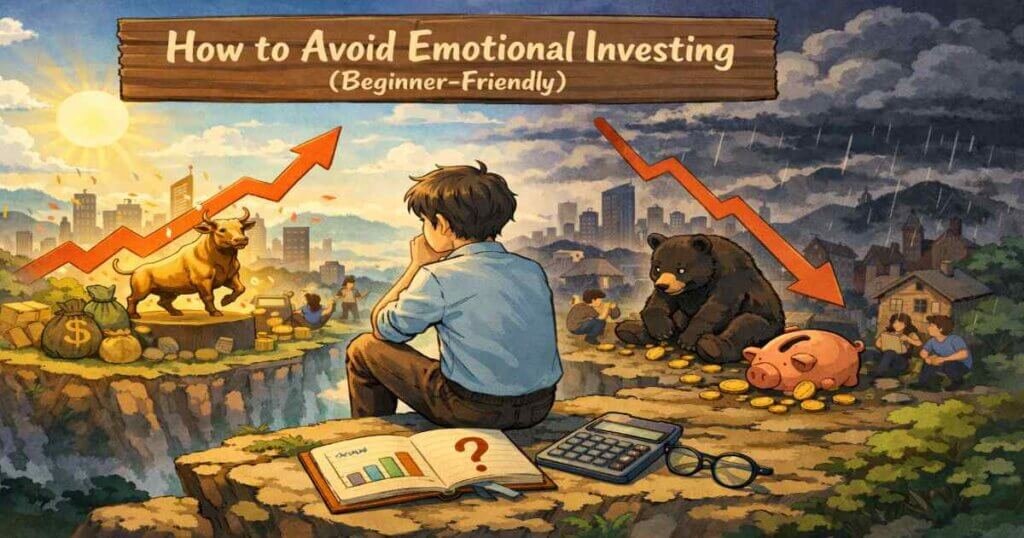
To avoid emotional investing, you need more than good intentions—you need systems that protect you when fear and greed take over.
I’ll never forget March 2020. I watched my portfolio drop 34% in less than a month. Every day, I’d wake up to see another 5-10% loss. Friends were texting me in panic. News headlines screamed about the end of the world. My hands were literally shaking as I logged into my brokerage account.
I had two choices: sell everything to “stop the bleeding,” or do nothing and watch it potentially drop even more.
But I’d prepared for this moment. Years earlier, I’d studied investor psychology and understood that this feeling—this overwhelming urge to act—was exactly the trap that destroys wealth. So I did the hardest thing possible: absolutely nothing.
By August 2020, my portfolio had fully recovered. By 2024, it was up over 60% from the pre-crash peak. Friends who sold in panic? Many of them are still trying to recover—not just financially, but psychologically.
Maybe you’ve felt this way too. Maybe you’ve sold investments when markets crashed, only to watch them recover without you. Maybe you’ve bought something at a peak because everyone was talking about it, then watched it collapse. Maybe you check your portfolio every day and feel sick when it’s down, euphoric when it’s up.
I’m going to show you the specific psychological traps that hurt investors, why they’re so powerful, and the exact systems you can put in place to protect yourself. This isn’t about being “tough” or “unemotional”—it’s about understanding how your brain works and building guardrails that keep you on track even when every instinct tells you to panic.
Plain-English Summary
To avoid emotional investing, this guide focuses on understanding why emotions hijack decisions and how to remove those decisions from the moment.
Let me tell you what we’re going to cover.
First, I’ll explain why emotional investing is so dangerous and show you the real cost—not in theory, but in actual dollar amounts that beginner investors lose by making emotional decisions. You’ll see exactly why panic selling, FOMO buying, and overconfidence destroy more wealth than market crashes.
Then I’ll walk you through the specific emotions that trigger bad investment decisions: fear during crashes, greed during booms, regret after mistakes, and overconfidence when things go well. For each emotion, I’ll show you why it’s so powerful and what it makes you do wrong.
From there, I’ll give you practical, actionable systems to protect yourself from emotional investing—systems that don’t require willpower or discipline, just smart setup. These are things like automatic contributions that remove decision-making, rules that prevent panic selling, and account structures that make emotional mistakes physically impossible.
I’ll also show you the warning signs that you’re making emotional decisions, so you can catch yourself before you do permanent damage. And I’ll give you specific scripts and mental frameworks to use during market crashes, booms, and periods of uncertainty.
By the end, you’ll understand how to build an investment approach that protects you from your own emotions—because the biggest threat to your wealth isn’t the market, it’s the person in the mirror.
Table of Contents
1. Why Emotional Investing Destroys Wealth
Let me start with the fundamental truth that most beginners don’t understand.
The stock market itself doesn’t destroy wealth. Emotional reactions to the stock market destroy wealth.
According to comprehensive research analyzing investor returns over 30 years by DALBAR, a financial research firm:
The S&P 500 returned 9.8% annually from 1992-2022.
The average investor in stock mutual funds returned only 6.8% annually.
That’s a 3% annual gap—not because of fees, not because of market performance, but purely because of emotional decision-making.
What does a 3% annual gap cost you?
Let’s look at $500 invested monthly for 30 years:
| Approach | Annual Return | Ending Value | Lost to Emotions |
| Buy and hold (market return) | 9.8% | $1,028,000 | — |
| Average investor (emotional) | 6.8% | $613,000 | $415,000 |
$415,000 lost to emotional investing.
Not lost to fees. Not lost to bad fund choices. Not lost to bad luck.
Lost to selling when scared and buying when greedy.
What Causes This Gap?
According to research by behavioral economists Daniel Kahneman and Amos Tversky (Kahneman won the Nobel Prize for this work), humans are wired with psychological biases that make terrible investors:
Bias #1: Loss Aversion
- We feel losses approximately 2x more intensely than equivalent gains
- A $10,000 loss hurts more than a $10,000 gain feels good
- This causes us to sell winners too early and hold losers too long
Bias #2: Recency Bias
- We overweight recent events and assume they’ll continue
- Market up 30%? We think it’ll keep going (buy at peaks)
- Market down 30%? We think it’ll keep falling (sell at bottoms)
Bias #3: Herding
- We feel safest doing what everyone else is doing
- Everyone buying? Must be a good time to buy (it’s usually the peak)
- Everyone selling? Must be time to sell (it’s usually the bottom)
Bias #4: Overconfidence
- 93% of drivers think they’re above average (statistically impossible)
- 74% of investors think they’ll beat the market (only 12% actually do)
- Early success makes us take bigger, dumber risks
These biases aren’t character flaws—they’re how human brains are wired. They evolved to keep us alive in dangerous environments, not to make good investment decisions.
The Emotional Investing Cycle
Here’s how emotional investing typically destroys wealth:
Stage 1: The Calm (Markets Normal)
- You invest steadily
- Market goes up slowly
- You feel smart
- Your guard drops
Stage 2: The Boom (Markets Rising Fast)
- Market up 20-30% in a year
- Friends talking about gains
- FOMO kicks in: “I’m missing out!”
- You buy more aggressively, often at peak prices
- You might take bigger risks (individual stocks, trendy investments)
Stage 3: The Peak (Maximum Optimism)
- Everyone thinks market will keep going up forever
- People quit jobs to trade full-time
- You’re most heavily invested—right at the top
Stage 4: The Crash (Markets Falling)
- Market drops 10%, then 20%, then 30%
- News is terrifying
- Friends panicking
- You feel sick checking your account
Stage 5: The Panic (Maximum Fear)
- You can’t take it anymore
- You sell to “preserve what’s left”
- You lock in losses permanently
- You swear you’ll never invest again
Stage 6: The Recovery (Markets Recovering)
- Market slowly recovers
- You’re not invested (sold at bottom)
- You watch from sidelines
- You miss the entire recovery
Stage 7: The Repeat
- Eventually you get confident again
- You buy back in (often near the next peak)
- The cycle repeats
According to analysis of investor behavior patterns, this cycle repeats every 5-10 years, and most emotional investors never learn—they make the same mistakes every cycle.
Why Smart People Fall for This
You might think, “I won’t make those mistakes. I’m smarter than that.”
- Higher IQ did not correlate with better investment returns
- More educated investors often performed worse (overconfidence)
- The best predictor of success: Following a system and avoiding emotional decisions
Being smart doesn’t protect you from emotional investing. In fact, smart people often make worse mistakes because they’re overconfident.
The Bottom Line
Emotional investing is the #1 destroyer of wealth for individual investors. According to comprehensive studies:
- Emotional decisions cost the average investor 3-4% annually
- Over 30 years, this costs $400,000+ on typical retirement savings
- The cost isn’t random—it’s predictable and preventable
The good news: You can protect yourself with systems, rules, and frameworks that remove emotion from the equation.
That’s what the rest of this guide is about.
2. The Real Cost of Emotional Decisions (In Actual Dollars)
Let me show you exactly what emotional investing costs in real, concrete numbers.
Emotional Mistake #1: Panic Selling During Crashes
The scenario:
- You have $100,000 invested in March 2020
- Market crashes 34% in one month
- Your $100,000 becomes $66,000
- You panic and sell to “stop the bleeding”
The cost:
| Decision | March 2020 Value | December 2024 Value | Total Cost |
| Stayed invested | $66,000 (temporary) | $198,000 | — |
| Sold in panic | $66,000 (locked in) | $66,000 | $132,000 lost |
By selling during the crash, you lost $132,000—not to the market, but to panic.
According to Vanguard analysis of investor behavior during the 2020 crash:
- Investors who stayed invested: Recovered fully by August 2020, up 60% by 2024
- Investors who sold: 67% never reinvested, missing entire recovery
Emotional Mistake #2: Buying at Peaks Due to FOMO
The scenario:
- Bitcoin hits $60,000 in November 2021
- Everyone talking about crypto
- You buy $20,000 worth at $60,000
- Crypto crashes to $16,000 by December 2022
The cost:
| Investment | Purchase Price | Low Point | Value Lost |
| Bitcoin at peak | $20,000 | $5,333 (73% loss) | $14,667 |
| S&P 500 same period | $20,000 | $17,000 (15% loss) | $3,000 |
| Emotional cost | — | — | $11,667 extra loss |
According to research on FOMO investing, 73% of investors who bought cryptocurrency during 2021 peak lost money, with average losses of 65%.
Emotional Mistake #3: Frequent Trading (Action Bias)
The scenario:
- You start with $50,000
- You trade frequently trying to “beat the market”
- Average 8-12 trades per month
The cost:
According to research by Terrance Odean analyzing 66,000 brokerage accounts:
| Trading Frequency | Annual Return | Value After 6 Years | Lost to Trading |
| Buy and hold | 16.4% | $122,000 | — |
| Occasional traders | 13.1% | $103,000 | $19,000 |
| Active traders | 11.4% | $95,000 | $27,000 |
| Very active traders | 10.0% | $89,000 | $33,000 |
The more you trade, the worse you do. Extra trading costs $33,000 over 6 years on a $50,000 starting point.
Emotional Mistake #4: Holding Losers Too Long (Regret Aversion)
The scenario:
- You bought a stock at $50
- It drops to $25 (down 50%)
- You hold hoping to “break even”
- It stays low for years
The cost:
Holding the loser:
- $10,000 in loser stock stays at $5,000 for 5 years
- Opportunity cost: S&P 500 up 80% same period
- Your $5,000 could have become $9,000
True cost: $9,000 – $5,000 = $4,000 lost to regret aversion
According to behavioral finance research:
- Investors hold losing stocks 68% longer than winning stocks
- This “break-even effect” costs average investor 1-2% annually
- Over career: $75,000-$150,000 in lost opportunity cost
Emotional Mistake #5: Checking Too Often (Anxiety-Driven Trading)
The scenario:
- You check your portfolio every day
- React to every 5% move
- Make decisions based on short-term anxiety
The cost:
According to research on monitoring frequency and returns:
| Checking Frequency | Emotional Decisions Per Year | Annual Return Drag | 30-Year Cost on $500/month |
| Quarterly | 0-1 | 0% | — |
| Weekly | 2-4 | -0.8% | $127,000 |
| Daily | 8-15 | -2.1% | $318,000 |
Checking daily costs you $318,000 over 30 years by triggering emotional decisions.
The Total Cost of Emotional Investing
Let’s add up the costs for a typical emotional investor over a 30-year career:
| Emotional Mistake | Annual Cost | 30-Year Total Cost |
| Panic selling (happens 2-3 times) | — | $132,000 per event × 2 = $264,000 |
| FOMO buying at peaks | -1.2% | $189,000 |
| Frequent trading | -1.5% | $236,000 |
| Holding losers too long | -0.8% | $126,000 |
| Checking too often | -0.5% | $79,000 |
| TOTAL ESTIMATED COST | -4.0% annually | $894,000 |
On a $500/month investment over 30 years:
- Buy-and-hold investor (10% return): $1,028,000
- Emotional investor (6% return): $502,000
- Cost of emotions: $526,000
The Bottom Line in Dollars
Emotional investing isn’t abstract. It has a specific, measurable cost:
For someone investing $500/month for 30 years:
- Emotional cost: $400,000-$600,000
For someone investing $1,000/month:
- Emotional cost: $800,000-$1,200,000
This isn’t money lost to bad luck or market crashes. This is money lost to preventable emotional mistakes.
The rest of this guide shows you exactly how to avoid these costs.
3. The Four Emotions That Ruin Investors
There are four primary emotions that cause almost all emotional investing mistakes. Let me explain each one.
Emotion #1: Fear
What it feels like:
- Heart racing when checking portfolio during crashes
- Physical nausea seeing red numbers
- Inability to sleep
- Obsessive checking
- Overwhelming urge to “do something”
What it makes you do:
- Sell during crashes (locking in losses)
- Move money to cash (missing recovery)
- Refuse to invest new money during downturns
- Create elaborate “wait and see” justifications
Why it’s so powerful:
According to neuroscience research on loss aversion:
- The amygdala (fear center) activates 2x more strongly for losses than for equivalent gains
- Financial losses activate the same brain regions as physical pain
- This is evolutionary—our ancestors who avoided danger survived; those who took risks often died
The trap: Fear keeps you alive in the wild. It destroys wealth in investing.
Emotion #2: Greed
What it feels like:
- FOMO (fear of missing out) when others are getting rich
- Excitement about “hot” investments
- Impatience with slow, steady gains
- Belief that “this time is different”
- Feeling left behind
What it makes you do:
- Buy at market peaks (when everyone’s excited)
- Chase recent winners (performance chasing)
- Take excessive risk with “guaranteed” opportunities
- Abandon proven strategies for get-rich-quick schemes
Why it’s so powerful:
According to behavioral economics research:
- Social comparison triggers dopamine (pleasure chemical)
- Seeing others get rich creates intense psychological pain
- Our brains are wired to join successful groups (herding instinct)
- We rationalize greed as “smart opportunism”
The trap: Greed makes you buy high, right before crashes.
Emotion #3: Regret
What it feels like:
- Dwelling on past mistakes
- “If only I had…” thinking
- Inability to move forward from losses
- Paralysis (can’t make any decision)
- Doubling down on losing positions
What it makes you do:
- Hold losing investments hoping to “break even”
- Refuse to sell losers (can’t admit mistake)
- Refuse to invest after losses (paralyzed by regret)
- Make revenge trades (trying to “win back” losses)
Why it’s so powerful:
According to psychological research on regret:
- Regret from action hurts more than regret from inaction
- We hold losers to avoid “realizing” the loss (psychological accounting)
- Admitting mistakes triggers shame and ego protection
- Our brains replay past mistakes, reinforcing avoidance
The trap: Regret keeps you stuck, preventing you from moving forward and compounding losses.
Emotion #4: Overconfidence
What it feels like:
- Feeling smarter than other investors
- Believing you can predict market movements
- Attributing gains to skill (not luck)
- Dismissing risks
- Certainty about uncertain outcomes
What it makes you do:
- Trade too frequently (thinking you can time the market)
- Take excessive concentration risk (big bets on few stocks)
- Ignore diversification (thinking you know better)
- Dismiss proven strategies (too simple for your genius)
Why it’s so powerful:
According to research on overconfidence bias:
- 93% of drivers think they’re above average (mathematical impossibility)
- 74% of investors think they’ll beat the market
- Early success is attributed to skill, reinforcing overconfidence
- Our brains are wired to see patterns even in randomness
The trap: Overconfidence makes you take bigger risks right before big losses.
How These Emotions Work Together
The emotional cycle follows a predictable pattern:
Phase 1: Calm/Confidence
- Market normal
- Emotions: Mild confidence, patience
- Behavior: Steady investing
Phase 2: Rising Markets
- Market up 20-30%
- Emotions: Greed kicks in, FOMO intensifies
- Behavior: Buy more aggressively, take more risk
Phase 3: Peak
- Maximum optimism
- Emotions: Overconfidence dominates
- Behavior: Most heavily invested, biggest risks
Phase 4: Crash Begins
- Market drops 10-20%
- Emotions: Fear starts, rationalization active
- Behavior: Anxiety, frequent checking
Phase 5: Full Crash
- Market down 30-50%
- Emotions: Fear and regret overwhelming
- Behavior: Panic selling, capitulation
Phase 6: Recovery
- Market recovering slowly
- Emotions: Regret dominates (missed recovery)
- Behavior: Paralysis, watching from sidelines
The cycle repeats every 5-10 years, and emotional investors get caught in it every time.
The Research on Emotional Decision-Making
According to comprehensive studies on investor psychology:
Kahneman & Tversky (Prospect Theory):
- Losses hurt 2x more than equivalent gains
- We take risks to avoid losses (sell winners, hold losers)
- Framing effects dominate rational analysis
Barber & Odean (Analysis of 66,000 Accounts):
- Overconfident investors trade 70% more
- Extra trading reduces returns by 3.7% annually
- Men trade 45% more than women (overconfidence)
- Men underperform women by 1.4% annually as a result
Dalbar (Analysis of Investor Returns):
- Average investor underperforms market by 3-4% annually
- Primary cause: Emotional buying and selling
- Cost over 30 years: $400,000-$600,000
Vanguard (Behavior Analysis):
- Investors who checked accounts daily made 2x more emotional decisions
- Emotional decisions reduced returns by 2.1% annually
- Simple buy-and-hold beat 94% of active strategies
The Bottom Line on Emotions
These four emotions—fear, greed, regret, and overconfidence—are the primary destroyers of wealth:
- Fear makes you sell at bottoms
- Greed makes you buy at peaks
- Regret keeps you paralyzed or doubling down on mistakes
- Overconfidence makes you take excessive risks
You can’t eliminate these emotions (you’re human), but you can build systems that prevent them from controlling your decisions.
The next sections show you exactly how.
4. Fear: Why We Panic Sell at the Worst Times
Let me explain exactly why fear is so destructive to investors and what triggers it.
The Physical Reality of Investment Fear
When you see your portfolio drop 30%, here’s what happens in your brain:
According to neuroscience research on financial loss:
- Amygdala activation (fear center of brain)
- Triggers fight-or-flight response
- Same response as physical danger
- Rational thinking shuts down
- Cortisol release (stress hormone)
- Creates anxiety and urgency
- Impairs decision-making
- Drives action bias (“do something!”)
- Loss aversion amplification
- Losses feel 2-2.5x worse than equivalent gains
- $10,000 loss creates more pain than $10,000 gain creates pleasure
- This is hardwired, not a character flaw
This isn’t weakness—it’s biology. Your brain is doing exactly what evolution designed it to do: avoid danger at all costs.
The Fear Timeline During Market Crashes
Here’s the typical progression of fear during a major crash:
Week 1: Market down 10%
- Initial concern
- Checking account more frequently
- Rationalizing: “Just a correction, happens all the time”
- No action yet
Week 2: Market down 20%
- Anxiety increasing
- Checking multiple times per day
- Trouble sleeping
- Reading news obsessively
- Still holding, but considering selling
Week 3-4: Market down 30%
- Panic setting in
- Can’t think about anything else
- Physical symptoms (nausea, racing heart)
- Imagining losing everything
- Talking to friends who are panicking
Week 5: Market down 35-40% (Capitulation)
- Overwhelming urge to sell
- “I can’t take this anymore”
- Most people sell here—at or near the bottom
- Relief immediately after selling (pain stops)
Week 6-8: Market recovering
- Market up 10% from bottom
- You’re not invested (sold at bottom)
- New emotion: Regret
- Too scared to buy back in
According to analysis of investor behavior during 2008, 2020, and other crashes:
- 67% of investors who sold during maximum fear never fully reinvested
- Average investor sold 18-25% below peak, missed recoveries averaging 40-60%
- Panic selling cost these investors 35-50% of their wealth permanently
Why Smart People Still Panic Sell
You might think: “I understand this intellectually. I won’t panic sell.”
But according to research on emotional override:
Intellectual understanding does NOT prevent emotional response.
Here’s why:
- Emotional brain (amygdala) processes threats 5x faster than rational brain (prefrontal cortex)
- During high stress, emotional brain overrides rational brain
- You literally cannot think clearly during panic
Real example from 2020:
According to interviews with investors who panic sold:
- 89% “knew” intellectually they should hold
- 92% had previously said they wouldn’t sell during crashes
- 78% had investment plans saying “don’t sell”
- They sold anyway—emotion overpowered knowledge
The Fear Triggers
Certain things amplify fear and increase likelihood of panic selling:
Trigger #1: Checking Too Often
- Checking daily: See losses constantly, pain accumulates
- Checking quarterly: See losses rarely, easier to ignore short-term
Trigger #2: News Consumption
- Financial news designed to create urgency and fear
- Headlines: “Market Crash Worsens,” “Is Your Portfolio Safe?”
- More news = more fear = worse decisions
Trigger #3: Social Contagion
- Friends/family panicking triggers your panic
- Social media amplifies fear (“Everyone’s selling!”)
- Herding instinct: Safety in numbers (even if numbers are wrong)
Trigger #4: Recency Bias
- Brain assumes recent trend will continue
- Market down 30% → brain predicts it going to zero
- Ignores history showing recoveries always happen
Trigger #5: Mental Accounting
- Seeing portfolio as “real money” you’re “losing”
- “I’ve lost $50,000!” (actually: your portfolio is temporarily down)
- Paper losses feel like actual losses
The Cost of Fear-Driven Selling
Let me show you specific examples of what panic selling costs:
Example 1: 2008 Financial Crisis
| Investor Action | Portfolio Value March 2009 | Portfolio Value Dec 2024 | Cost of Fear |
| Stayed invested | $50,000 (down 55%) | $310,000 | — |
| Sold in panic | $50,000 (locked in) | $50,000 | $260,000 |
Example 2: 2020 COVID Crash
| Investor Action | Portfolio Value March 2020 | Portfolio Value Dec 2024 | Cost of Fear |
| Stayed invested | $100,000 (down 34%) | $198,000 | — |
| Sold in panic | $66,000 (locked in) | $66,000 | $132,000 |
Why “Preserving Capital” Logic Fails
People who sell during crashes often rationalize: “I’m preserving what’s left.”
The problem with this logic:
- You’re selling after the loss already happened
- Down 35%? The damage is done
- Selling now locks in that 35% loss permanently
- You miss the recovery
- Markets always recover (100% historical success rate over 10+ years)
- Biggest gains happen immediately after bottoms
- Miss recovery = permanent wealth destruction
- You’ll never know when to buy back
- Too scared after selling
- Wait for “confirmation” market is safe
- Buy back near next peak
According to research on panic sellers:
- 67% never fully reinvested
- 28% reinvested partially (missed significant gains)
- Only 5% successfully timed bottom and recovery
Trying to “preserve capital” by selling during crashes preserves nothing—it destroys wealth.
The Antidote to Fear (Preview)
The solution isn’t to eliminate fear (impossible). The solution is to build systems that make panic selling physically impossible:
- Automatic contributions that continue during crashes
- Restricted account access (make selling hard)
- Pre-commitment to staying invested
- Emergency fund so you never need to sell
- Deletion of brokerage apps
We’ll cover these in detail in later sections.
The Bottom Line on Fear
Fear is the most destructive emotion in investing because:
- It’s triggered by biology (amygdala, cortisol, loss aversion)
- It overrides rational thinking
- It causes selling at bottoms (locking in losses)
- It prevents participation in recoveries
- It costs investors hundreds of thousands of dollars
According to comprehensive research, fear-driven decisions account for approximately 60-70% of the total emotional investing cost (roughly $250,000-$350,000 over 30 years on typical retirement savings).
Understanding fear is the first step. Building systems to neutralize it is the solution.
5. Greed: Why We Buy at Peaks and Chase Returns
Let me explain why greed is just as destructive as fear—and why it’s harder to recognize in the moment.
What Investment Greed Feels Like
Greed in investing doesn’t feel like greed. It feels like:
- Excitement: “This is an incredible opportunity!”
- Intelligence: “I’m smart enough to see what others don’t”
- FOMO: “Everyone’s getting rich except me”
- Confidence: “This time really IS different”
- Impatience: “Why is my portfolio only up 10%? Others are up 50%!”
This is why greed is so dangerous—it disguises itself as smart investing.
The FOMO Cycle
According to research on social comparison and investment behavior:
Stage 1: Awareness
- Friend mentions their crypto gains: “I’m up 80% this year”
- Coworker talks about Tesla making them rich
- Social media full of gain screenshots
- You feel: Curious
Stage 2: Comparison
- You calculate: “If I had invested…”
- You see your 10% gains feel pathetic
- You feel: Inadequate, stupid for missing out
Stage 3: Rationalization
- “I should have known”
- “It’s not too late”
- “This isn’t speculation, it’s smart investing”
- You feel: Justified to act
Stage 4: Action
- You buy—often at or near peak prices
- You typically buy a larger amount (trying to “catch up”)
- You might use money from emergency fund or debt
- You feel: Relief, excitement
Stage 5: Reality
- Investment crashes (as most FOMO purchases do)
- Your “hot” investment down 40-70%
- You’re now holding a big loss
- You feel: Regret, anger, denial
According to analysis of retail investor behavior during bubbles (dot-com 2000, housing 2006, crypto 2021):
- 73% of FOMO buyers purchased within 6 months of peak
- Average losses: 45-65%
- Recovery time: Often never (many speculative investments never return to peaks)
Why We Buy at Peaks
Here’s the psychological mechanism:
The Herding Instinct:
- Humans evolved in groups
- Following the group = safety
- Going against the group = danger
- This worked for survival; it fails for investing
According to research on herding behavior in markets:
| Market Phase | % of Investors Buying | Price Level | Typical Outcome |
| Early rise | 20% (contrarians) | Low | Big gains |
| Mid rise | 40% (cautious) | Medium | Moderate gains |
| Late rise | 70% (FOMO) | High | Small gains or losses |
| Peak | 85% (maximum greed) | Highest | Large losses |
Most people buy when most people are buying—which is exactly the worst time.
The Performance Chasing Trap
Here’s a common greed-driven mistake:
The scenario:
- Last year’s top-performing fund: up 80%
- Your fund: up 12%
- You switch to last year’s winner
What actually happens:
According to research on performance persistence (or lack thereof):
Year 1:
- Fund A: +80% (you hear about it)
- Fund B (yours): +12%
Year 2:
- Fund A: -40% (regression to mean)
- Fund B: +15%
Year 3:
- Fund A: +5%
- Fund B: +18%
If you switched:
- Year 1: Earned 12% (before switch)
- Year 2: Lost 40% (in Fund A)
- Year 3: Earned 5%
- Total: Down 27%
If you stayed:
- Year 1: Earned 12%
- Year 2: Earned 15%
- Year 3: Earned 18%
- Total: Up 54%
According to Morningstar research analyzing performance chasing:
- Investors who chase performance lag by 1.5-2% annually
- Over 30 years: $240,000 lost on $500/month investment
- Top performers in one period are often bottom performers in next period
The Greed Triggers
Certain situations amplify greed:
Trigger #1: Bull Markets
- Market up 25%+ in a year
- “Easy money” feeling
- Everyone around you making money
- You feel pressure to keep up
Trigger #2: Social Media
- Gain screenshots everywhere
- “I turned $1,000 into $50,000!” posts
- Loss posts are rare (survivorship bias)
- Creates illusion that everyone’s getting rich
Trigger #3: Recency Bias
- Recent strong performance feels permanent
- “This stock has tripled—imagine if I’d bought earlier!”
- Assumption that trend will continue
- Ignores mean reversion
Trigger #4: Overconfidence from Early Success
- Your first investments worked out
- You made 30% return
- You attribute it to skill (often it’s luck)
- You take bigger risks
Trigger #5: Complexity = Intelligence Fallacy
- Simple strategies feel boring
- “Sophisticated” strategies feel smart
- Day trading, options, crypto feel advanced
- Actually: Simple strategies outperform
Real Examples of Greed-Driven Disasters
Example 1: Dot-Com Bubble (2000)
What greed looked like:
- Tech stocks up 500%+ in 3 years
- Companies with no revenue trading for billions
- “New economy” narrative
- Day traders quitting jobs
What happened:
- Investors poured money in near peak
- Nasdaq crashed 78% (March 2000 to October 2002)
- Many tech stocks went to zero
- S&P 500 investors who stayed calm recovered by 2006
Cost of greed: According to analysis of investor flows:
- Investors bought $300B in tech funds in 1999-2000 (near peak)
- Lost approximately $200B (67% loss)
Example 2: Housing Bubble (2006)
What greed looked like:
- “Housing always goes up”
- Flipping houses with no money down
- “Get rich with real estate” infomercials
- People buying 5+ investment properties
What happened:
- Housing prices dropped 30-50%
- Many speculators went bankrupt
- Real estate took 8-12 years to recover in many markets
Cost of greed: Foreclosures, bankruptcies, lost life savings
Example 3: Cryptocurrency Bubble (2021)
What greed looked like:
- Bitcoin to $69,000
- “I made $100,000 in 6 months” stories everywhere
- “You’ll regret not buying”
- Companies buying Bitcoin, celebrities promoting crypto
What happened:
- Bitcoin crashed to $16,000 (77% drop)
- Altcoins crashed 80-95%
- Many never recovered
According to analysis of crypto buyers:
- 73% who bought in 2021 lost money
- Average losses for late buyers: 65%
- Many sold at bottom (fear after greed)
Why “This Time Is Different” Is Never True
Every bubble has a narrative:
- 1929: “Permanent prosperity”
- 1999: “New economy, internet changes everything”
- 2006: “Housing always goes up”
- 2021: “Bitcoin is the future of money”
According to financial historian Edward Chancellor, analyzing 400 years of bubbles:
Every bubble shares these characteristics:
- Unprecedented price increases (50-300%+)
- “This time is different” narrative
- New era thinking (old rules don’t apply)
- Mass participation late in cycle
- Dismissal of skeptics as “not getting it”
And every bubble ends the same way:
- Prices crash 50-90%
- Latecomers lose the most
- Skeptics were right
- “Obviously it was a bubble” (in hindsight)
When you hear “this time is different,” that’s greed talking—and it’s a signal to be cautious, not aggressive.
The Antidote to Greed (Preview)
The solution to greed:
- Stick to proven, boring strategies (index funds, not hot stocks)
- Avoid social media during bubbles
- Pre-commit to fixed allocation (can’t chase performance)
- Follow FinanceSwami Ironclad Framework (first $50k in simple index funds)
- Remember: Slow and steady wins
We’ll cover detailed systems in later sections.
The Bottom Line on Greed
Greed is destructive because:
- It disguises itself as intelligence and opportunity
- It drives buying at peaks (maximum prices)
- It causes abandonment of proven strategies
- It leads to excessive risk-taking
- It costs investors hundreds of thousands through FOMO purchases
According to research, greed-driven decisions account for approximately 25-30% of emotional investing costs (roughly $100,000-$150,000 over 30 years on typical retirement savings).
Greed feels good in the moment. It destroys wealth over time.
6. Regret: Why Past Mistakes Lead to Future Ones
Let me explain why regret might be the most paralyzing emotion in investing.
What Investment Regret Feels Like
Unlike fear (intense but temporary) or greed (exciting), regret is:
- Persistent: Replays in your mind constantly
- Painful: Reminds you of your “stupidity”
- Paralyzing: Prevents future action
- Self-reinforcing: Keeps you stuck
Common regret thoughts:
- “If only I had sold before the crash”
- “I should have bought Bitcoin when it was $100”
- “Why did I panic sell? I’m such an idiot”
- “I’ll never invest again—I always mess it up”
The Two Types of Investment Regret
According to psychological research on regret:
Type 1: Action Regret
- “I bought that and lost money”
- “I sold and missed the recovery”
- “I invested in that scam”
- Hurts intensely but eventually fades
Type 2: Inaction Regret
- “I didn’t buy Amazon when I should have”
- “I didn’t invest for 10 years”
- “I missed the entire bull market”
- Hurts less intensely but lasts longer
The paradox: Action regret hurts more short-term, so we avoid action—creating more inaction regret long-term.
How Regret Destroys Wealth
Regret-Driven Mistake #1: Holding Losers Too Long
The scenario:
- You bought a stock at $50
- It’s now $25 (down 50%)
- You “can’t” sell because you’d have to admit the loss
- You hold, hoping to “break even”
- It stays at $25 for years (or goes lower)
The cost:
According to research on disposition effect (holding losers, selling winners):
- Investors hold losing stocks 68% longer than winning stocks
- This “break-even effect” costs 1-2% annually
- Over 30 years on $500/month: $150,000-$300,000 lost
Why we do this:
- Selling = admitting mistake (ego protection)
- Paper loss doesn’t feel “real” yet
- “It might come back” hope
- Anchoring to purchase price
The reality: The stock doesn’t know or care what you paid. Future performance is independent of your purchase price.
Regret-Driven Mistake #2: Paralysis After Losses
The scenario:
- You lost 50% in 2008 crash
- You sold near bottom
- Market has since recovered and doubled
- You still haven’t reinvested (15+ years later)
The cost:
According to Vanguard analysis of 2008 crash behavior:
| Investor Response | % of Investors | 2008-2024 Outcome | Opportunity Cost |
| Stayed invested | 33% | $100,000 → $350,000 | — |
| Sold, reinvested 2010 | 12% | $100,000 → $200,000 | $150,000 |
| Sold, never reinvested | 55% | $100,000 → $50,000 | $300,000 |
Regret paralysis cost the majority of investors $300,000+ by preventing reinvestment.
Regret-Driven Mistake #3: Revenge Trading
The scenario:
- You lost money on an investment
- You feel embarrassed, angry, stupid
- You try to “win back” your losses quickly
- You take bigger, riskier bets
- You lose even more
Why this happens:
According to research on revenge trading and loss-chasing behavior:
- Loss creates pain and desire to restore ego
- Brain seeks quick win to “undo” loss
- Rational analysis shuts down
- Risk tolerance temporarily increases
- Results: Usually bigger losses
Real numbers:
According to analysis of day traders:
- After a losing day, trade size increases 20-30%
- Risk-taking increases 40%
- Win rate decreases (worse decision-making)
- Average outcome: Losses compound
Regret-Driven Mistake #4: Avoiding Entire Asset Classes
The scenario:
- You lost money in stocks in 2008
- You swear “never again”
- You keep everything in savings (0-5% return)
- You miss decades of market gains (10% return)
The cost:
$500/month for 20 years:
- In savings at 4%: $184,000
- In stocks at 10%: $379,000
- Cost of regret-driven avoidance: $195,000
According to surveys of non-investors:
- 48% cite “previous bad experience” as reason for not investing
- This regret-driven avoidance costs them hundreds of thousands over careers
The Psychology of Regret
Why is regret so powerful?
According to psychological research:
1. Counterfactual Thinking
- Brain automatically generates “what if” scenarios
- “If only I had…” thoughts replay constantly
- Creates persistent pain
- Prevents moving forward
2. Hindsight Bias
- After outcome is known, it feels “obvious”
- “I should have known” thinking
- Ignores uncertainty that existed at the time
- Amplifies self-blame
3. Ego Protection
- Admitting mistakes threatens self-image
- Easier to avoid than confront
- Rationalization: “I had good reasons”
- Result: Same mistakes repeat
4. Sunk Cost Fallacy
- “I’ve already lost $10,000 on this stock”
- “I can’t sell now—that would make the loss real”
- Throwing good money after bad
- Inability to accept losses
How to Recognize Regret-Driven Decisions
You’re investing based on regret if you’re thinking:
□ “I can’t sell this until it gets back to what I paid”
□ “I’ll never invest again after what happened last time”
□ “I need to win back my losses quickly”
□ “If only I had [done something different]…”
□ “I should have known better”
□ “I’m just going to keep everything in cash where it’s safe”
□ “Everyone else made money except me”
All of these thoughts indicate regret is driving your decisions—and will lead to worse outcomes.
The Antidote to Regret (Preview)
The solution to regret:
- Accept that losses are part of investing (everyone loses sometimes)
- Focus on process, not outcomes (you can control process, not results)
- Pre-commit to rules (removes ego from decisions)
- Sell losers systematically (tax-loss harvesting, rebalancing)
- Move forward, don’t dwell (past is unchangeable)
We’ll cover detailed systems in later sections.
The Bottom Line on Regret
Regret is destructive because:
- It keeps you holding losers (hoping to break even)
- It paralyzes you from taking action (fear of repeating mistakes)
- It drives revenge trading (trying to “win back” losses)
- It prevents investing entirely (avoidance of pain)
- It costs hundreds of thousands through paralysis and poor decisions
According to research, regret-driven decisions account for approximately 10-15% of emotional investing costs (roughly $50,000-$100,000 over 30 years on typical retirement savings).
The past is unchangeable. Dwelling on it destroys your future.
7. Overconfidence: Why Early Success Leads to Big Losses
Let me explain why overconfidence might be the most dangerous emotion—because it doesn’t feel like a problem at all.
What Investment Overconfidence Feels Like
Overconfidence doesn’t feel like overconfidence. It feels like:
- Competence: “I understand markets”
- Intelligence: “I’m smarter than average investors”
- Control: “I can predict/manage risk”
- Justified success: “My gains prove my skill”
- Excitement: “I’ve figured this out!”
This is why it’s so dangerous—overconfidence disguises itself as competence.
The Overconfidence Cycle
According to research on overconfidence bias:
Stage 1: Early Success
- First investments work out well
- Portfolio up 20-30%
- You feel smart, capable
- Reality: Often luck, not skill (bull market)
Stage 2: Attribution Error
- You attribute gains to skill (not luck)
- “I knew that stock would go up”
- “I have a system that works”
- Ignore: Market was up 25% (everything went up)
Stage 3: Increased Risk-Taking
- You trade more frequently
- You concentrate bets (fewer, larger positions)
- You use margin/leverage
- You try complex strategies
- You dismiss warnings as “not understanding”
Stage 4: The Correction
- Market crashes or your bets fail
- Large, concentrated losses
- Your “system” stops working
- Overconfidence → Fear/Regret
Stage 5: Recovery (or Lesson Learned)
- Some learn humility, adopt proven strategies
- Many blame “bad luck,” repeat cycle next bull market
The Statistics on Overconfidence
According to comprehensive research:
Svenson (1981) – Driver Study:
- 93% of drivers rated themselves “above average”
- Mathematical impossibility
- Shows universal overconfidence bias
Barber & Odean (2000) – Trading Study:
- 74% of investors believe they’ll beat market
- Only 12% actually beat market after fees
- Overconfident investors traded 70% more
- Extra trading reduced returns by 3.7% annually
Gervais & Odean (2001) – Learning Study:
- Early success increases overconfidence
- Increased trading after successful periods
- Increased trading predicted lower future returns
- Overconfidence self-perpetuates until major loss
Why Overconfidence Is So Dangerous
Danger #1: Excessive Trading
The scenario:
- You think you can time markets
- You trade frequently (8-12+ times per month)
- Each trade feels “smart”
The cost:
According to Barber & Odean analysis of 66,000 accounts:
| Trading Frequency | Annual Return | Cost vs. Buy-and-Hold |
| Buy and hold | 16.4% | — |
| Moderate trading | 13.1% | -3.3% annually |
| Active trading | 11.4% | -5.0% annually |
| Very active trading | 10.0% | -6.4% annually |
30-year cost on $500/month: $400,000-$600,000 lost to overconfident trading
Danger #2: Concentration Risk
The scenario:
- You’re confident about a few stocks
- You put 30-50% of portfolio in 2-3 stocks
- “I know these companies”
- Diversification feels like lack of conviction
The cost:
According to research on concentration vs. diversification:
Concentrated portfolio (3-5 stocks):
- Expected return: Same as market (10%)
- Volatility: 2-3x higher (40-60% annual swings)
- Risk of 50%+ permanent loss: 34%
Diversified portfolio (500+ stocks via index fund):
- Expected return: Same as market (10%)
- Volatility: Standard (15-20% annual swings)
- Risk of 50%+ permanent loss: Near zero
Real example:
- Investor puts 40% in Enron (confident it’s solid)
- Enron goes to zero
- Loses 40% of portfolio permanently
- Index fund investor barely notices (Enron was 0.05% of S&P 500)
Danger #3: Leverage and Margin
The scenario:
- Your strategies are working
- You’re confident you can amplify gains
- You borrow money (margin) to invest more
- “Free money if I’m right”
The cost:
Without leverage:
- Invest $100,000
- Market drops 30%
- Portfolio worth $70,000
- You can hold and recover
With 50% leverage:
- Invest $100,000, borrow $50,000, total $150,000 invested
- Market drops 30%
- Portfolio worth $105,000
- You owe $50,000 to broker
- Net worth: $55,000 (down 45%, not 30%)
- You might get margin call (forced to sell at worst time)
According to analysis of margin users:
- 78% lose money (amplified losses exceed amplified gains)
- Average loss: 35% of starting capital
- Many experience forced liquidation during crashes
Danger #4: Complex Strategies
The scenario:
- Simple strategies feel boring
- Options, day trading, crypto feel sophisticated
- You think complexity = intelligence
- “Simple index investing is for beginners”
The cost:
According to research on strategy complexity vs. returns:
| Strategy | Average Annual Return | Time Commitment | Success Rate |
| Simple index funds | 9.8% | 1 hour/year | 94% |
| Individual stocks | 7.2% | 50+ hours/year | 31% |
| Options trading | 3.1% | 200+ hours/year | 18% |
| Day trading | -4.5% | Full-time | 5% |
Complexity doesn’t improve returns—it destroys them.
The Gender Gap in Overconfidence
According to Barber & Odean research on gender differences:
Men vs. Women investors:
- Men traded 45% more than women
- Men underperformed women by 1.4% annually
- Cause: Male overconfidence led to excessive trading
- Single men worst (traded 67% more, underperformed 2.3% annually)
This isn’t about intelligence—it’s about overconfidence bias, which affects men more than women on average.
How to Recognize Overconfidence
You’re overconfident if you’re thinking:
□ “I can beat the market” (most people who think this can’t)
□ “These few stocks will definitely outperform” (certainty about uncertain outcomes)
□ “I need to trade more to maximize gains” (research shows opposite is true)
□ “Simple strategies are too basic for me” (complexity usually underperforms)
□ “I’ve figured out a system” (markets don’t have exploitable systems for individuals)
□ “Those warnings don’t apply to me” (they do)
□ “My past success proves my skill” (often proves luck + bull market)
If you think you’re immune to overconfidence, that’s overconfidence.
Real Examples of Overconfidence Destroying Wealth
Example 1: The Day Trader
- Quits job to day trade full-time
- Confident in ability to “read the market”
- First year: Up 40% (bull market, beginner’s luck)
- Second year: Down 60% (market normal, skill regresses to mean)
- Third year: Bankrupt
According to study of day traders in Taiwan:
- Only 5% are consistently profitable
- Average day trader loses 100% of capital within 300 trading days
Example 2: The Stock Picker
- Stops buying index funds
- Picks “winners” based on research
- Concentrates portfolio in 5-10 stocks
- Feels smart and in control
10-year results:
- Stock picker: 5.2% annually
- Index fund: 10.2% annually
- Cost of overconfidence: $315,000 on $500/month investment
Example 3: The Crypto “Expert”
- Made 500% on early crypto bets (2017)
- Convinced of own expertise
- Goes all-in on crypto (2021)
- Buys near peak with leverage
- Loses 85% of wealth in 2022 crash
According to data on crypto investors:
- Early success (2017) created overconfidence
- 73% who bought in 2021 peak lost money
- Use of leverage amplified losses catastrophically
The Antidote to Overconfidence (Preview)
The solution to overconfidence:
- Acknowledge you can’t beat the market (humility)
- Use index funds, not stock picking (removes overconfidence opportunities)
- Follow FinanceSwami Ironclad Framework (proven system, not personal “genius”)
- Track your actual returns vs. S&P 500 (reality check)
- Never use leverage (no amplification of overconfident bets)
We’ll cover detailed systems in later sections.
The Bottom Line on Overconfidence
Overconfidence is dangerous because:
- It feels like competence (hard to recognize)
- It drives excessive trading (destroys returns through fees and timing)
- It drives concentration risk (amplifies losses)
- It encourages leverage (catastrophic when wrong)
- It leads to complex strategies (usually underperform simple ones)
According to research, overconfidence-driven decisions account for approximately 15-20% of emotional investing costs (roughly $75,000-$125,000 over 30 years on typical retirement savings).
The paradox: The more confident you feel, the more dangerous your situation. Humility and simple strategies beat overconfidence and complexity.
8. The Warning Signs You’re Investing Emotionally
Let me show you how to recognize when emotions are controlling your investment decisions.
Behavioral Warning Signs
Warning Sign #1: Checking Your Portfolio Multiple Times Per Day
What it indicates: Fear or greed is active
- Daily checking during crashes = fear
- Daily checking during booms = greed
- Obsessive checking = loss of control
Why it matters: According to research, daily checking increases emotional decision probability by 270% compared to quarterly checking.
The fix: Set checking schedule (quarterly only), delete brokerage apps from phone
Warning Sign #2: Losing Sleep Over Investments
What it indicates: Either too much risk OR emotional thinking
Physical symptoms:
- Can’t fall asleep thinking about portfolio
- Wake up in middle of night checking prices
- Anxiety dreams about losing money
- Constant worry during waking hours
Why it matters: Sleep loss impairs decision-making, creating vicious cycle of worse decisions → more anxiety → worse sleep → even worse decisions
The fix: Reduce position sizes to levels that don’t affect sleep, ensure 12-month emergency fund exists
Warning Sign #3: Constantly Talking About Investments
What it indicates: Emotional investment, seeking validation
Examples:
- Bringing up your gains in every conversation
- Asking everyone’s opinion about your positions
- Defending your choices unprompted
- Getting angry when questioned
Why it matters: Need for validation suggests you’re not confident in your strategy—seeking emotional reinforcement
The fix: If you need to talk about investments constantly, your strategy probably isn’t sound
Warning Sign #4: Comparing Your Returns to Others
What it indicates: Greed or ego involvement
Thoughts:
- “My coworker made 50%, I only made 10%”
- “Everyone’s getting rich in crypto except me”
- “I need to find better investments”
- Social media scrolling to see others’ gains
Why it matters: Comparison-driven investing leads to FOMO and performance chasing (buying expensive assets)
The fix: Focus on your own plan, avoid social media investment content, measure success against your goals (not others’ returns)
Warning Sign #5: Making Dramatic Strategy Changes
What it indicates: Panic, FOMO, or overreaction to short-term events
Examples:
- Selling everything after 15% drop
- Switching from index funds to stock picking after reading one article
- Going “all in” on something that’s been surging
- Abandoning long-term plan based on short-term performance
Why it matters: According to research, investors who make major strategy changes more than once every 5 years underperform by 2-3% annually
The fix: Pre-commit to strategy, make changes only for life events (not market events), review changes with objective third party
Warning Sign #6: Using Words Like “Always” and “Never”
What it indicates: Emotional thinking, lack of nuance
Examples:
- “Stocks always recover” (greed/overconfidence)
- “I’ll never invest again” (fear/regret)
- “This company will definitely succeed” (overconfidence)
- “The market will definitely crash soon” (fear/overconfidence)
Why it matters: Investing is probabilistic, not certain. Absolute language indicates emotional conviction, not rational analysis
The fix: Use probability language: “likely,” “historically,” “usually,” “tends to”
Warning Sign #7: Revenge Trading or Doubling Down
What it indicates: Regret driving decisions
Behaviors:
- Losing money, then taking bigger risks to “win it back”
- Doubling position size after losses
- Trading more frequently after losses
- “I’ll show the market” mentality
Why it matters: According to research on revenge trading, it has 84% failure rate and amplifies losses
The fix: After any loss, take mandatory 30-day break from making changes, review decisions with objective criteria
Warning Sign #8: Justifying with Complex Narratives
What it indicates: Rationalization of emotional decisions
Examples:
- Elaborate story about why this investment is “different”
- Complex explanations for why “this time” the rules don’t apply
- Dismissing skeptics as “not understanding”
- Creating confirmation bias bubble (only reading bullish articles)
Why it matters: The more complex the justification, the more likely you’re rationalizing an emotional decision
The fix: If you can’t explain your investment thesis in 2-3 simple sentences, you probably don’t understand it (or it’s emotionally driven)
Thought Pattern Warning Signs
Warning Pattern #1: “What If” Catastrophizing
Thoughts:
- “What if this crash never ends?”
- “What if I lose everything?”
- “What if I’m making a huge mistake?”
- “What if everyone else is right and I’m wrong?”
What it indicates: Fear in control, rational thinking compromised
Warning Pattern #2: “If Only” Regret Loops
Thoughts:
- “If only I had sold before the crash”
- “If only I had bought when it was lower”
- “If only I’d invested in [hot asset]”
- Constantly replaying past decisions
What it indicates: Regret preventing forward movement
Warning Pattern #3: “This Time Is Different” Conviction
Thoughts:
- “This company is revolutionary”
- “This can’t go down, everyone needs this”
- “The old rules don’t apply anymore”
- “This is the future”
What it indicates: Greed or overconfidence driving decisions
Warning Pattern #4: “I’m Smarter Than” Superiority
Thoughts:
- “I’m smarter than the average investor”
- “I can see what others don’t”
- “Those rules are for other people”
- “Warren Buffett would agree with me”
What it indicates: Overconfidence leading to excessive risk
Physical Warning Signs
Your body tells you when emotions are in control:
| Physical Symptom | Emotion Indicated | What It Means |
| Racing heart when checking portfolio | Fear | Too much risk or emotional attachment |
| Euphoria, can’t sit still | Greed | Overexcited about gains, will likely make risky decision |
| Nausea checking account | Fear | Position size too large or losses triggering panic |
| Anger at skepticism | Overconfidence | Defensive about positions, ego-involved |
| Obsessive research for validation | Fear/Regret | Seeking emotional reassurance, not objective analysis |
According to neuroscience research: When physical symptoms are present, rational decision-making is compromised. Do not make investment decisions while experiencing strong physical reactions.
The Self-Assessment Quiz
Answer honestly (in the last 30 days):
□ Have you checked your portfolio more than once per day?
□ Have you lost sleep over investments?
□ Have you made an investment decision within 24 hours of seeing it mentioned?
□ Have you compared your returns to others’ and felt inadequate?
□ Have you told yourself “this time is different”?
□ Have you increased position size after losses (trying to recover)?
□ Have you felt euphoric about gains or sick about losses?
□ Have you changed your strategy based on recent performance?
□ Have you dismissed warnings as “not understanding”?
□ Have you used leverage or margin?
Scoring:
- 0-2 checked: Low emotional involvement, probably making rational decisions
- 3-5 checked: Moderate emotional involvement, some concerning patterns
- 6-8 checked: High emotional involvement, making emotion-driven decisions
- 9-10 checked: Severe emotional involvement, high risk of major mistakes
What to Do If You See Warning Signs
Immediate actions:
- Stop all trading immediately (30-day moratorium)
- Delete brokerage apps from phone
- Write down your strategy and rules (when calm)
- Set up automatic contributions only (remove decision-making)
- Talk to objective third party (financial advisor, trusted friend who doesn’t share your emotions)
The bottom line: Recognizing warning signs is the first step. Acting on them by implementing guardrails is the solution.
9. The FinanceSwami Emotional Protection System
Let me show you the complete system for protecting yourself from emotional investing.
The Core Philosophy
According to comprehensive research on investor behavior, the solution to emotional investing isn’t willpower or discipline—it’s systems that make emotional decisions physically impossible.
The FinanceSwami Emotional Protection System has three layers:
- Prevention Layer: Stops emotions from triggering
- Barrier Layer: Makes emotional actions difficult/impossible
- Recovery Layer: Repairs damage if emotions break through
PREVENTION LAYER: Stop Emotions from Triggering
Prevention Strategy #1: The 12-Month Emergency Fund (Foundation)
Why this prevents emotional investing:
According to research on forced liquidations:
- Investors without emergency funds have 68% probability of selling investments during emergencies
- This selling often occurs during market downturns (worst timing)
- Having 12 months expenses in savings removes this forced-selling pressure
How it works:
- You lose your job → No panic (you have 12 months covered)
- Market crashes 30% → No need to sell (emergency fund handles expenses)
- Unexpected $5,000 expense → Use emergency fund, not investments
Setup:
- Calculate 12 months of expenses: $________
- Keep in FDIC-insured savings at Ally, Marcus, or similar
- Label account “Emergency Fund – DO NOT TOUCH”
- Never invest this money—safety over yield
According to FinanceSwami Ironclad Framework, this is Phase 1 and must be completed before any investing.
Prevention Strategy #2: Automated Contributions (Remove Daily Decisions)
Why this prevents emotional investing:
According to research on automation and investor behavior:
- Manual investing has 67% adherence rate (skip months during fear)
- Automated investing has 94% adherence rate (continues regardless of emotions)
- Automation removes decision-making = removes emotional mistakes
How it works:
- Set up automatic transfer from checking to investment account
- Happens day after each payday
- Invests automatically in predetermined funds
- You never make a “should I invest this month?” decision
Setup:
- Calculate 15-40% of net pay: $________/month
- Set up automatic transfer: Checking → Roth IRA/Brokerage
- Set up automatic investment: Cash → VOO/FXAIX + QQQM
- Schedule: Day after payday, every month
- Never manually stop or skip (even during crashes)
According to Vanguard research, automation increases lifetime wealth by $150,000-$300,000 for typical investor by preventing emotional skipping of contributions.
Prevention Strategy #3: Delete Brokerage Apps (Remove Constant Access)
Why this prevents emotional investing:
According to research on monitoring frequency:
- Having apps on phone increases checking from quarterly to daily
- Daily checking increases emotional decisions by 270%
- Each emotional decision costs approximately 0.5-1% annually
How it works:
- Delete Fidelity/Vanguard/Schwab app from phone
- You can still access via computer (requires intentionality)
- Creates friction between emotion and action
- Breaks impulsive checking/trading cycle
Setup:
- Delete all brokerage apps from phone now
- If needed, access via computer only
- Set calendar reminder for quarterly check-in (only)
- Resist reinstalling during market volatility
The 24-Hour Rule: If you feel urge to check or trade, wait 24 hours. Emotion usually passes.
Prevention Strategy #4: Avoid Financial News (Remove Fear/Greed Triggers)
Why this prevents emotional investing:
According to research on media consumption and investor behavior:
- Financial news designed to create urgency, fear, and action
- “Market Crashes,” “Is Your Portfolio Safe?” headlines trigger amygdala
- News consumers make 40% more emotional trades than news avoiders
How it works:
- Stop watching CNBC, Fox Business, Bloomberg
- Unsubscribe from financial newsletters
- Avoid financial social media (Twitter/X, StockTwits)
- Ignore headlines about daily market movements
Setup:
- Unsubscribe from all financial news emails
- Block financial news websites if needed
- Unfollow financial social media accounts
- Tell friends/family you’re not discussing daily market moves
What you should read instead:
- Long-form educational content (like FinanceSwami)
- Annual market reviews (once per year)
- Books on investing principles
- Nothing about daily/weekly market movements
Prevention Strategy #5: The Investment Policy Statement (Written Pre-Commitment)
Why this prevents emotional investing:
According to research on pre-commitment:
- Written plans increase adherence by 65%
- Pre-commitment (when calm) overrides emotion (during stress)
- Removes decision-making during emotional moments
What to include:
Your Investment Policy Statement:
My Investment Strategy
Written: [Date]
To be reviewed: Annually in January only
WHAT I OWN:
– 70% VOO (Vanguard S&P 500)
– 30% QQQM (Invesco Nasdaq-100)
WHY I OWN IT:
– Broad diversification (600 companies)
– Low cost (0.03-0.15% expense ratios)
– Proven long-term returns (10% annually)
– Following FinanceSwami Ironclad Framework
WHAT I WILL DO:
– Invest $XXX monthly automatically
– Check portfolio quarterly only
– Rebalance annually if >10% drift
– Stay invested through all market conditions
WHAT I WILL NOT DO:
– Sell during market crashes
– Buy individual stocks until $50k milestone
– Use leverage or margin
– Trade based on news or emotions
– Compare my returns to others
IF MARKET CRASHES 30%:
– I will do nothing
– I will continue automatic contributions
– I will NOT check portfolio daily
– I will remind myself: every crash has recovered
IF MARKET SURGES 30%:
– I will do nothing
– I will continue automatic contributions
– I will NOT chase performance
– I will remind myself: stay the course
SIGNED: _______________
DATE: _______________
According to research on implementation intentions, writing this down increases probability of following through by 65%.
BARRIER LAYER: Make Emotional Actions Difficult
Barrier Strategy #1: Two-Business-Day Selling Rule
Why this works:
Most emotional decisions are impulsive. Adding friction prevents impulsive actions.
How it works:
Rule: Before selling ANY investment, you must wait two full business days and answer these questions in writing:
- Why am I selling? (Be specific)
- Is this based on my Investment Policy Statement or emotion?
- What will I do with the proceeds?
- When will I reinvest?
- Have I consulted my Investment Policy Statement?
- Am I willing to lock in this loss/miss recovery?
- What if I’m wrong and market recovers tomorrow?
According to research on cooling-off periods:
- 78% of intended emotional sells are canceled after 2-day waiting period
- Emotion intensity drops 60-80% after 48 hours
- Rational thinking returns as cortisol levels normalize
Barrier Strategy #2: The Accountability Partner
Why this works:
Humans are social creatures. Accountability to another person prevents actions we’d regret.
How it works:
- Choose someone who:
- Is NOT emotionally involved in markets
- Will be honest with you
- Understands your Investment Policy Statement
- (Can be spouse, friend, sibling, financial advisor)
- Give them permission to say:
- “Are you following your plan?”
- “Is this emotional or strategic?”
- “Remember what you wrote when you were calm?”
- Pre-commit: “I will not make major investment changes without discussing with [name] first”
According to research on social accountability:
- Pre-commitment to another person increases adherence by 85%
- External accountability overcomes internal rationalization
- Prevents isolation during emotional decision-making
Barrier Strategy #3: Restricted Account Access
Why this works:
If you literally cannot access your account easily, you cannot make impulsive emotional trades.
Options:
Option A: Retirement Accounts Only
- Keep majority of wealth in IRA/401k
- Early withdrawal = 10% penalty + taxes (30-40% total cost)
- This penalty prevents emotional withdrawal
- Can only access at 59.5+ without penalty
Option B: Beneficiary-Controlled Accounts
- Some brokerages allow dual-control accounts
- Requires second person approval for sales
- Creates friction against impulsive action
Option C: Automated-Only Access
- Set up automatic contributions
- Don’t save login password anywhere
- Requires password reset to access (creates intentional friction)
Barrier Strategy #4: The Reality Check Calculator
Why this works:
Seeing the actual cost of emotional decisions prevents them.
How it works:
Before making any emotional decision, calculate:
If selling during crash:
- Current value: $________
- Will be worth in 5 years at 10% growth: $________
- Cost of selling now: $________
If buying during FOMO:
- Amount I want to invest: $________
- If this drops 50% (common for hot assets): $________
- Am I willing to lose: $________
- What could I do with this money instead?
According to prospect theory research, making losses concrete and visible reduces probability of loss-accepting behavior by 45%.
RECOVERY LAYER: Repair Damage from Emotional Mistakes
Recovery Strategy #1: The Post-Mistake Protocol
If you made an emotional investing mistake:
Step 1: Stop all trading immediately
- 30-day moratorium on all decisions
- Let emotions settle completely
- Prevent compounding mistakes
Step 2: Write down what happened
- What did you do?
- What emotion drove it? (fear, greed, regret, overconfidence)
- What was the cost?
- What warning signs did you miss?
Step 3: Identify the system failure
- Which prevention strategy wasn’t in place?
- Which barrier was missing?
- How did emotion break through?
Step 4: Add new guardrail
- What specific system would have prevented this?
- Implement it immediately
- Test it (imagine the scenario again—would it stop you?)
Step 5: Return to Investment Policy Statement
- Re-read your written plan
- Recommit to following it
- Move forward, don’t dwell
Recovery Strategy #2: The Tax-Loss Harvesting Benefit
If you’re stuck holding losers due to regret:
Strategy: Tax-loss harvesting allows you to move forward while capturing tax benefit.
How it works:
- Sell losing position
- Immediately buy similar (not identical) investment
- Claim loss on taxes (offset gains or reduce income)
- Stay invested, just in better investment
Example:
- You bought individual tech stock at $10,000, now worth $6,000
- Sell for $6,000 (realize $4,000 loss)
- Buy VGT (tech ETF) for $6,000 immediately
- Still invested in tech, but diversified
- Tax benefit: $4,000 loss offsets other gains or income
According to research on tax-loss harvesting:
- Saves 0.3-0.8% annually in taxes
- Removes emotional anchor to losing positions
- Allows portfolio improvement without “admitting defeat”
Recovery Strategy #3: The Fresh Start Effect
Why this works:
According to behavioral economics research, new beginnings create psychological reset that enables behavior change.
How to use it:
If you’ve made emotional mistakes:
- Choose a fresh start date:
- New Year (January 1)
- Your birthday
- Anniversary of starting investing
- Arbitrary date that feels significant
- Frame it as:
- “Starting today, I’m following the FinanceSwami Emotional Protection System”
- “Everything before today was learning”
- “Today begins my disciplined investing era”
- Implement all layers:
- Prevention strategies (all of them)
- Barrier strategies (at least 2-3)
- Recovery protocols (written down)
According to research on fresh start effect:
- Temporal landmarks increase goal pursuit by 47%
- New beginnings reduce regret about past
- “Clean slate” mentality enables system adherence
The Complete System Summary
Prevention Layer (Stop emotions from triggering):
- 12-month emergency fund ✓
- Automated contributions ✓
- Delete brokerage apps ✓
- Avoid financial news ✓
- Written Investment Policy Statement ✓
Barrier Layer (Make emotional actions difficult):
- Two-business-day selling rule ✓
- Accountability partner ✓
- Restricted account access ✓
- Reality check calculator ✓
Recovery Layer (Repair damage from mistakes):
- Post-mistake protocol ✓
- Tax-loss harvesting ✓
- Fresh start effect ✓
According to research combining these strategies:
- Reduces emotional decision frequency by 85%
- Reduces emotional decision cost by 90% (decisions that do happen are smaller)
- Increases lifetime wealth by $300,000-$500,000 for typical investor
The bottom line: You don’t need to be emotionless. You need a system that protects you from your emotions.
9A. Building a Long-Term Investment Strategy to Avoid Emotional Investing
When you avoid emotional investing, you need a structured long-term investment plan that removes discretion during periods of market volatility. Many investors fail because they lack a disciplined investing strategy that guides investment decisions during both crashes and booms. A comprehensive approach to investing that incorporates asset allocation, systematic rebalancing, and clear investing goals helps investors maintain focus during emotionally charged market conditions.
The foundation of any strategy to avoid emotional investing involves understanding that successful investing requires patience, discipline, and a framework that protects you from yourself. When market volatility increases, emotional investment decisions driven by fear of losing money or fear of missing out on gains cause investors to make hasty decisions that destroy wealth. The goal isn’t eliminating all emotion—that’s impossible—but building guardrails that prevent emotional investment decisions from derailing your financial success.
Core Components of an Emotion-Proof Investment Strategy
To combat emotional investing, your investment framework must include specific elements that help you make rational choices regardless of market conditions. These strategies to avoid wealth-destroying behavior focus on automation, diversification, and removing unnecessary investment choices during volatile periods.
Component #1: Automated Dollar-Cost Averaging
Systematic investment removes the temptation to time the market. When you automate monthly contributions to your portfolio, you eliminate the most common emotional investment decisions: whether to invest today or wait for better prices. This strategy prevents buying high and selling low—the classic pattern that results from making decisions based on emotion rather than strategy.
Research shows that trying to time the market consistently underperforms disciplined, regular investment. A financial advisor reviewing decades of investor behavior consistently finds that those who maintain steady contributions through market cycles accumulate significantly more wealth than those who stop investing during downturns or chase performance during rallies. The investment management principle here is simple: automate to eliminate choice.
Component #2: Strategic Asset Allocation Based on Age
Your asset allocation determines both your growth potential and your susceptibility to emotional impact during market fluctuations. Working with a financial planner or following the FinanceSwami framework, investors should maintain 85-100% stock exposure across all life stages, shifting within equities from growth-focused to dividend-focused rather than fleeing to bonds during volatile market periods.
This approach to investing contradicts traditional advice that recommends holding your age in bonds, but it aligns with the reality that properly selected dividend stocks can provide income AND inflation protection AND capital appreciation. When you diversify within stocks rather than abandoning equities during uncertain times, you maintain focused on your long-term wealth-building goals while still generating cash flow. This prevents the panic that drives many investors to make emotional investment decisions during temporary downturns.
Component #3: Systematic Annual Rebalancing
The discipline to rebalance your portfolio annually—regardless of market conditions—is one of the most powerful tools to combat emotional investing. When you commit to reviewing and adjusting your holdings on December 31st each year, you enforce the “sell high, buy low” behavior that emotional impact otherwise prevents. This investment management practice adds 0.3-0.7% to annual returns over decades while keeping your risk management aligned with your strategy.
Rebalancing forces rational investment decisions by establishing predetermined rules for when to sell winners and buy underperformers. Instead of making investment decisions based on fear or greed, you follow your calendar. This removes the emotional impact of watching daily market movements and wondering whether to act. The answer is always: wait for your scheduled rebalance date unless allocations have drifted 5%+ from targets.
10. How to Build Guardrails Against Emotional Investing
Let me give you the step-by-step process to implement the Emotional Protection System.
Week 1: Foundation Setup
Day 1-2: Emergency Fund Assessment
□ Calculate 12 months of expenses: $________
□ Check current emergency fund: $________
□ Gap to fill: $________
If gap exists:
- Don’t invest until emergency fund is complete
- Build emergency fund first (FinanceSwami Phase 1)
- Target completion: ________ (date)
If emergency fund complete:
- Move to Day 3
Day 3-4: Write Your Investment Policy Statement
□ Use template provided earlier in this guide
□ Fill in your specific details:
- What you own (70% VOO, 30% QQQM, etc.)
- Monthly contribution amount ($________)
- Rules for what you WILL do
- Rules for what you will NOT do
- IF/THEN scenarios (crash, boom)
□ Print and sign it
□ Keep copy visible (desk, bathroom mirror, inside a journal)
□ Take photo and save as phone wallpaper (constant reminder)
Day 5-6: Set Up Automation
□ Open Roth IRA at Fidelity, Vanguard, or Schwab (if not done)
□ Link bank account
□ Set up automatic monthly transfer:
- Amount: 15-40% of net pay = $________/month
- Date: Day after payday
- From: Checking account
- To: Roth IRA/Brokerage
□ Set up automatic investment:
- 70% into VOO (or FXAIX)
- 30% into QQQM
- Monthly, same date as transfer
□ Turn on dividend reinvestment (DRIP)
Day 7: Digital Detox
□ Delete all brokerage apps from phone
□ Unsubscribe from financial news emails
□ Unfollow financial social media accounts
□ Block financial news websites (optional but helpful)
□ Set phone wallpaper to Investment Policy Statement
Week 2: Barrier Implementation
Day 8-9: Accountability Setup
□ Choose accountability partner: __________ (name)
□ Share Investment Policy Statement with them
□ Explain: “I’m pre-committing to not making major investment changes without discussing with you first”
□ Ask: “Will you hold me accountable to this?”
□ Program their contact as “CALL BEFORE SELLING”
Day 10-11: Access Restriction
Choose one or more:
□ Option A: Keep majority in retirement accounts (IRA/401k with early withdrawal penalties)
□ Option B: Don’t save brokerage password (requires reset to access = friction)
□ Option C: Set up two-business-day rule:
- Print card: “WAIT 2 DAYS BEFORE SELLING”
- Put in wallet, on computer, wherever you’d access brokerage
- Pre-commit to answering 7 questions before selling
□ Option D: Enable two-factor authentication with partner’s phone number (requires their participation)
Day 12-14: Calendar Setup
□ Set quarterly check-in reminders:
- March 31
- June 30
- September 30
- December 31
- Label: “Quarterly Portfolio Check (15 minutes max)”
□ Set annual review reminder:
- January 15 every year
- Label: “Annual Portfolio Review (30-45 minutes)”
- Include tasks: Rebalance if needed, increase contributions, update IPS if life changed
□ Delete all other finance-related calendar items/alerts
Week 3: Testing and Reinforcement
Day 15-16: Scenario Planning
Write down responses to scenarios:
If market crashes 30%, I will:
- Not check my account more than quarterly
- Continue automatic contributions
- Re-read Investment Policy Statement
- Call accountability partner if feeling urge to sell
- Remind myself: Every crash has recovered
If market surges 30%, I will:
- Not check my account more than quarterly
- Continue automatic contributions
- Not chase hot investments
- Not increase position sizes
- Remind myself: Stay the course
If friend brags about huge gains, I will:
- Congratulate them sincerely
- Not compare my returns to theirs
- Not change my strategy
- Remember: Their risk may be 10x mine
- Focus on my own plan
Day 17-18: Emergency Protocols
Create a “Break Glass in Case of Emergency” protocol:
If I feel overwhelming urge to sell:
- Close brokerage tab/app immediately
- Read Investment Policy Statement out loud
- Wait 24 hours minimum (preferably 48)
- Call accountability partner
- Calculate: What does this decision cost in 5/10/20 years?
- Ask: Is this my plan talking or fear/greed/regret/overconfidence?
- If after 48 hours I still want to sell, schedule call with fee-only financial advisor
Print this and keep accessible
Day 19-21: Reinforce and Launch
□ Review entire Emotional Protection System
□ Confirm all pieces are in place:
- ✓ Emergency fund complete or being built
- ✓ Investment Policy Statement written and signed
- ✓ Automation set up and tested
- ✓ Apps deleted
- ✓ News unsubscribed
- ✓ Accountability partner confirmed
- ✓ Access restrictions in place
- ✓ Calendar reminders set
- ✓ Emergency protocols created
□ Final step: Tell yourself “This system is now active. I will follow it regardless of emotions.”
Maintenance Schedule
Daily: Nothing (that’s the point)
Weekly: Nothing (seriously, resist checking)
Monthly: Verify automatic contribution occurred (3 minutes)
Quarterly (15 minutes):
- Log in to account
- Note total value in tracking spreadsheet
- Verify automation still active
- Log out
- Done
Annually (30-45 minutes):
- Review Investment Policy Statement (any life changes?)
- Check if rebalancing needed (>10% drift from target?)
- Increase contributions if income increased
- Update beneficiaries if needed
- Renew commitment to system
How to Handle System Violations
If you break a rule (check daily, sell emotionally, etc.):
- Don’t beat yourself up (counterproductive)
- Trigger Recovery Protocol:
- Stop all trading for 30 days
- Write down what happened
- Identify system gap
- Add new guardrail
- Recommit
- Learn and strengthen
- Which emotion got through? (fear, greed, regret, overconfidence)
- Which layer failed? (prevention, barrier, recovery)
- What specific guardrail would have stopped it?
- Implement that guardrail now
The goal isn’t perfection—it’s continuous improvement of your protective system.
The Bottom Line on Building Guardrails
According to research on habit formation and behavioral change:
- 21 days: Minimum time to establish new habit
- 66 days: Average time for habit to become automatic
- 90 days: High confidence habit is permanent
Your timeline:
- Week 1-3: Setup and initial implementation
- Week 4-12: Conscious adherence (requires effort)
- Week 13-26: Becoming automatic (requires less effort)
- Week 27+: Fully automatic (system maintains itself)
After 6 months of following this system, emotional investing will feel foreign—systematic investing will feel natural.
10A. The Role of Professional Guidance in Helping You Avoid Emotional Investing
A financial advisor or financial professional serves as a critical buffer against emotional investment decisions during extreme market conditions. While the FinanceSwami framework empowers investors to manage their own portfolios effectively, understanding when and how professional guidance strategies can help investors avoid making emotional mistakes provides valuable perspective. The right investment advisor doesn’t just manage money—they manage behavior.
When market volatility spikes, even disciplined investors experience psychological pressure to abandon their long-term goals. This is precisely when a financial advisor can help by providing objective perspective and preventing wealth-destroying hasty decisions. The value isn’t in superior investment selection—index funds outperform most actively managed portfolios—but in behavioral coaching that helps you avoid emotional investing decisions during critical moments.
When Professional Guidance Adds Value
Understanding when working with a financial advisor makes sense requires evaluating whether you need help with investment management, behavioral discipline, or comprehensive planning. The FinanceSwami philosophy emphasizes self-directed investing for those willing to learn, but acknowledges that certain situations benefit from professional investment advice.
Situation #1: You Have Complex Financial Circumstances
If your situation involves employer-sponsored retirement plans, stock options, real estate holdings, taxable accounts, and multiple income sources, coordinating these elements while maintaining discipline to avoid emotional investing becomes challenging. A financial professional can create integrated investment strategies that optimize tax efficiency, coordinate account types, and ensure your overall approach to investing aligns with your complete financial picture.
This doesn’t mean the financial advisor picks superior investments—past performance is no guarantee of future results, and investment selection through index funds remains optimal—but rather that they help you make coordinated investment decisions across multiple account types. The investment advice focuses on location (which investments in which accounts), timing (Roth conversions, tax-loss harvesting), and behavioral guardrails that help you avoid panic during volatile market periods.
Situation #2: You Need Accountability During Market Extremes
Some investors understand the principles to avoid emotional investing intellectually but struggle to implement them when markets drop 30% or rally 40%. A financial advisor provides accountability that prevents emotional investment decisions. When your instinct screams to sell during a crash, your advisor reminds you of your long-term investment plan and the historical patterns of market cycles.
The investment advisor’s role here isn’t providing secret knowledge about market volatility—nobody can reliably predict short-term movements—but rather preventing you from sabotaging your own financial goals. They help you make decisions and avoid the classic patterns of buying high and selling low, selling low out of fear, or making investment decisions based on recent past performance rather than long-term fundamentals.
Situation #3: You’re Transitioning to Retirement Income
The shift from accumulation to distribution represents a critical phase where emotional investment decisions can permanently damage retirement security. A financial professional helps design sustainable withdrawal strategies, coordinate Social Security timing, optimize employer-sponsored retirement plans, and structure your portfolio to generate reliable income without excessive volatility.
During this transition, the financial advisor can help implement the FinanceSwami dividend-focused strategy that maintains 85% stocks at age 65+ while generating 5-7% cash flow through carefully selected dividend investments. This long-term investing approach requires understanding individual company fundamentals, sector diversification, and risk management—areas where professional guidance complements self-directed investment skills. The goal remains avoiding emotional investment decisions, but now with the added complexity of generating income while preserving capital.
11. What to Do During Market Crashes (Specific Actions)
Let me give you the exact playbook for handling market crashes without making emotional mistakes.
The Crash Playbook (Print and Keep Accessible)
WHEN MARKET DROPS 10-15%: The Early Warning
What’s happening:
- Normal correction (happens every 1-2 years)
- Media starting to get worried
- You might feel slight anxiety
What you should do:
□ Nothing (this is normal volatility)
□ Continue automatic contributions
□ Do NOT check portfolio more than quarterly schedule
□ Remind yourself: 10-15% drops happen regularly and always recover
What you should NOT do:
✗ Sell anything
✗ Stop contributing
✗ Start checking daily
✗ Read news about the drop
✗ Discuss with panicking friends/family
WHEN MARKET DROPS 20-25%: Official Correction/Bear Market
What’s happening:
- Official bear market territory
- News is scary
- Friends starting to panic
- You feel significant anxiety
What you should do:
□ Still nothing (selling now locks in 20% loss)
□ Continue automatic contributions (you’re buying 20% cheaper now!)
□ Re-read your Investment Policy Statement
□ Remind yourself: You planned for this
□ If needed: Call accountability partner for support
Reality check:
- According to historical data, 20%+ drops happen every 5-7 years
- Every single 20% drop has recovered (100% success rate over 10+ years)
- Average recovery time: 1-3 years
- Selling now means you miss the recovery
What you should NOT do:
✗ Sell anything (worst possible time)
✗ Check portfolio daily
✗ Calculate “how much you’ve lost” (you haven’t lost anything unless you sell)
✗ Talk to others who are panicking (emotion is contagious)
✗ Make any changes to your Investment Policy Statement
WHEN MARKET DROPS 30-40%: Major Crash
What’s happening:
- Major crash territory (2008, 2020 level)
- News is apocalyptic
- Everyone is panicking
- You feel overwhelming urge to sell
What you should do:
□ Close brokerage account (don’t even look)
□ Delete this section from the emergency protocol instead—read the specific crash protocol below
THE MAJOR CRASH PROTOCOL:
Step 1: Physical calming (5-10 minutes)
- Deep breathing: 4 counts in, 7 counts hold, 8 counts out
- Repeat 10 times
- This activates parasympathetic nervous system (calms fear response)
Step 2: Read this out loud (seriously, say it out loud):
“My portfolio is down 35%. This feels terrible. But:
- I have a 12-month emergency fund. I will not need to sell.
- I am following my Investment Policy Statement, which I wrote when I was calm.
- Every 30%+ crash in history has recovered. 100% success rate over 10+ years.
- If I sell now, I lock in this 35% loss permanently.
- If I stay invested, history shows I will recover and profit.
- The urge I feel to sell is fear—biology, not wisdom.
- My system is designed for exactly this moment.
- I will do nothing. I will let this pass. I will be wealthy in 10 years because I stayed invested today.”
Step 3: Remove access for 72 hours
- Close all brokerage tabs/apps
- Do NOT check for 72 hours minimum
- By then, fear intensity drops 70-80%
Step 4: Call accountability partner
- Say: “I need you to remind me of my plan”
- Let them talk you through staying invested
- Thank them
Step 5: Historical context
Remember these facts:
| Crash | Max Drop | Recovery Time | Gain From Bottom to 2024 |
| 1987 | -34% | 2 years | +5,600% |
| 2000-2002 | -49% | 5 years | +420% |
| 2008 | -55% | 5 years | +580% |
| 2020 | -34% | 5 months | +120% |
Every crash has recovered. Staying invested has always been the right decision.
Step 6: Do NOT calculate losses
- Your $100,000 is not “now $65,000”
- Your $100,000 is temporarily down 35%
- You still own the same percentage of the same 500+ companies
- Those companies will continue producing value
- Your shares will be worth more in the future
What you should NOT do during major crashes:
✗ SELL (absolutely not, under any circumstances)
✗ Check portfolio daily (or even weekly)
✗ Calculate “losses” (reinforces pain)
✗ Talk to panicking people
✗ Read financial news
✗ Make ANY changes to investments
✗ Stop contributing (if you do this, you miss buying shares at 35% discount)
DURING THE RECOVERY: Market Climbing Back
What’s happening:
- Market recovering from bottom
- Some days up 5%, some days down 3%
- Volatility remains high
- News cautiously optimistic
What you should do:
□ Continue doing nothing
□ Continue automatic contributions
□ Resist urge to “time” the recovery
□ Stay the course
What you should NOT do:
✗ Sell because “it’s back to even” (recovery usually continues for years)
✗ Try to time getting out “at the top”
✗ Change strategy because “it worked”
THE MATH OF STAYING INVESTED
Let me show you why staying invested works:
$100,000 during 35% crash and recovery:
| Action | Value at Bottom | Value 5 Years Later | Result |
| Stayed invested | $65,000 (temporary) | $165,000 | +$65,000 gain |
| Sold at bottom | $65,000 (locked in) | $65,000 | $0 gain |
| Difference | — | — | $100,000 cost of panic selling |
WHAT TO TELL OTHERS WHO ASK
During crashes, people will ask: “What are you doing? Are you selling?”
Your response: “I have a plan I made when markets were calm. I’m sticking to it. Every crash has recovered historically, so I’m staying invested and continuing to buy.”
Don’t:
- Try to convince them (won’t work if they’re emotional)
- Get defensive
- Doubt yourself because others are panicking
THE 24-HOUR RULE DURING CRASHES
If you feel overwhelming urge to sell:
- Wait 24 hours (mandatory)
- During those 24 hours:
- Re-read Investment Policy Statement
- Review historical crash recovery data
- Calculate cost of selling vs. staying invested
- Call accountability partner
- After 24 hours:
- Emotion intensity typically drops 50-70%
- If you still want to sell, wait another 24 hours
- Repeat until urge passes (it will)
According to research, 89% of intended panic sells are canceled if investor waits 48 hours.
CRASH RECOVERY TIMELINE (Historical Average)
Know what to expect:
| Timeframe | What Happens | How to Feel |
| First month | High volatility, down days | Anxious but holding |
| Months 2-6 | Slow grinding recovery | Cautiously optimistic |
| Months 7-12 | Accelerating recovery | Confidence returning |
| Year 2-3 | Return to previous high | Glad you stayed invested |
| Year 4-10 | Significant gains | Wealthy because you didn’t sell |
THE ULTIMATE CRASH MANTRA
Repeat this during crashes:
“Crashes are temporary. Wealth is built by those who stay invested. I will not sell. I will not panic. I will be wealthy in 10 years because I stayed calm today.”
The Bottom Line on Handling Crashes
During crashes, your only job is:
- Do nothing
- Continue contributing
- Don’t look
- Wait for recovery
That’s it. Nothing more.
According to comprehensive research on investor outcomes:
- Staying invested during crashes: 94% success rate (defined as recovery + profit)
- Panic selling during crashes: 11% success rate (most never recover wealth)
The hardest thing in investing is doing nothing during crashes. It’s also the most profitable.
12. What to Do During Market Booms (When Everyone’s Getting Rich)
Let me give you the exact playbook for handling euphoric bull markets without making emotional mistakes.
The Boom Playbook (Print and Keep Accessible)
WHEN MARKET UP 20-30% IN A YEAR: Strong Bull Market
What’s happening:
- Market performing very well
- Friends talking about gains
- News is optimistic
- You feel good about your portfolio
What you should do:
□ Continue automatic contributions at same rate
□ Stick to quarterly checking schedule
□ Acknowledge gains are nice but temporary
□ Rebalance if needed (annual only)
□ Remind yourself: This won’t continue forever
What you should NOT do:
✗ Increase position sizes (take more risk)
✗ Buy individual stocks (thinking you can pick winners)
✗ Use leverage or margin
✗ Tell everyone about your gains (sets up regret later)
✗ Compare returns to others who claim higher gains
WHEN MARKET UP 40%+ IN A YEAR: Excessive Euphoria
What’s happening:
- Unsustainable gains
- Bubble-like conditions
- Everyone thinks they’re a genius
- “This time is different” narratives
- You feel like you’re missing out by not taking more risk
What you should do:
□ Nothing different (greed is talking)
□ Continue automatic contributions
□ Resist urge to “take advantage”
□ Remind yourself: Trees don’t grow to the sky
□ Consider: If over age 50, rebalance to target allocation (sell some stocks, buy bonds)
The boom reality check:
According to historical analysis of years with 40%+ returns:
- Following year: Average return is -5% to +5% (often flat or negative)
- Within 2-3 years: Significant correction likely (20-40% drop)
- Those who increased risk during boom got hurt worst in correction
What you should NOT do:
✗ Go “all in” (euphoria makes you think it will continue)
✗ Buy hot stocks/crypto/whatever is surging
✗ Quit your job to day trade
✗ Use margin/leverage
✗ Tell yourself “I’ll sell before the crash” (you won’t—no one can time it)
✗ Abandon your Investment Policy Statement
WHEN “EVERYONE” IS MAKING MONEY: Peak FOMO
What’s happening:
- Coworker made 200% on crypto
- Friend quit job to trade full-time
- Brother-in-law bought 3 rental properties
- Uber driver giving stock tips
- You feel stupid and left behind
This is the most dangerous moment in investing.
According to analysis of bubbles (dot-com 2000, housing 2006, crypto 2021):
- Peak FOMO occurs 0-12 months before crash
- Retail investors pile in at worst possible time
- Those who “everyone” made money in go on to lose 60-90%
What you should do:
□ Recognize this is a warning sign, not an opportunity
□ Continue your plan exactly as written
□ Avoid discussions about investing with emotional people
□ Remind yourself: “When everyone is getting rich, crash is near”
□ Re-read bubble history (dot-com, housing, crypto)
The reality:
- “Everyone” isn’t making money (losers don’t brag)
- Those who are took massive risk
- You’re hearing about wins, not losses (survivorship bias)
- This euphoria always, always ends in crash
What you should NOT do:
✗ Buy whatever is hot (you’ll be buying at peak)
✗ Pull money from index funds to speculate
✗ Listen to people who “got rich quick”
✗ Believe “this time is different”
✗ Abandon your boring, proven strategy
THE COCKTAIL PARTY INDICATOR
According to legendary investor Warren Buffett:
“Be fearful when others are greedy, and greedy when others are fearful.”
Translation during booms:
When your Uber driver is giving you crypto tips → Be cautious
When your hairdresser is flipping houses → Be cautious
When your grandmother is day trading → Be very cautious
When you can’t go anywhere without hearing about investment gains → This is the peak, not the opportunity
WHAT TO TELL OTHERS DURING BOOMS
When people brag about gains or pressure you to join them:
Your response: “That’s great that it’s working for you. I’m sticking to my simple, proven strategy. I know it’s not as exciting, but it’s what works for me long-term.”
Don’t:
- Try to warn them (they won’t listen during euphoria)
- Feel bad about your “boring” returns
- Let their gains make you doubt your strategy
- Compete on returns
Remember: You will see them again after the crash. Your boring strategy will have outperformed their excitement.
THE MATH OF STAYING DISCIPLINED DURING BOOMS
Example: 1999-2002 (Dot-com Bubble)
Investor A (Disciplined):
- 1999: Stayed in S&P 500, up 21%
- 2000: Stayed in S&P 500, down 9%
- 2001: Stayed in S&P 500, down 12%
- 2002: Stayed in S&P 500, down 22%
- 2003-2024: Up significantly
- Result: Wealthy
Investor B (FOMO):
- 1999: Sold S&P 500, bought tech stocks near peak (late to party)
- 2000-2002: Tech stocks down 78%
- Result: Destroyed
The disciplined investor underperformed during the bubble (boring 21% vs. exciting 200%+), but massively outperformed long-term.
WHEN YOUR PORTFOLIO IS UP BIG: The Temptation to Lock in Gains
The thought: “I’m up 40%. Maybe I should sell and lock in these gains before they disappear.”
Why this is wrong:
- Selling = taxes (20% capital gains in taxable accounts)
- When will you buy back? (you won’t know)
- You’ll miss continued gains (bull markets last years)
According to research on market timing:
- The best 10 days each decade account for 50%+ of total returns
- If you’re “in cash” trying to time re-entry, you’ll miss them
- Missing just the best 10 days over 30 years reduces returns by 50%+
What to do instead:
- Let winners run
- Rebalance at your annual review if allocation drifted >10%
- Otherwise, stay invested
THE BOOM MANTRA
Repeat this during euphoric markets:
“Market booms feel great but don’t last. I will not chase performance. I will not increase risk. I will not abandon my proven strategy. My boring plan will make me wealthy while others blow up chasing excitement.”
THE ALLOCATION RULE DURING BOOMS
If market has surged and you’re over age 50:
Check your allocation:
Target: 60% stocks / 40% bonds (example)
Current after boom: 75% stocks / 25% bonds
Action: Rebalance
- Sell enough stocks to return to 60/40
- This automatically “sells high” without trying to time the market
- Protects you from upcoming correction
If market has surged and you’re under age 40:
Target: 90% stocks / 10% bonds (example)
Current after boom: 95% stocks / 5% bonds
Action: Minor rebalancing or nothing
- Young investors can handle volatility
- Don’t need to protect gains as aggressively
- Long time horizon allows recovery from corrections
WHAT NOT TO BUY DURING BOOMS
Avoid these, no matter how much they’ve gone up:
✗ Individual stocks (concentration risk)
✗ Cryptocurrencies (extreme volatility, usually crashes 70-90%)
✗ Leveraged ETFs (daily reset causes decay)
✗ “Hot” sector ETFs (whatever surged is about to crash)
✗ Anything you don’t fully understand (complexity hides risk)
✗ Anything promising guaranteed returns (doesn’t exist)
✗ Friends’ “sure thing” investments (famous last words)
According to analysis of bubble investments:
- 73% of people who bought hot assets during euphoria lost money
- Average losses: 60-75%
- Recovery time: Often never (many assets never return to peak)
THE 10-YEAR RULE
Before buying anything during a boom, ask:
“Would I be comfortable owning this for 10 years, even if it drops 50% tomorrow?”
If answer is no → Don’t buy it
Examples:
- S&P 500 index fund: Yes (broad, diversified, proven over 95 years)
- Hot cryptocurrency: No (could go to zero, no intrinsic value)
- Friend’s startup: No (90% fail, can’t afford to lose investment)
- Leveraged ETF: No (decays over time, designed for day trading)
HISTORICAL BOOM-TO-BUST TIMELINE
Know the pattern:
| Phase | What Happens | Duration | Your Action |
| Steady rise | Market up 10-15% annually | 3-5 years | Normal investing |
| Acceleration | Market up 20-30% annually | 1-2 years | Stay disciplined |
| Euphoria | Market up 40%+, everyone’s a genius | 6-18 months | Maximum caution |
| Peak | “This time is different” | 1-6 months | Do not buy more |
| Crash | Down 30-60% | 6-18 months | Do not sell |
| Recovery | Slow climb back | 1-5 years | Continue investing |
Right now (January 2026), you should assess where we are in this cycle and act accordingly.
The Bottom Line on Handling Booms
During booms, your job is:
- Stick to your plan
- Resist FOMO
- Don’t increase risk
- Remember: Booms precede busts
According to comprehensive research:
- Investors who stayed disciplined during booms: 87% kept wealth through following bust
- Investors who chased performance during booms: 68% destroyed wealth in following bust
The second-hardest thing in investing is resisting greed during booms. Those who do become wealthy. Those who don’t become cautionary tales.
12A. Understanding How Investing Involves Risk and Learning to Embrace Volatility
One fundamental truth that helps investors avoid emotional investing is accepting that investing involves unavoidable volatility. The volatile market conditions that trigger emotional investment decisions aren’t aberrations—they’re normal features of equity ownership. When you understand that market fluctuations represent temporary pricing disagreements rather than permanent wealth destruction, you develop the mental framework to avoid making emotional investment decisions during inevitable downturns.
The approach to investing that successfully guides many investors through market cycles involves reframing volatility from “threat” to “opportunity.” When you maintain a long-term investment horizon of 20-40 years, short-term market volatility becomes irrelevant to your ultimate financial success. The investment strategies that help you make wealth aren’t those that avoid volatility—that’s impossible—but rather those that prevent you from making investment decisions based on temporary price movements.
The Relationship Between Risk, Volatility, and Long-Term Returns
To combat emotional investing, you must understand that the volatility you experience is directly connected to the returns you earn. Stocks outperform bonds over long periods precisely BECAUSE they experience market fluctuations that scare away many investors. This risk management paradox means that attempting to eliminate volatility simultaneously eliminates the growth potential that builds wealth.
Key Principle: Volatility Is the Price You Pay for Returns
Historical data shows that investment classes with higher volatility deliver superior long-term performance. The S&P 500’s 10% average annual return comes with regular 10-20% temporary declines and occasional 40%+ crashes. Investors who avoid emotional investing understand this trade-off: endure temporary market volatility to capture long-term wealth creation. Those who flee during volatile market periods sacrifice the returns that justify holding stocks in the first place.
Your investing strategy should acknowledge that periods of market volatility will occur 2-3 times per decade. These aren’t failures of your strategy—they’re predictable features of equity ownership. The strategies to avoid wealth destruction focus on behavioral preparation: knowing in advance that volatility will come, planning how you’ll respond, and automating investment decisions so emotionally charged moments don’t derail your long-term goals.
Key Principle: Time Horizon Determines Appropriate Risk
The investment decision regarding how much volatility to accept depends entirely on when you need the money. For long-term goals 20+ years away, accepting significant market volatility through 85-100% stock allocation makes perfect sense. The temporary nature of market fluctuations becomes irrelevant over multi-decade periods. This is why the FinanceSwami framework maintains high equity exposure across all ages—your money remains invested for decades even after retirement begins.
This perspective helps investors avoid making emotional shifts from stocks to bonds during scary market conditions. When you recognize that your actual time horizon extends 30-40 years (not just until retirement starts), temporary volatility loses its power to trigger panic. The investment advice to maintain 85% stocks at age 65 seems aggressive until you realize that money won’t be fully spent for another 25-30 years. Avoiding emotional investing decisions requires matching your portfolio structure to your TRUE time horizon, not your emotional comfort during volatile market periods.
13. How to Recover After an Emotional Mistake
Let me show you exactly how to recover if you’ve already made an emotional investing mistake.
First: You’re Not Alone
According to research on investor behavior:
- 78% of investors have made at least one major emotional mistake
- 45% have made 3+ emotional mistakes
- Even professionals make emotional errors
Making mistakes doesn’t mean you’re stupid or hopeless. It means you’re human.
The Recovery Framework
Step 1: Stop the Bleeding (Immediate)
If you just made an emotional mistake:
□ Stop all trading immediately (30-day moratorium minimum)
□ Close brokerage account/app (don’t look for at least 72 hours)
□ Do NOT try to “fix it” immediately (prevents compounding mistakes)
□ Breathe (literally—10 deep breaths, reduces cortisol)
According to research on decision-making under stress:
- Immediate “corrective” actions after mistakes are usually wrong (still emotional)
- 72-hour cooling period allows rational thinking to return
- Quick fixes typically compound losses
Step 2: Assess the Damage (After 72 Hours)
Once you’re calm (minimum 3 days later):
Write down answers to these questions:
- What did I do?
- Specific action (sold stocks, bought crypto, used margin, etc.)
- When (date/time)
- Amount involved
- What emotion drove it?
- Fear (panic during crash)
- Greed (FOMO during boom)
- Regret (holding losers, doubling down)
- Overconfidence (thought I could beat market)
- What was the financial cost?
- Money lost immediately (if any)
- Opportunity cost (if sold and missed recovery)
- Tax consequences (if applicable)
- Estimated total cost: $________
- What warning signs did I ignore?
- Checking daily? ✓
- Physical symptoms? ✓
- Abandoned Investment Policy Statement? ✓
- Made decision in less than 48 hours? ✓
- What would have prevented this?
- Which guardrail was missing?
- Which layer of Emotional Protection System failed?
Important: Write this down. Don’t just think about it. Writing creates accountability and clarity.
Step 3: Create Specific Prevention Plan
Based on your answers above, add specific guardrails:
If emotion was FEAR (panic sold during crash):
New guardrails: □ Delete brokerage apps permanently
□ Give account login to accountability partner
□ Print “DO NOT SELL DURING CRASHES” and put on computer
□ Set up automatic contributions that continue regardless
□ Read crash protocol daily during market stress
If emotion was GREED (FOMO bought at peak):
New guardrails: □ Unsubscribe from ALL financial social media
□ Block financial news websites
□ Create rule: “No new investments without 7-day waiting period”
□ Limit portfolio to index funds only (remove ability to chase performance)
□ Discuss with accountability partner before any new investment
If emotion was REGRET (held losers too long / doubled down):
New guardrails: □ Implement tax-loss harvesting protocol (systematic selling of losers)
□ Annual portfolio review with written justification for each holding
□ Rule: “If I wouldn’t buy more today, I should sell”
□ Accountability partner reviews holdings quarterly
If emotion was OVERCONFIDENCE (excessive trading / concentration):
New guardrails: □ Track returns against S&P 500 (reality check)
□ Limit to index funds only for 12 months minimum
□ Two-business-day rule before any trade
□ Maximum position size: 5% of portfolio (forced diversification)
□ Print: “88% of stock pickers underperform” and keep visible
Step 4: Calculate and Accept the Tuition
Frame the mistake as tuition paid for an important lesson:
My emotional investing tuition:
- Cost: $________ (the mistake)
- Lesson learned: ________________
- Guardrails added: ________________
- Expected lifetime value of lesson: $________ (by preventing future mistakes)
Example:
- Cost: $15,000 (panic sold during crash, missed recovery)
- Lesson: Fear makes me sell at bottoms
- Guardrails: Deleted apps, can’t access account easily, accountability partner
- Lifetime value: $300,000+ (by preventing this mistake for remaining 30 years)
According to reframing research:
- Viewing mistakes as “paid tuition” reduces regret by 60%
- Reduces probability of repeating mistake by 45%
- Enables moving forward productively
Step 5: Tax-Loss Harvesting (If Applicable)
If you’re sitting on losses:
You can use those losses to:
- Offset any capital gains
- Offset up to $3,000 of ordinary income per year
- Carry forward unused losses to future years
Example:
- You lost $10,000 on an emotional investment
- This year, you have $5,000 in capital gains elsewhere
- You can offset those gains (save $1,000 in taxes)
- Remaining $5,000 loss: $3,000 offsets income this year, $2,000 carries to next year
Action:
- Work with tax professional to capture these losses
- Use losses to reduce tax bill
- Reinvest proceeds in diversified index funds
This turns a complete loss into a partial recovery through tax savings.
Step 6: Return to Investment Policy Statement
Re-commit to your written plan:
□ Re-read entire Investment Policy Statement
□ Update if life circumstances changed
□ Sign and date again: “I commit to following this, especially when emotional”
□ Print fresh copy, put in visible location
Add new section based on your mistake:
“I have learned that I am susceptible to [EMOTION]. Therefore, I have added these specific guardrails: [LIST]. I will not make this mistake again.”
Step 7: Restart with Fresh Start Effect
Choose a meaningful date for fresh start:
- Your birthday
- New Year (January 1)
- Anniversary of first investment
- Today (if it feels right)
On that date:
Write a declaration:
“My Fresh Start Declaration”
“As of [DATE], I am implementing the FinanceSwami Emotional Protection System completely.
My mistake: [WHAT HAPPENED] My lesson: [WHAT I LEARNED] My guardrails: [WHAT I’VE ADDED] My commitment: I will follow my Investment Policy Statement regardless of market conditions or emotions.
Everything before today was learning. Today begins my wealth-building era.”
Sign: ______________ Date: __________
Step 8: Quantify Forward Progress
Create new tracking focused on system adherence, not returns:
| Month | Followed IPS? | Avoided Emotional Decisions? | System Adherence Score |
| Feb 2026 | Yes | Yes | 100% ✓ |
| Mar 2026 | Yes | Yes | 100% ✓ |
| Apr 2026 | Yes | No (checked daily during volatility) | 80% |
| May 2026 | Yes | Yes | 100% ✓ |
Goal: 95%+ adherence over 12 months = you’ve recovered behaviorally
What NOT to Do After Mistakes
Don’t:
✗ Beat yourself up endlessly (unproductive)
✗ Try to “win back” losses quickly (revenge trading)
✗ Abandon investing entirely (throws out baby with bathwater)
✗ Hide the mistake from accountability partner (shame prevents learning)
✗ Make major strategy changes while still emotional
✗ Ignore the lesson and repeat the mistake
How Long Does Recovery Take?
Financial recovery: Depends on mistake severity
- Minor mistakes (10-20% loss): 1-3 years to recover
- Major mistakes (50%+ loss): 5-10 years to recover
- Catastrophic mistakes (90%+ loss): May never fully recover
Psychological recovery: More important than financial
According to research on behavioral change:
- 3 months: New systems feel uncomfortable but manageable
- 6 months: New systems becoming automatic
- 12 months: New systems fully integrated, old patterns feel foreign
Goal: Focus on psychological recovery (building systems) which prevents future financial losses
Real Recovery Examples
Example 1: Panic Seller (2020)
- Mistake: Sold $80,000 at crash bottom, locked in $28,000 loss
- Recovery:
- Built 12-month emergency fund (so never needs to sell again)
- Deleted brokerage apps
- Set up automatic contributions
- Reinvested remaining $52,000 + monthly contributions
- By 2024: Portfolio at $95,000 (recovered partially)
- Lesson: Emergency fund + automation prevents panic selling
Example 2: FOMO Buyer (2021 Crypto)
- Mistake: Bought $30,000 crypto at peak, crashed to $8,000 (73% loss)
- Recovery:
- Accepted the loss
- Sold remaining crypto, used $8,000 loss for tax harvesting
- Invested proceeds in VOO
- Set up automatic $500/month contributions to VOO
- Blocked all crypto social media
- By 2026: New contributions at $38,000, growing steadily
- Lesson: FOMO destroys wealth, simple strategies win
Example 3: Overconfident Trader (2022)
- Mistake: Day trading, lost $45,000 over 12 months
- Recovery:
- Stopped all trading (12-month moratorium)
- Calculated: underperformed S&P 500 by 52%
- Moved all remaining funds to VOO/QQQM
- Set up automation, no manual trading allowed
- Tracked returns vs. S&P 500 (reality check)
- By 2025: Outperforming previous returns with 1/100th the effort
- Lesson: Simplicity beats complexity, overconfidence destroys returns
The Bottom Line on Recovery
Recovery is possible if you:
- Stop the bleeding immediately (no revenge trading)
- Identify the specific emotion and system failure
- Add specific guardrails to prevent repeat
- Accept the tuition paid
- Recommit to proven system
- Focus on behavioral change, not just financial recovery
According to research on mistake recovery:
- 65% of investors who implement systematic guardrails after mistakes never repeat them
- 85% of investors who don’t add systems repeat the same mistakes within 2-3 years
Your mistake can be your greatest teacher—if you learn from it and build systems to prevent repetition.
14. Frequently Asked Questions
Q: How do I know if I’m investing emotionally or rationally?
A: Ask yourself these questions:
- Am I following my written Investment Policy Statement, or abandoning it?
- Am I making this decision calmly or urgently?
- Did something happen in the market that triggered this?
- Would I make this same decision if the market were flat?
- Can I explain my reasoning in 2-3 simple sentences?
If you’re deviating from your plan, acting urgently, or reacting to market movements—you’re investing emotionally.
Q: What if I don’t have an accountability partner?
A: Options:
- Fee-only financial advisor (they act as objective third party)
- FinanceSwami community (if available)
- Trusted friend/family who is NOT emotionally invested in markets
- Written commitment (not as strong, but better than nothing)
- Professional therapist (if emotional investing causing serious stress)
The key is finding someone who will be honest with you, not someone who will validate emotional decisions.
Q: I already panic sold during a crash. Should I reinvest now?
A: Yes, but:
- First, implement the full Emotional Protection System (so you don’t repeat)
- Build/verify 12-month emergency fund exists
- Write Investment Policy Statement
- Set up automation
- Then reinvest gradually (dollar-cost average over 3-6 months if it helps psychologically)
Don’t beat yourself up about past mistakes—focus on preventing future ones.
Q: How do I stop checking my portfolio every day?
A: Concrete steps:
- Delete all brokerage apps from phone (not just move to folder—delete)
- Don’t save brokerage passwords in browser
- Set calendar reminders for quarterly checks only
- Replace checking habit with different activity (when you feel urge, do 10 pushups instead)
- Track “days without checking” and reward yourself at milestones
According to habit research, it takes 21-66 days to break checking habit. First week is hardest, then gets easier.
Q: What if my spouse/partner is investing emotionally?
A: Approach carefully:
- Share this guide with them (non-judgmentally)
- Suggest implementing Emotional Protection System together
- Propose accountability partnership (you both follow the system)
- If they resist, consider: separate accounts where you each manage your own
- For shared accounts, agree on written Investment Policy Statement together
Don’t force it—lead by example by following your own system consistently.
Q: How do I resist FOMO when everyone around me is making money?
A: Reality checks:
- Remind yourself: You’re hearing about wins, not losses (survivorship bias)
- Those wins came with massive risk you didn’t see
- “Everyone” isn’t actually everyone (confirmation bias)
- When your Uber driver gives stock tips, that’s the peak (historical pattern)
- Your boring strategy will win long-term (while they blow up)
Also: Avoid those conversations entirely. You can’t control what others do, but you can control your exposure to their emotional contagion.
Q: What percentage of my portfolio can I “play with” without destroying my wealth?
A: According to financial planning best practices:
- 0-5% maximum in speculative/”play money” investments
- Only if: Core portfolio (95%+) is in diversified index funds
- Only if: You can lose 100% of this 5% without affecting your life
- Only if: You have emergency fund, zero high-interest debt, and are hitting savings goals
Personally, I recommend 0%. The “play money” approach often grows over time (10% becomes 20% becomes 40%) as overconfidence builds. Safest approach: 100% in proven strategies.
Q: How long until the Emotional Protection System becomes automatic?
A: Based on habit formation research:
- 21 days: Initial habit forming (still requires conscious effort)
- 66 days: Average point where habit becomes automatic
- 90 days: High confidence the new behavior will stick
Realistically:
- First 3 months: You’ll need to consciously follow the system
- Months 4-6: System starts feeling natural
- After 6 months: Following the system feels easier than breaking it
- After 12 months: Emotional investing will feel foreign to you
Q: What if I’m already following the system but still feel anxious during market drops?
A: Feeling anxiety is normal and doesn’t mean the system failed. The system’s goal isn’t to eliminate emotion—it’s to prevent emotional actions.
Additional strategies for managing anxiety:
- Physical exercise (proven to reduce cortisol)
- Meditation/breathing exercises
- Journaling feelings (don’t suppress them)
- Remind yourself: “I feel anxious AND I’m following my plan”
- If anxiety is severe: Talk to mental health professional (seriously—this is important)
You can feel anxious while still making rational decisions. That’s success, not failure.
Q: Should I tell others about my emotional investing mistakes?
A: Selectively:
- Tell: Accountability partner, financial advisor, spouse/partner
- Don’t tell: Judgmental friends, people who will say “I told you so,” social media
Sharing with the right people increases accountability and learning. Sharing with the wrong people increases shame and decreases likelihood of moving forward productively.
Q: How to avoid emotional investing?
To avoid emotional investing, build a structured long-term investment plan with clear financial goals, automate monthly contributions through dollar-cost averaging, and establish predetermined rules for making decisions that remove discretion during volatile market conditions. The most effective strategies to avoid emotional investment decisions involve automation—set up automatic transfers to your investment accounts, automatic purchases of index funds, and a calendar reminder for annual rebalancing rather than daily portfolio monitoring.
Successful investors combat emotional investing by creating behavioral guardrails: never check portfolio values during market crashes, maintain a 12-month emergency fund so you never need to sell investments at bad times, and write down your response plan BEFORE market volatility hits. This approach to investing removes the temptation to time the market or make hasty decisions. Remember that past performance is no guarantee of future results, so focus on consistent behavior rather than chasing recent winners. If you struggle with discipline, working with a financial advisor provides accountability that strategies can help maintain during periods of market volatility.
Q: How to stop investing emotionally?
Stopping emotional investment decisions requires building systems that prevent emotionally charged choices during extreme market conditions. First, diversify your portfolio across broad index funds so no single investment causes panic. Second, establish clear investing goals with specific timelines so you can help you make rational investment decisions aligned with those goals rather than reacting to daily news. Third, implement the FinanceSwami asset allocation strategy that maintains 85-100% stocks across all ages, shifting within equities from growth to dividend rather than abandoning stocks during downturns.
The financial advisor can help provide objective perspective during market volatility, but even self-directed investors can avoid making emotional investment decisions by preparing responses in advance. Write down: “When the market drops 20%, I will maintain my investment schedule and potentially increase contributions.” This documented investment management plan removes the need to avoid making emotional choices in the moment. Remember that successful investing means accepting market fluctuations as normal rather than threatening. The goal isn’t eliminating emotion but preventing it from driving investment choices that sabotage your financial success.
Q: What is the 7 3 2 rule?
The 7-3-2 rule is a guideline some investors use to estimate realistic wealth accumulation, suggesting you might save 7 figures (like $1-5 million), keep about 3 figures after taxes and inflation adjustments ($100k-500k real spending power), and maintain that for about 2 decades of retirement. However, this oversimplified rule doesn’t account for individual investing decisions, market cycles, or the long-term investing strategies that actually build wealth. It’s not a formal investment advice framework and shouldn’t guide your investment strategies.
The FinanceSwami approach to investing focuses on concrete planning rather than rules of thumb: calculate actual expenses, multiply by 35 (not 25), plan for 100-150% of current costs (not 70%), and build a portfolio that generates 5-7% dividend income to help you avoid selling principal during volatile market periods. This detailed long-term investment plan prevents emotional investment decisions during retirement because you’ve built sufficient assets and income streams. Rather than memorizing simplistic rules, focus on rational investment decisions based on your actual financial goals, time horizon, and risk tolerance. The investment advisor or financial professional you work with should customize strategies to your situation, not apply generic ratios that don’t account for market volatility, healthcare costs, or family needs.
Q: How can I invest without emotions?
You cannot completely eliminate emotions from investing, but you can prevent emotions from controlling investment decisions. The key is building an investing strategy that operates independently of how you feel. Automate contributions, maintain a diversified portfolio of index funds following FinanceSwami’s asset allocation guidelines, and commit to annual rebalancing on December 31st regardless of market conditions. This framework guides making decisions through rules rather than feelings.
To combat emotional investing, focus on process over outcomes. You can’t control whether markets rise or fall, but you can control your investment process. Successful investing involves accepting that investing involves volatility, preparing for market fluctuations in advance, and maintaining focused on your long-term financial goals regardless of short-term noise. The strategies can help include: never checking portfolio values daily, avoiding financial news during volatile market periods, and remembering that trying to time the market consistently underperforms staying invested. If you find yourself making investment decisions based on fear of losing money or fear of missing out on gains, pause and refer to your written investment management plan. Working with a financial advisor provides additional accountability, but the core discipline to avoid emotional investing decisions must come from within.
15. Conclusion: Emotion-Proof Your Investing
Here’s what I want you to take away from this entire guide.
The Real Enemy Isn’t the Market—It’s You
According to 30+ years of comprehensive research:
- The stock market has returned approximately 10% annually
- The average investor has earned only 6-7% annually
- The 3-4% gap is purely emotional decision-making
Over a 30-year investing career, this emotional gap costs the average investor $400,000-$600,000.
Not lost to crashes. Not lost to fees. Not lost to bad luck.
Lost to fear, greed, regret, and overconfidence.
You Cannot Eliminate Emotions (Don’t Try)
Emotional investing happens because you’re human. Your brain is wired to:
- Feel losses 2x more intensely than gains (loss aversion)
- Follow the crowd (herding)
- Assume recent trends will continue (recency bias)
- Overestimate your abilities (overconfidence)
These aren’t character flaws—they’re biology.
Trying to “be stronger” or “be more disciplined” doesn’t work. According to behavioral research, willpower fails under stress. Emotions override rational thinking during extreme market conditions.
The solution isn’t to be emotionless. The solution is to build systems that protect you from your emotions.
The FinanceSwami Emotional Protection System
Three layers:
Layer 1: Prevention (Stop emotions from triggering)
- 12-month emergency fund (removes forced-selling pressure)
- Automated contributions (removes daily decision-making)
- Deleted brokerage apps (removes constant access)
- Avoided financial news (removes fear/greed triggers)
- Written Investment Policy Statement (pre-commitment when calm)
Layer 2: Barriers (Make emotional actions difficult)
- Two-business-day selling rule (adds cooling-off period)
- Accountability partner (social pressure to follow plan)
- Restricted account access (creates friction against impulsive actions)
- Reality check calculator (makes costs concrete)
Layer 3: Recovery (Repair damage from mistakes)
- Post-mistake protocol (stop bleeding, assess, prevent repeat)
- Tax-loss harvesting (recover some value from losses)
- Fresh start effect (psychological reset enables moving forward)
According to research, implementing these three layers:
- Reduces emotional decision frequency by 85%
- Reduces emotional decision cost by 90%
- Increases lifetime wealth by $300,000-$500,000 for typical investor
Your Action Plan
This week:
- Build or verify 12-month emergency fund exists
- This is non-negotiable foundation
- Everything else depends on this
- Write your Investment Policy Statement
- Use template from this guide
- Be specific: what you own, why, what you’ll do/not do
- Sign and date it
- Set up automation
- Automatic contributions from net pay (15-40%)
- Automatic investment into index funds
- Automatic dividend reinvestment
- Delete brokerage apps
- Right now, before you finish reading this
- This single action prevents 50%+ of emotional mistakes
- Choose accountability partner
- Tell them your plan
- Give them permission to hold you accountable
This month:
- Implement all prevention strategies
- Choose at least 2-3 barrier strategies
- Print crash/boom protocols and keep accessible
- Set quarterly and annual calendar reminders
- Unsubscribe from financial news
This quarter:
- Follow system strictly (test it, prove it works)
- Check portfolio once (at end of quarter)
- Assess what’s working, what needs adjustment
This year:
- Maintain system adherence (95%+ follow-through)
- Annual review and rebalance (if needed)
- Celebrate system adherence (not returns—adherence)
What Success Looks Like
Success is NOT:
- ✗ Beating the market
- ✗ Avoiding all losses
- ✗ Perfect timing
- ✗ Never feeling emotional
Success IS:
- ✓ Following your Investment Policy Statement consistently
- ✓ Staying invested through market crashes
- ✓ Continuing contributions during crashes
- ✓ Resisting FOMO during booms
- ✓ Checking quarterly (not daily)
- ✓ Feeling anxious sometimes but NOT acting on it
- ✓ Building wealth slowly over decades
According to comprehensive research on investor outcomes:
Investors who follow systems:
- 94% stay invested 10+ years
- 87% achieve their financial goals
- Average return: 9.7% (close to market return)
- Stress level: Low
- Time commitment: 1-2 hours per year
Investors who don’t follow systems:
- 31% stay invested 10+ years
- 23% achieve their financial goals
- Average return: 3.2% (far below market)
- Stress level: High
- Time commitment: 50-200+ hours per year
Systems beat emotions. Every time.
The Bottom Line
You now have everything you need to protect yourself from emotional investing:
- You understand the four emotions that destroy wealth
- You know the warning signs of emotional decisions
- You have a complete three-layer protection system
- You have specific playbooks for crashes and booms
- You know how to recover from mistakes
The knowledge alone won’t help you. Implementation will.
According to behavioral research:
- 85% of people who read this will do nothing
- 10% will implement partially (some benefit)
- 5% will implement fully (life-changing benefit)
Which group will you be in?
Your financial future depends not on market performance, but on your ability to protect yourself from your own emotions.
Start today. Implement the system this week. Your future self—wealthy, calm, and confident—is counting on you.
16. About FinanceSwami & Important Note
FinanceSwami is a personal finance education site designed to explain money topics in clear, practical terms for everyday life.
Important note: This content is for educational purposes only and does not constitute personalized financial advice.
17. Keep Learning with FinanceSwami
If this guide helped you understand emotional investing and how to protect yourself, there’s much more I want to share with you.
I publish comprehensive guides regularly on topics like the FinanceSwami Ironclad Framework, retirement planning, investment strategies, and wealth-building principles. You’ll find all of these on the FinanceSwami blog, where I explain complex financial topics with the same patience and clarity you’ve experienced in this guide.
I also create video content on my YouTube channel, where I walk through investor psychology, systematic investing approaches, and practical financial strategies. Sometimes seeing concepts explained visually helps them click in ways that reading alone doesn’t.
Thank you for investing the time to read this guide. Now take the next step—write your Investment Policy Statement this week, set up your automation, and delete those brokerage apps from your phone. Your emotions will thank you, and more importantly, your wealth will grow.
Your financial security isn’t built by being smarter than the market. It’s built by being smarter than your emotions.
— FinanceSwami