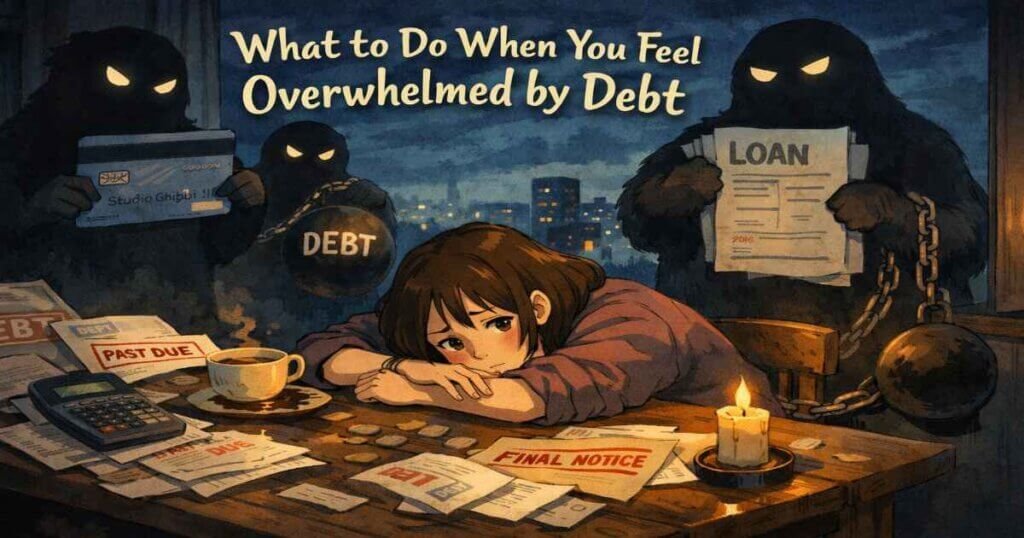
What To Do When You Feel Overwhelmed by Debt
If you feel overwhelmed by debt, you’re not broken — you’re under pressure, and that pressure can be managed step by step.
If you’re reading this right now, there’s a good chance you’re feeling that crushing weight in your chest when you think about your debt – the kind of anxiety that wakes you up at 3 AM, the avoidance that makes you delete bank emails without reading them, or the shame that keeps you from talking to anyone about what you’re going through. According to the American Psychological Association’s 2024 Stress in America survey, 77% of Americans report feeling stressed about money, with debt being the single most commonly cited financial stressor. More telling, a 2023 study by the National Foundation for Credit Counseling found that 68% of people with debt report feeling “overwhelmed” by it – experiencing not just financial pressure but genuine psychological distress that affects their sleep, relationships, work performance, and overall quality of life.
Here’s what you need to understand right now: feeling overwhelmed by debt is not a character flaw, it’s not evidence that you’re financially incompetent, and you’re not alone in experiencing these feelings. According to mental health researchers studying financial stress, debt overwhelm is a predictable psychological response to a situation where you face multiple simultaneous stressors (various debts requiring different payments), perceived lack of control (interest accruing regardless of your efforts), and complex decision-making under pressure (which debt to pay first, whether to borrow more to pay existing debt, etc.).
But here’s the problem most people face: when you’re overwhelmed by debt, your brain goes into a state that psychologists call “learned helplessness” – you feel like nothing you do will matter, so you avoid dealing with it entirely. This avoidance makes the debt grow through interest and fees, which increases the overwhelm, which increases the avoidance. It’s a vicious cycle that keeps people trapped for years, not because they lack the ability to address their debt, but because the emotional weight of it prevents them from taking the first steps.
This guide is different from typical debt advice. I’m not going to start by telling you to make a budget or cut your expenses or call your creditors. Those things matter, but they don’t matter yet. First, we need to address the psychological overwhelm that’s paralyzing you. I’m going to help you understand why debt feels so overwhelming (the psychological mechanisms at play), give you immediate strategies to reduce the panic and anxiety you’re feeling right now, show you how to break the avoidance cycle that’s keeping you stuck, teach you how to create a simple “control center” for your debt so it feels manageable, help you distinguish between what you can control and what you can’t, and provide a realistic action plan that addresses both the emotional and practical sides of debt.
Whether you owe $3,000 or $50,000, whether you’re current on payments or months behind, whether this is your first time feeling overwhelmed or you’ve been struggling for years, this guide will help you move from paralysis to action.
Plain-English Summary
Being overwhelmed by debt is a psychological response to financial stress — not a personal failure.
Feeling overwhelmed by debt means experiencing psychological distress – anxiety, avoidance, shame, hopelessness – in response to your debt situation. It’s more than just worry about money; it’s a state where the emotional weight of debt makes it difficult to think clearly, make decisions, or take action. This overwhelm is often accompanied by physical symptoms (difficulty sleeping, stomach problems, headaches), behavioral symptoms (avoiding bills and statements, isolating from friends and family, difficulty concentrating at work), and cognitive symptoms (constant worry, racing thoughts, difficulty making decisions).
The overwhelm happens because debt creates a perfect storm of psychological stressors: it feels unsolvable (especially when interest keeps adding to the balance), it triggers shame (our culture treats debt as personal failure), it requires complex decisions under pressure (which debt to prioritize, whether to borrow more, how to find extra money), and it threatens your basic security (fear of losing housing, vehicles, or essential services).
Breaking free from debt overwhelm requires a two-track approach: managing the emotional/psychological distress so you can think clearly and function, and taking small, concrete actions that give you a sense of control and progress. You can’t skip the emotional work and jump straight to practical solutions – if you do, the overwhelm will keep sabotaging your efforts.
In this guide, I’m going to address both tracks: the psychological tools to reduce anxiety and break avoidance patterns, and the practical first steps to start addressing your debt without making the overwhelm worse.
Feeling overwhelmed doesn’t mean you’re weak or incapable. It means you’re human, facing a genuinely difficult situation. Let me help you find your way through it.
Table of Contents
1. Why Debt Feels So Overwhelming: The Psychology
Let me start by explaining why debt creates such intense psychological distress – understanding this helps you realize your feelings are normal responses to a genuinely difficult situation.
Multiple Simultaneous Stressors
Unlike a single problem with a single solution, debt typically involves multiple accounts, each with its own balance, interest rate, minimum payment, and due date. Your brain has to track and manage all of this simultaneously.
Example: You might have a credit card ($4,200 at 22%), a medical bill ($1,800 in collections), a personal loan ($6,500 at 14%), and a car payment ($8,200 at 7%). That’s four separate stressors, each requiring attention and decisions.
Research on cognitive load shows that humans struggle when managing more than 3-4 complex variables simultaneously. Debt often exceeds this threshold, creating genuine cognitive overwhelm.
The “Unsolvable Problem” Perception
Debt feels unsolvable because interest makes the problem grow even when you’re actively working on it. You pay $200 toward a credit card and the balance only goes down $125 because $75 went to interest. This creates a sense of futility.
The psychological term is “learned helplessness” – when you repeatedly take action and see minimal or no positive results, you eventually stop trying because you’ve learned that effort doesn’t help.
This is why some people make minimum payments for months or years and still owe almost as much as they started with – leading them to give up entirely.
Compound Shame Effect
American culture treats debt as a moral failing rather than a financial circumstance. You’re bombarded with messages that debt means you’re irresponsible, lazy, or bad with money. This creates shame.
Shame is one of the most psychologically toxic emotions because it makes you want to hide. When you’re ashamed of your debt, you avoid looking at statements, you don’t talk to anyone about it, and you isolate yourself – all of which make the situation worse.
Research by Dr. Brené Brown shows that shame thrives in secrecy and silence. The more you hide your debt, the more shameful it feels, and the more overwhelmed you become.
Decision Fatigue Under Pressure
Every debt decision requires mental energy: Which debt should I pay first? Should I pay minimums on everything or focus on one? Should I borrow from my 401(k) to pay off credit cards? Should I consolidate? Should I settle? Should I file bankruptcy?
These aren’t easy decisions, and you’re making them while stressed, anxious, and probably sleep-deprived. Decision fatigue is real – the more decisions you face, the worse your decision-making becomes.
Loss of Control
Debt creates a sense that external forces control your life. Interest accrues whether you want it to or not. Collection calls come when they want. Creditors make demands on their timeline, not yours.
Psychological research consistently shows that perceived lack of control is one of the strongest predictors of anxiety and depression. Debt strips away your sense of control, leaving you feeling powerless.
The Compound Effect
All of these factors work together, creating overwhelm that’s greater than the sum of its parts:
Multiple stressors + learned helplessness + shame + decision fatigue + loss of control = overwhelming psychological burden that can paralyze even highly capable people.
Understanding this helps you realize: you’re not weak for feeling overwhelmed. You’re experiencing a predictable psychological response to a genuinely difficult situation.
2. Physical and Mental Signs You’re Overwhelmed
Debt overwhelm isn’t just “feeling stressed.” It creates real physical, mental, and behavioral symptoms. Let me help you identify what overwhelm looks like so you know when you need to address it.
Physical Symptoms
Sleep disruption: Difficulty falling asleep, waking up at 3-4 AM with anxiety about debt, or sleeping too much (depression-related avoidance).
Digestive issues: Stomach problems, nausea, loss of appetite or stress eating.
Headaches and muscle tension: Especially in shoulders, neck, and jaw from chronic stress.
Fatigue: Feeling exhausted even after adequate sleep, because chronic stress depletes your energy.
Heart palpitations: Racing heart when thinking about debt or seeing bills.
If you’re experiencing multiple physical symptoms, your debt stress has reached a level that requires attention – not just for financial reasons, but for your health.
Mental and Emotional Symptoms
Constant worry: Debt thoughts intrude into your daily life. You’re thinking about it during work, during conversations, while trying to relax.
Avoidance: You delete emails from creditors without reading them, let bills stack up unopened, ignore collection calls.
Shame and embarrassment: You feel like you’ve failed, like you’re the only one struggling, like you can’t tell anyone.
Hopelessness: You believe the situation will never get better, that you’ll be in debt forever.
Anxiety attacks: Panic when bills arrive, when thinking about money, or when facing financial decisions.
Depression: Loss of interest in activities, social withdrawal, feeling numb or disconnected.
Irritability: Snapping at family members, feeling on edge, short-tempered.
Behavioral Symptoms
Procrastination: Putting off dealing with debt-related tasks, even when you know delay makes things worse.
Isolation: Withdrawing from friends and family because you’re ashamed or because you can’t afford to socialize.
Compulsive checking: Constantly checking your bank balance, debt balances, or credit score.
Or complete avoidance: Never checking anything financial because it’s too anxiety-provoking.
Difficulty concentrating: Can’t focus at work, forgetting things, making mistakes.
Relationship conflict: Fighting with spouse/partner about money, hiding spending or debt.
Self-Awareness Check
Which symptoms are you experiencing?
DEBT OVERWHELM SYMPTOM CHECK
Physical:
□ Sleep problems
□ Digestive issues
□ Headaches/tension
□ Fatigue
□ Heart palpitations
Mental/Emotional:
□ Constant worry
□ Avoidance
□ Shame
□ Hopelessness
□ Anxiety attacks
□ Depression
□ Irritability
Behavioral:
□ Procrastination
□ Isolation
□ Compulsive checking
□ Complete avoidance
□ Difficulty concentrating
□ Relationship conflict
If you checked 5 or more items, you’re experiencing significant debt overwhelm that needs both emotional and practical intervention.
When Symptoms Require Professional Help
Seek professional mental health support if you’re experiencing thoughts of self-harm, suicidal ideation, severe depression lasting more than two weeks, panic attacks that interfere with daily functioning, or substance use to cope with debt stress.
Debt problems can be solved. Your mental health and safety come first.
3. The Debt-Shame-Avoidance Cycle
Understanding this cycle is crucial because it’s what keeps people trapped in debt overwhelm for months or years. Let me show you how it works and how to break it.
The Cycle Explained
Stage 1: Debt Accumulation
You accumulate debt for any number of legitimate reasons: medical emergency, job loss, supporting family, poor financial education, living expenses exceeding income, or unexpected life events.
Stage 2: Shame Sets In
You internalize cultural messages that debt = failure. You feel embarrassed, ashamed, like you should have known better or done better. You judge yourself harshly.
Stage 3: Avoidance Begins
Shame makes you want to hide from the problem. You stop opening bills. You delete creditor emails. You avoid checking your balance. You don’t talk to anyone about it.
Stage 4: Debt Grows
While you’re avoiding, interest accrues, late fees accumulate, and collection activity begins. The debt grows larger.
Stage 5: Increased Shame
Now there’s more debt, which increases the shame. “How did I let it get this bad?” This intensifies avoidance.
Stage 6: Cycle Repeats and Intensifies
The cycle continues: more debt leads to more shame leads to more avoidance leads to more debt. Each iteration makes the problem worse and the overwhelm more intense.
The Avoidance Paradox
Here’s the cruel irony: avoidance is intended to reduce anxiety (you don’t look at the bills, so you don’t feel immediate distress), but it actually increases anxiety over time.
Not knowing is worse than knowing. The vague fear of “I owe some unknown amount” creates more anxiety than “I owe exactly $18,450 across 4 accounts.”
Breaking the Cycle: The Critical Intervention Points
You can break this cycle at multiple points:
Break the shame: Recognize that debt is a financial circumstance, not a moral failing. Millions of people carry debt. It doesn’t define your worth.
Break the avoidance: Force yourself to look at the actual numbers. Knowledge reduces anxiety more than ignorance does.
Break the isolation: Tell one person you trust. Shame thrives in secrecy; it weakens when exposed to empathy.
Break the helplessness: Take one small action. Even a tiny action (opening one statement, calling one creditor) proves you have some control.
Real Example: Maria’s Cycle
Maria’s debt: $12,000 across 3 credit cards
The cycle:
- She felt ashamed about the debt (credit cards from a period of unemployment)
- She avoided opening statements for 8 months
- Late fees and interest added $1,800 to her balance
- She felt even more ashamed (“How did I let it get to $13,800?”)
- She avoided for 4 more months
- Collection calls began, adding more stress
The breaking point: Maria finally told her sister about the debt. Her sister didn’t judge her – she said “Lots of people go through this. Let’s figure it out together.” This broke Maria’s isolation and shame.
The action: With her sister’s support, Maria opened all her statements, wrote down exactly what she owed, and called her credit card companies to discuss options.
The result: She got on payment plans, stopped the late fees, and started making progress. The anxiety decreased once she stopped avoiding.
4. Immediate Strategies to Calm the Panic
When you’re in acute anxiety about your debt – maybe you just got a collection letter, or you can’t sleep because you’re worrying – you need immediate tools to calm down before you can take productive action.
Strategy 1: The 5-4-3-2-1 Grounding Technique
When anxiety spikes, this technique brings you back to the present moment:
Name 5 things you can see (desk, chair, window, pen, phone) Name 4 things you can touch (keyboard, fabric of your shirt, table surface, your hair) Name 3 things you can hear (traffic outside, humming of computer, your breathing) Name 2 things you can smell (coffee, soap, fresh air) Name 1 thing you can taste (mint from toothpaste, coffee residue)
This interrupts the anxiety spiral by forcing your brain to focus on sensory input instead of worry.
Strategy 2: Box Breathing
A simple breathing technique used by Navy SEALs to manage stress:
Breathe in for 4 counts Hold for 4 counts Breathe out for 4 counts Hold for 4 counts Repeat 4 times
This activates your parasympathetic nervous system (the “calm down” system) and interrupts the fight-or-flight response.
Strategy 3: The Reality Check Statement
When your brain is catastrophizing (“I’m going to lose everything, I’ll be homeless, my life is ruined”), interrupt with reality:
Say out loud: “Right now, in this moment, I am safe. I have [housing/food/clothing]. The worst-case scenario is not happening right now. I will handle this one step at a time.”
This grounds you in present reality rather than feared future outcomes.
Strategy 4: The Worry Window
If you’re obsessively worrying about debt all day, set a “worry window” – a specific 15-30 minute period where you allow yourself to fully engage with debt worries.
Example: “I will think about my debt from 7:00-7:30 PM. Outside that window, when debt thoughts intrude, I’ll note them and save them for worry window.”
This contains the anxiety rather than letting it bleed into every moment of your day.
Strategy 5: Physical Movement
Anxiety is physical – your body is in fight-or-flight mode. Physical movement helps discharge that energy:
- 10 minutes of walking
- Dancing to one song
- 20 jumping jacks
- Stretching routine
- Cleaning one room
Movement interrupts the anxiety loop and often provides mental clarity.
Emergency Calm-Down Script
When panic hits, use this script:
“I am feeling overwhelmed right now, and that’s okay.
This feeling will pass.
I am safe in this moment.
I have faced difficult situations before and survived.
I will face this one step at a time.
I don’t need to solve everything right now.
Right now, I just need to breathe and calm down.
[Take 5 deep breaths]
When I’m calm, I will take one small action.
For now, breathing is enough.”
5. Breaking the Avoidance Pattern
Avoidance is the biggest psychological barrier to addressing debt. Here’s how to break it.
Understanding Why You Avoid
Avoidance serves a purpose: it provides short-term relief from anxiety. Not looking at the bill means not feeling the immediate distress of seeing the balance.
The problem: this short-term relief creates long-term harm. Interest accrues, fees pile up, and the vague fear of “unknown debt” creates more anxiety than actually knowing would.
The 5-Minute Exposure Method
You can’t go from complete avoidance to full engagement instantly. Start with tiny exposures:
Day 1: Spend 5 minutes gathering your unopened bills and statements into one place. Don’t open them yet. Just gather them.
Day 2: Open one statement. Don’t read the whole thing. Just open it and see the first page. Close it. Done.
Day 3: Read the account summary of that one statement. Note the balance, minimum payment, and due date. Write it down. Done.
Day 4: Do the same with a second statement.
Each small exposure proves to your brain: “I can handle looking at this. It creates anxiety, but I survive it.”
The Accountability Partner Method
Ask someone you trust to sit with you while you open bills or check balances. Their presence provides:
- Emotional support
- Accountability (harder to avoid when someone’s there)
- Perspective (“Okay, you owe $8,200. That’s a lot, but it’s not a million dollars. We can work with this.”)
The Worst-Case Scenario Exercise
Often avoidance is driven by vague catastrophic fears. Make them concrete:
What am I most afraid will happen?
“I’ll find out I owe so much money I’ll have to declare bankruptcy and lose everything.”
Is that actually true? What do I actually owe?
(After checking) “I owe $15,300 total. That’s scary but not bankruptcy-level.”
What’s the realistic worst case?
“Realistic worst case: I can’t make all the minimums, some accounts go to collections, my credit score drops, but I can set up payment plans and rebuild.”
Can I survive that?
“Yes. It would be hard, but I’d survive.”
Making fears concrete almost always reveals they’re not as catastrophic as the vague dread suggests.
The “Just One Thing” Rule
When avoidance feels overwhelming, commit to just one tiny action:
- Open just one envelope
- Check the balance on just one account
- Read one article about debt (you’re doing that now – good!)
- Call one creditor
- List one debt on paper
One action breaks the pattern. Often, once you do one thing, momentum carries you to a second and third.
Reward Small Acts of Courage
Every time you do something you’ve been avoiding (open a bill, check a balance, make a call), acknowledge it:
“I did something hard today. I faced something I’ve been avoiding. That took courage.”
Give yourself credit. Facing debt when you’re overwhelmed requires genuine bravery.
6. Creating Your Debt “Control Center”
One reason debt feels overwhelming is that information is scattered: bills in different drawers, accounts with different servicers, payment due dates you can’t remember. Creating a centralized “control center” dramatically reduces overwhelm.
What Is a Debt Control Center?
A single place (physical or digital) where all your debt information lives. When you need to know anything about your debt, you go to this one place.
Option 1: Physical Control Center
Get:
- A folder or binder
- Lined paper or a simple notebook
- One envelope for important documents
Include:
- List of all debts (creditor, balance, rate, minimum, due date)
- Recent statement from each account
- Payment plan agreements
- Creditor contact information
Option 2: Digital Control Center
Create:
- A spreadsheet (Google Sheets or Excel)
- A folder in your email for debt-related messages
- A note in your phone with account logins
The Debt Control Center Template
MY DEBT CONTROL CENTER
Created: [Date]
Last Updated: [Date]
DEBT #1:
Creditor: _______________
Account #: _______________
Balance: $__________
Interest Rate: ______%
Minimum Payment: $__________
Due Date: _____ (each month)
Status: Current / Late / Collections
Contact: _______________
Notes: _______________
DEBT #2:
[Same format]
TOTALS:
Total Debt: $__________
Total Monthly Minimums: $__________
Total Past Due: $__________
IMPORTANT DATES:
Next payment due: _____
Payment plan review: _____
Creditor call scheduled: _____
ACTION ITEMS:
□ _____________________
□ _____________________
□ _____________________
Why This Reduces Overwhelm
Concrete vs. abstract: “I owe so much money” (abstract, terrifying) becomes “I owe $12,450 across 4 accounts” (concrete, manageable).
Single source of truth: You’re not trying to remember numbers or hunting for statements. Everything is in one place.
Sense of control: Creating this document is an act of control. You’re organizing chaos.
Decision support: When you need to make a debt decision, you have all the information in front of you.
The First-Time Creation Process
Set aside 30-60 minutes when you won’t be interrupted.
Gather all debt-related materials: statements, bills, collection letters, emails.
Create your template (physical or digital).
Fill in what you know from memory first.
Then add information from statements: balances, rates, minimums, due dates.
Don’t worry about perfection: If you don’t know something, leave it blank and fill it in later.
Update it: Set a recurring reminder to update this monthly (first of each month is easy to remember).
This single task – creating your debt control center – often provides significant psychological relief because it converts overwhelming chaos into organized information.
7. The Brain Dump: Getting Debt Anxiety Out of Your Head
When debt thoughts are swirling in your mind constantly, a brain dump helps externalize them and reduce their power.
What Is a Brain Dump?
Writing down every worry, fear, thought, and question about your debt in one unfiltered stream. You’re transferring anxiety from your brain to paper, where it becomes less overwhelming.
How to Do a Debt Brain Dump
Get paper and pen (or computer if you prefer).
Set a timer for 10 minutes.
Write continuously without stopping. Don’t edit, don’t organize, don’t judge. Just write every thought that comes up about your debt.
Examples of what might come out:
- “I owe so much money and I don’t know how to pay it”
- “I’m scared my car will be repossessed”
- “I can’t sleep because I’m thinking about credit card bills”
- “I feel like a failure for getting into this situation”
- “I don’t know if I should pay the medical bill or the credit card first”
- “What if I lose my job? I can’t afford any of this even with my job”
- “I’m avoiding my spouse because I don’t want to talk about money”
Don’t stop writing until the timer goes off.
After the Brain Dump
Step 1: Read what you wrote.
Step 2: Categorize items with a highlighter or different colors:
- Orange: Practical/actionable concerns (which debt to pay, what to do about collections)
- Blue: Emotional concerns (shame, fear, anxiety)
- Green: Questions you need answers to (Can I negotiate? Should I consolidate?)
- Pink: Things you can’t change (past decisions, already-accrued interest)
Step 3: Notice patterns. Are most concerns emotional or practical? Do you have specific questions that need answering?
Step 4: Pick ONE orange item (practical concern) to address this week.
Why This Works
Externalizes worries: When worries are in your head, they loop endlessly. On paper, they’re finite and visible.
Reduces mental load: Your brain can stop trying to “remember” all your worries because they’re captured.
Reveals what’s really bothering you: Sometimes the surface worry (“I can’t pay my bills”) masks a deeper fear (“I’m afraid I’m a failure”).
Creates starting points: The orange items (practical concerns) become your action list.
Example: Tom’s Brain Dump
Tom did a brain dump and discovered most of his anxiety was about one specific concern: “What if I can’t pay rent because of debt payments?”
Once he identified this as the core fear, he could address it specifically: calculate exactly whether rent was at risk (it wasn’t – he had enough for rent), create a priority system (rent first, then utilities, then debt), and his overwhelming general anxiety reduced to a specific manageable concern.
8. Separating What You Can Control from What You Can’t
Overwhelm often comes from feeling like everything is out of control. Separating controllable from uncontrollable helps you focus energy productively.
What You CANNOT Control (Let It Go)
Interest already accrued: It’s done. You can’t go back and stop it from accumulating. Regretting it doesn’t change it.
Past financial decisions: Whether you “should have” known better, done better, saved more, borrowed less – it’s in the past.
Other people’s judgments: What creditors think of you, what family might say if they knew, what society thinks about debt – you can’t control their judgments.
The economy, interest rates, inflation: Macro-economic factors are beyond your control.
How long it takes to pay off debt: You can’t make it disappear tomorrow. Large debt takes time.
What You CAN Control (Focus Here)
How much you pay toward debt monthly: Within your budget constraints, you decide payment amounts.
Which debt you prioritize: Snowball, avalanche, highest balance, whatever strategy you choose.
Whether you negotiate with creditors: You can call and ask for lower rates, payment plans, or settlements.
Your spending from today forward: You can’t change past spending, but you control future spending.
Whether you seek help: Credit counseling, financial advice, therapy – you can choose to get support.
How you talk to yourself about debt: Self-compassion vs. self-criticism is your choice.
Whether you keep avoiding or start acting: Even small actions are within your control.
The Control Circle Exercise
Draw two circles:
Outer circle: Things outside your control (past decisions, creditor policies, interest already accrued, economic conditions)
Inner circle: Things within your control (today’s actions, who you call, how much you pay, whether you seek help)
Rule: Spend your mental energy only on the inner circle. When you catch yourself worrying about outer circle items, redirect: “That’s outside my control. What can I control right now?”
The Serenity Prayer for Debt
Adapted from the original:
“Grant me the serenity to accept the debts I cannot change [past balances, accrued interest], the courage to change the things I can [my actions today, payment strategies, seeking help], and the wisdom to know the difference.”
Practical Application
When you think: “I’m so stupid for getting into this debt”
Redirect to: “I can’t change past decisions, but I can control my actions today. What’s one thing I can do right now?”
When you think: “This will take forever to pay off”
Redirect to: “I can’t make it disappear instantly, but I can make one payment this month, which is progress.”
This shift from what you can’t control to what you can reduces helplessness and increases agency.
9. The 5-Minute Action Rule
When you’re overwhelmed, big actions feel impossible. The 5-Minute Action Rule makes progress accessible.
The Rule
Commit to working on your debt situation for just 5 minutes. After 5 minutes, you can stop guilt-free. Often, you’ll continue beyond 5 minutes once you’ve started, but even if you don’t, 5 minutes of action is infinitely better than zero.
5-Minute Actions for Debt
Monday: List one debt with its balance, rate, and minimum payment.
Tuesday: Open one bill you’ve been avoiding.
Wednesday: Calculate total minimum payments across all debts.
Thursday: Research one debt repayment strategy (snowball, avalanche, consolidation).
Friday: Call one creditor and ask about payment plan options (even just getting through to customer service counts).
Saturday: Set up one automatic payment for one debt.
Sunday: Read one section of a debt management guide (like this one).
Why This Works
Lowers the barrier to action: “Just 5 minutes” feels doable when “fix my entire debt situation” feels impossible.
Builds momentum: Small actions create psychological momentum. Success breeds motivation for more action.
Combats all-or-nothing thinking: You don’t need a perfect comprehensive plan. Imperfect action beats perfect inaction.
Proves you have control: Each 5-minute action demonstrates agency, reducing learned helplessness.
The Compound Effect
Five minutes per day = 35 minutes per week = 2.5 hours per month of debt-focused action.
In one month of 5-minute daily actions, you could: list all your debts, calculate your debt-to-income ratio, research repayment strategies, call 3-4 creditors about options, set up automatic payments, and create a basic payment plan.
That’s substantial progress from “just 5 minutes per day.”
Permission to Stop
Here’s what’s critical: after 5 minutes, you genuinely have permission to stop. This isn’t a trick to get you to work longer.
Sometimes you’ll work for 20 minutes and make real progress. Sometimes you’ll do exactly 5 minutes and stop. Both are valid. Both are better than avoidance.
10. Dealing with Collection Calls and Letters
Collection activity creates acute overwhelm. Here’s how to handle it without letting it paralyze you.
Understanding Your Rights (FDCPA)
The Fair Debt Collection Practices Act protects you from abusive collection practices.
Collectors CANNOT:
- Call before 8 AM or after 9 PM
- Call you at work if you tell them your employer doesn’t allow it
- Harass, threaten, or use profane language
- Falsely claim you’ll be arrested
- Contact third parties about your debt (except to locate you)
- Continue calling after you request written communication only
If they violate these rules: Document it, file a complaint with the Consumer Financial Protection Bureau (CFPB), and know that violations can actually strengthen your negotiating position.
When a Collector Calls
Breathe first. Collection calls are designed to create urgency and pressure. Don’t let them rush you.
Ask for verification: “I need you to send me written verification of this debt including the original creditor, amount, and your authority to collect.”
Don’t make promises you can’t keep: Don’t agree to payment amounts you can’t afford just to end the call.
Request written communication: “Please send all future communication in writing to [address]. Do not call me.”
Take notes: Date, time, collector’s name, company, what was said.
Handling Collection Letters
Don’t ignore them. Opening the letter and reading it creates less anxiety than the unknown.
Check the date: You have 30 days from the date of the first letter to dispute the debt or request validation.
Validate the debt: Within 30 days, send a debt validation letter requesting proof:
[Your Name]
[Address]
[Date]
[Collection Agency]
[Address]
Re: Account #[number from letter]
Dear Sir/Madam:
I received your letter dated [date] regarding the above account. I am requesting validation of this debt as permitted under the Fair Debt Collection Practices Act.
Please provide:
1. Proof that I owe this debt
2. Original creditor information
3. Amount owed with itemization
4. Your authority to collect this debt
Until you provide this verification, cease all collection activity as required by law.
Sincerely,
[Your name]
Send via certified mail with return receipt.
The 24-Hour Rule
When you receive a collection call or letter that creates panic:
Rule: Don’t make any decisions or commitments for 24 hours.
Tell the collector: “I need to review my finances. I’ll call you back within 48 hours.”
This prevents panic-driven decisions (like agreeing to payments you can’t afford or giving them bank account access).
What Collection Activity Means
It’s not the end: Collection letters feel catastrophic, but they’re a negotiating stage, not the final stage.
You have options: Payment plans, settlements, validation challenges, credit counseling.
They want to collect: Collectors would rather get some payment than no payment. This gives you negotiating leverage.
11. When You Can’t Make Minimum Payments
If you’re overwhelmed by debt and can’t afford the minimum payments on all your accounts, you’re facing a debt crisis that requires immediate triage. This is one of the most stressful positions to be in – feeling overwhelmed by debt is difficult enough, but when you literally don’t have enough money to cover minimum payments, the overwhelm can feel paralyzing.
The Reality: You’re Not Alone
According to Federal Reserve data from 2024, approximately 12% of credit card holders have missed at least one minimum payment in the past year, and about 3% are unable to make minimum payments on multiple accounts simultaneously. When you’re overwhelmed by debt to the point where minimum payments exceed your capacity, you’re experiencing what financial counselors call “payment insolvency” – your required debt payments are greater than your available income after essential expenses.
Understanding the Consequences
When you can’t make minimum payments, several things happen:
Immediate consequences (30 days):
Late fees added to your balance ($25-40 per missed payment)
Interest continues accruing
Your anxiety about being overwhelmed by debt intensifies
Phone calls from creditors begin
Short-term consequences (60-90 days):
Additional late fees
Penalty interest rates may apply (up to 29.99%)
Credit score drops (60-110 points per 30-day late payment)
Collection calls intensify
Accounts may be closed
Long-term consequences (120+ days):
Accounts charged off (sold to collection agencies)
Collections activity begins
Legal action possible (lawsuits, wage garnishment)
Credit score drops to 450-550 range
Housing and employment affected
Understanding these consequences helps you prioritize – but it doesn’t solve the immediate problem of not having enough money.
The Debt Payment Priority Matrix
When you’re overwhelmed by debt and can’t pay everything, you must prioritize. Not all debts are equal in terms of immediate consequences.
Debt Payment Priority Matrix
| Priority Level | Debt Type | Why It’s Priority | Consequence of Non-Payment |
| CRITICAL (Pay First) | Mortgage/Rent | Losing housing is catastrophic | Eviction, homelessness |
| CRITICAL | Utilities (electric, water, heat) | Essential for basic living | Service disconnection |
| CRITICAL | Car payment (if needed for work) | Losing transportation = losing income | Repossession, job loss |
| HIGH | Child support/alimony | Legal obligation, severe penalties | Wage garnishment, jail time |
| HIGH | IRS tax debt | Federal power to garnish/levy | Wage garnishment, bank levy |
| MEDIUM | Student loans | Can’t discharge in bankruptcy | Wage garnishment (eventually) |
| MEDIUM | Medical bills | No immediate consequence | Collections, credit damage |
| LOW | Credit cards | No collateral at risk | Collections, credit damage |
| LOW | Personal loans (unsecured) | No immediate consequence | Collections, lawsuit (eventually) |
When you’re overwhelmed by debt and can’t pay everything, pay in order from Critical to Low.
Immediate Actions When You Can’t Make Minimums
Action #1: Calculate the Gap (5 minutes)
Write down:
Total minimum payments required: $_______
Money available for debt after essentials: $_______
The gap: $_______
Example:
Required: $850
Available: $520
Gap: $330
Seeing the number makes it concrete. You’re short $330, not “I can’t pay my debts” (vague terror).
Action #2: Contact Creditors Before You Miss Payments (if possible)
If you see that you can’t make payments before they’re due, contact creditors proactively.
Script for calling creditors:
“Hello, my name is [name] and I’m calling about account [last 4 digits]. I’m experiencing financial hardship due to [job loss/medical emergency/income reduction]. I want to pay this debt, but I cannot afford the current minimum payment of $[amount]. Do you have hardship programs that could reduce my payment temporarily or freeze my interest?”
What they might offer:
Hardship program (reduced payments for 6-12 months)
Interest freeze
Fee waivers
Skip-a-payment option
Settlement (pay less than owed)
Not all creditors offer these, but many do. Calling before you miss payments shows good faith.
Action #3: Decide Which Debts to Pay
Using the priority matrix above, allocate your available money to critical and high-priority debts first.
Example allocation with $520 available:
Critical debts (must pay):
Rent: $300
Utilities: $80
Car payment: $140
Subtotal: $520 (all available money used)
What didn’t get paid:
Credit Card 1: $125 minimum (LOW priority)
Credit Card 2: $85 minimum (LOW priority)
Medical bill: $50 minimum (MEDIUM priority)
Personal loan: $90 minimum (LOW priority)
In this scenario, you keep your housing, utilities, and transportation (critical for survival and income), but credit cards and other unsecured debts don’t get paid.
This is a crisis decision, not a permanent plan, but it keeps you housed and employed so you can work on solutions.
Action #4: Document Everything
When you’re overwhelmed by debt and can’t make payments:
Create a hardship file:
Copies of termination letter (if job loss)
Medical bills (if medical emergency)
Paystubs showing reduced income
Budget showing income vs. expenses
List of creditors you contacted and their responses
This documentation helps if:
Creditors request proof of hardship
You need to negotiate settlements
You consider bankruptcy
You dispute collection activity
Hardship Programs: What to Request
When calling creditors, ask specifically about:
Reduced payment plans:
“Can my minimum payment be reduced from $150 to $50 for the next 6 months?”
Interest freeze:
“Can you freeze interest on my account while I recover financially?”
Fee waivers:
“Can you waive the late fees if I commit to a payment plan?”
Forbearance:
“Can I skip 1-2 payments and add them to the end of my loan?”
Settlement:
“I have $500 available. Would you accept this as settlement in full?”
Many creditors have formal hardship programs but won’t offer them unless you ask.
What If You’ve Already Missed Payments?
If you’re already behind and overwhelmed by debt with missed payments piling up:
Step 1: Stop the bleeding. Focus on critical priorities (housing, utilities, transportation) immediately.
Step 2: Let low-priority debts go to collections temporarily. This sounds scary, but credit card collections don’t immediately harm your housing or income. You can deal with collections later through negotiation or settlement.
Step 3: Stabilize your income/expenses. Once critical needs are covered, work on either increasing income or reducing expenses to create capacity for debt payments.
Step 4: Address collections strategically. Once you have capacity, negotiate with collection agencies for settlements (typically 30-60% of balance).
Budget Reallocation Template
When you’re overwhelmed by debt and can’t make minimums, create a crisis budget:
CRISIS BUDGET – WHEN YOU CAN’T PAY ALL DEBTS
MONTHLY INCOME:
Source 1: $______
Source 2: $______
Total Income: $______
CRITICAL EXPENSES (MUST PAY):
Housing (rent/mortgage): $______
Utilities (electric, water, gas): $______
Food (groceries only, no dining out): $______
Transportation (car payment, insurance, gas): $______
Healthcare (prescriptions, critical care): $______
Subtotal Critical: $______
HIGH PRIORITY DEBTS:
Child support/alimony: $______
IRS tax debt: $______
Subtotal High Priority: $______
TOTAL CRITICAL + HIGH PRIORITY: $______
REMAINING AVAILABLE: [Income – Critical – High Priority] = $______
MEDIUM/LOW PRIORITY DEBTS (PAY WITH REMAINING):
Student loans: $______ [If money available]
Medical bills: $______ [If money available]
Credit cards: $______ [If money available]
Personal loans: $______ [If money available]
DEBTS NOT PAID THIS MONTH:
_____________ (will go 30 days late)
_____________ (will go 30 days late)
_____________ (will go 30 days late)
PLAN FOR UNPAID DEBTS:
Call creditor: ___/___/___ (date)
Request hardship program: Yes/No
Expected outcome: _________________
Increasing Income Options (Short-Term)
When you’re overwhelmed by debt and need more income immediately:
This week:
Sell items (Facebook Marketplace, Craigslist, OfferUp)
Gig economy (DoorDash, Uber, TaskRabbit, Instacart)
Ask for overtime at current job
Return items for refunds
This month:
Temporary part-time work (retail, food service hiring immediately)
Freelance work (Upwork, Fiverr, based on your skills)
Babysitting, dog walking, house sitting
These aren’t permanent solutions, but they can bridge the gap while you stabilize.
Reducing Expenses (Emergency Mode)
When overwhelmed by debt and income is insufficient, cut everything non-essential:
Immediate cuts:
Cancel all subscriptions (Netflix, Spotify, gym, etc.) – save $50-150/month
Stop dining out entirely – save $100-300/month
Reduce phone plan to cheapest option – save $30-60/month
Cancel cable/internet (use phone data temporarily) – save $80-150/month
Stop discretionary shopping completely – save $100-500/month
Total potential savings: $360-1,160/month
These cuts are temporary while you’re in crisis mode.
When to Consider Bankruptcy
If you’re overwhelmed by debt and can’t make minimum payments even after:
Cutting all non-essential expenses
Attempting to increase income
Contacting all creditors for hardship programs
Prioritizing critical debts
Consider consulting a bankruptcy attorney if:
Your total unsecured debt exceeds your annual income
Minimum payments exceed 40% of your take-home pay
You’re facing lawsuits or wage garnishment
You see no realistic path to paying off debt in 5 years
Bankruptcy isn’t failure – it’s a legal tool for financial crisis that’s exactly this severe.
You’re Not Alone in This
If you’re overwhelmed by debt and can’t make minimum payments, approximately 8-10 million Americans are in the same situation right now. Financial crisis is isolating, but it’s not rare. The shame you feel is normal but not deserved – debt crisis happens to good people facing difficult circumstances.
Your immediate job is survival: keep housing, utilities, transportation. Everything else is secondary.
11A. Understanding Credit Card Debt: Why It Keeps You Overwhelmed by Debt
Credit card debt is one of the most common reasons people feel overwhelmed by debt. Unlike other forms of debt, credit card balances carry high interest rates – often 18% to 29% – which means even when you’re making payments, a significant portion goes to interest rather than reducing what you actually owe.
When you’re overwhelmed by debt from credit cards specifically, it’s because credit card debt compounds faster than almost any other type of debt. If you owe money on multiple credit cards, you’re essentially fighting separate battles simultaneously, each with its own minimum payment, interest rate, and due date.
The psychology of credit card debt makes feeling overwhelmed particularly intense. Credit cards are revolving debt – meaning unlike a car loan or mortgage with a fixed payoff date, credit card debt can feel endless. You make a payment, the balance barely budges, and the cycle continues indefinitely unless you take deliberate action to pay down debt systematically.
Here’s what makes credit card debt especially challenging when you’re overwhelmed by debt:
The interest compounds daily. Every day you carry a balance, interest accrues. On a $5,000 balance at 22% APR, you’re paying roughly $3 per day in interest – that’s $90 per month before you even touch the principal.
Minimum payments are designed to keep you in debt. Credit card companies calculate minimum payments to maximize their profit, not to help you get out of debt. A minimum payment of 2-3% means a $5,000 balance could take 15-20 years to pay off if you only make minimums.
Multiple cards create decision paralysis. When you’re overwhelmed by debt across 3, 4, or 5 credit cards, deciding which to pay first becomes another source of stress. This is where the debt strategies in Section 13 become critical – you need a clear system, not guesswork.
The FinanceSwami approach to credit card debt when you’re feeling overwhelmed is straightforward: stop the bleeding first (no new charges), then attack systematically (smallest balance or highest interest rate), and maintain momentum (celebrate each card you pay off completely).
11B. Debt Consolidation Strategies: Using a Consolidation Loan When Overwhelmed by Debt
A debt consolidation loan can be a powerful tool when you’re overwhelmed by debt, but it’s not a magic solution – it’s a strategic financial tool that works only if you address the behavior that created the debt in the first place.
A consolidation loan means taking out a new loan to pay off your debt – typically combining multiple credit card balances, personal loans, or other high-interest debts into a single loan with one monthly payment. The goal is to simplify your debt and potentially reduce your interest rate.
Here’s how a debt consolidation loan works in practice: You borrow a lump sum from a bank, credit union, or online lender. You use that amount you borrow to pay off your existing debts completely. Now instead of juggling 5 credit card payments, you have one loan payment to one trusted financial institution.
Types of consolidation options when you’re overwhelmed by debt:
Personal consolidation loan from a bank or credit union: Fixed interest rate (typically 6-18% depending on credit), fixed monthly payment, fixed term (usually 2-5 years). This is the most straightforward debt consolidation loan option.
Balance transfer credit card: Move high-interest credit card debt to a new card with 0% introductory APR (usually 12-18 months). This gives you a window to pay down debt without additional interest, but requires discipline – if you don’t pay it off before the intro period ends, you’re back to high rates.
Home equity line of credit: If you own a home, you can borrow against your home equity to consolidate debt. Interest rates are lower, but you’re putting your home at risk – if you can’t repay, you could lose your house. Use this option with extreme caution.
Debt consolidation loan through a debt relief program: These are often marketed aggressively but come with significant fees and credit damage. Approach with caution and understand all costs.
When a consolidation loan makes sense if you’re overwhelmed by debt:
You have good to fair credit (score above 640). This qualifies you for interest rates lower than what you’re currently paying on credit cards.
You’re committed to not adding new debt. A consolidation loan only works if you stop using the credit cards you just paid off. Many people consolidate, then rack up new credit card debt, ending up worse than before.
Your debt is manageable with a 3-5 year payoff plan. If your total unsecured debt exceeds your annual income, consolidation might not be enough – you may need to explore other options in Section 17.
When a consolidation loan doesn’t make sense:
Your credit score is below 600. You’ll likely get an interest rate that’s not much better than your current credit cards, making consolidation pointless.
You haven’t addressed spending habits. If you consolidate but don’t change the behavior that created debt, you’ll end up with both the consolidation loan AND new credit card debt within 12 months.
Your debt is so high that even consolidated payments are unaffordable. Consolidation doesn’t reduce what you owe – it just restructures it.
The FinanceSwami perspective on debt consolidation: It’s a useful tool for the right situation, but it’s not a substitute for a solid repayment plan and behavioral change. If you consolidate, close the credit cards you pay off (or at minimum, put them somewhere you can’t easily access them). Use consolidation as a tool to simplify and accelerate your debt payoff, not as a way to avoid dealing with the root problem.
11C. Take Control of Your Finances: Building Your Checking Account Safety System
When you’re overwhelmed by debt, one of the fastest ways to feel more in control is to create a proper checking account safety system that prevents overdrafts, missed payments, and the cascade of fees that make debt worse.
Your checking account is the operational center of your financial life – money flows in (income) and out (bills, debt payments, expenses). When you’re feeling overwhelmed by debt, checking account chaos amplifies the stress. Overdraft fees of $35 per transaction can quickly add hundreds of dollars in monthly fees, making your debt situation worse.
Here’s how to take control of your finances starting with your checking account:
Set up separate checking accounts for different purposes. Many people find success with a three-account system: (1) Income account – where paychecks deposit, (2) Bills account – for fixed expenses and debt payments, (3) Spending account – for variable expenses like groceries and gas. This separation creates clarity and prevents accidentally spending money earmarked for critical payments.
Automate transfers on payday. The day your paycheck hits, automatically transfer: (1) Fixed amount to bills account to cover that month’s obligations, (2) Smaller amount to spending account for week’s expenses. What stays in income account is surplus that can go to extra debt payments or emergency fund.
Never link overdraft protection to a credit card. Banks offer to “protect” you from overdrafts by charging purchases to a credit card or line of credit. This seems helpful but creates new debt every time you miscalculate. If you must have overdraft protection, link to a savings account instead.
Use checking account alerts religiously. Set up text or email alerts for: balance below $100, any transaction over $50, daily balance summary. These alerts catch problems before they become expensive mistakes.
The FinanceSwami approach to checking accounts when you’re overwhelmed by debt: Your checking account should be boring and predictable. Excitement in checking accounts means surprises, and surprises mean stress and fees. Automate everything possible, maintain a buffer of $200-500 if possible, and use alerts to stay aware without obsessively checking balances.
11D. Creating Your Debt Repayment Plan: How to Get Out of Debt Systematically
Getting out of debt requires more than hope and good intentions – it requires a concrete repayment plan that addresses both the math and the psychology of debt reduction.
A repayment plan is your step-by-step roadmap for how you’ll pay off your debt completely. Without a plan, you’re just making random payments and hoping for the best. With a plan, every dollar has a purpose and you can measure progress toward freedom.
Here’s how to create an effective repayment plan when you’re overwhelmed by debt:
Component 1: Complete debt inventory. List every debt: creditor name, total balance, minimum payment, interest rate, due date. This is covered in Section 13, but it’s the foundation of any repayment plan.
Component 2: Calculate total debt and timeline. Add up everything you owe. Then calculate how much you can realistically allocate to debt payments each month (income minus essential expenses). Divide total debt by monthly payment amount to get your rough timeline. This number might be shocking, but it’s better to know the truth.
Component 3: Choose your strategy – Debt Snowball or Debt Avalanche. These are the two proven approaches to pay off your debt:
Debt Snowball (pay smaller debts first): List debts from smallest to largest balance. Pay minimums on everything. Attack smallest debt with all extra money. When first debt is paid off, roll that payment to the next smallest. Repeat until debt-free. This method works psychologically – quick wins keep you motivated to stay motivated through the process.
Debt Avalanche (pay highest interest first): List debts from highest to lowest interest rate. Pay minimums on everything. Attack highest interest debt with all extra money. When first debt is paid off, roll that payment to next highest interest. This method saves the most money on interest long-term.
Which strategy to choose? If you’re severely overwhelmed by debt and need psychological wins to stay motivated, choose Snowball. If you’re disciplined and want to optimize for lowest total interest paid, choose Avalanche. Both work – the best plan is the one you’ll actually follow.
Component 4: Build in accountability and milestones. Set specific milestones: “First $1,000 paid off by [date],” “Credit Card #1 paid completely by [date].” Share your plan with someone you trust who can check in monthly. Schedule quarterly reviews to assess progress and adjust if needed.
Component 5: Address the emergency fund paradox. When you’re overwhelmed by debt, you face a dilemma: should you build an emergency fund or attack debt? The FinanceSwami recommendation: Build a starter emergency fund of $500-$1,000 first (this prevents new debt when unexpected expenses hit), then focus intensely on debt, then build full emergency fund once debt is gone.
The repayment plan template is simple but powerful. Get a single piece of paper. Write:
DEBT REPAYMENT PLAN
Strategy: [Snowball or Avalanche]
Total Debt: $______
Monthly Payment Budget: $______
Extra Payment This Month: $______
Target Debt This Month: [Which debt gets extra payment]
Payment Order:
1. [Debt name] – $______ balance – Target payoff date: ____
2. [Debt name] – $______ balance – Target payoff date: ____
3. [Continue for all debts]
Review this plan every month. Update balances. Celebrate progress. Adjust timeline as needed. The plan keeps you focused when motivation fades.
12. The Urgent vs. Important Matrix for Debt
When you’re overwhelmed by debt, everything feels urgent and important simultaneously. Collection calls feel urgent. Minimum payments feel urgent. The fear of losing your car feels urgent. This constant urgency creates decision paralysis – you’re so overwhelmed by debt that you freeze and can’t prioritize what actually needs attention first.
The Urgent vs. Important Matrix (popularized by Stephen Covey) helps you categorize tasks so you can focus on what truly matters when you’re overwhelmed by debt.
Understanding the Four Quadrants
The matrix has two axes:
Urgency: Does this need immediate attention? (Yes or No)
Importance: Will this significantly impact my financial situation? (Yes or No)
This creates four quadrants:
Quadrant 1: Urgent AND Important (Crisis/Emergency)
Quadrant 2: Important but NOT Urgent (Planning/Prevention)
Quadrant 3: Urgent but NOT Important (Distractions/Interruptions)
Quadrant 4: Not Urgent AND Not Important (Time Wasters)
The Debt-Specific Matrix
QUADRANT 1: URGENT & IMPORTANT (Do Immediately)
These are true crises when you’re overwhelmed by debt:
✓ Housing payment due in 3 days and you don’t have it
Consequence: Eviction, homelessness
Action: Contact landlord immediately, seek emergency assistance, borrow from family if possible
✓ Utility shut-off notice (24-48 hours)
Consequence: No heat, water, or electricity
Action: Call utility company, request payment arrangement, seek utility assistance programs
✓ Car repossession imminent (90+ days late, received final notice)
Consequence: Lose transportation, possibly lose job
Action: Contact lender immediately, negotiate payment plan, consider voluntary surrender if unaffordable
✓ Wage garnishment order received
Consequence: 25% of paycheck automatically taken
Action: Contact attorney, explore bankruptcy or payment arrangements
✓ Severe medical emergency requiring immediate care
Consequence: Health deterioration or death
Action: Seek care immediately, deal with medical debt later
Quadrant 1 tasks demand immediate action. Don’t delay.
QUADRANT 2: IMPORTANT BUT NOT URGENT (Plan & Prevent)
These are strategic actions that prevent future crises when you’re overwhelmed by debt:
✓ Creating a debt payoff plan
Importance: Provides roadmap out of debt
Urgency: No immediate deadline
When: This week, when you have 1-2 hours of quiet time
✓ Building a small emergency fund ($500-$1,000)
Importance: Prevents new debt from unexpected expenses
Urgency: No deadline
When: Gradually, $50-100/month
✓ Increasing income through side work or job search
Importance: More income = faster debt payoff
Urgency: No immediate need
When: Ongoing effort, dedicate 5 hours/week
✓ Reviewing and cutting monthly expenses
Importance: Frees up money for debt payoff
Urgency: No specific deadline
When: This weekend, 2-3 hour review session
✓ Negotiating lower interest rates with creditors
Importance: Saves hundreds or thousands in interest
Urgency: No deadline
When: This week, call during lunch break
✓ Learning about debt management strategies
Importance: Better decisions = faster progress
Urgency: No deadline
When: 30 minutes daily for a week
Quadrant 2 is where you make real progress. When overwhelmed by debt, most people neglect Quadrant 2 because it’s not urgent – but these activities prevent future crises.
The mistake people make: Spending all time in Quadrant 1 (crisis) and Quadrant 3 (distractions), never getting to Quadrant 2 (prevention).
QUADRANT 3: URGENT BUT NOT IMPORTANT (Minimize/Delegate)
These feel urgent when you’re overwhelmed by debt but don’t actually move you forward:
✗ Collection calls on accounts already 120+ days late
Feels urgent: Phone ringing, anxiety spike
Not important: Account already in collections, no immediate consequence
Action: Let go to voicemail, deal with on your schedule
✗ Responding to every creditor email immediately
Feels urgent: Email notification creates pressure
Not important: Most can wait 24-48 hours
Action: Set specific time to respond (e.g., Thursdays 6-7pm)
✗ Checking credit score daily
Feels urgent: Anxiety about credit damage
Not important: Daily changes don’t affect actions
Action: Check monthly, not daily
✗ Researching every debt payoff method in detail
Feels urgent: Need to find “perfect” solution
Not important: Any consistent method works
Action: Choose one method (snowball or avalanche), commit
✗ Arguing with collection agents about debt validity
Feels urgent: They’re demanding payment now
Not important: Arguing doesn’t eliminate debt
Action: Request written validation, then respond in writing
✗ Reading every debt-related article/watching every video
Feels urgent: More information feels productive
Not important: Analysis paralysis prevents action
Action: Learn basics, then take action
Quadrant 3 creates the illusion of productivity while keeping you overwhelmed by debt. These activities consume energy without progress.
QUADRANT 4: NOT URGENT & NOT IMPORTANT (Eliminate)
These activities waste time when you’re overwhelmed by debt:
✗ Obsessively calculating debt payoff dates
Not urgent or important: Excessive calculation doesn’t speed payoff
Time waste: Could be working to earn extra income instead
✗ Comparing yourself to others’ debt journeys
Not urgent or important: Others’ situations don’t affect yours
Emotional drain: Creates discouragement
✗ Worrying about credit score 5 years from now
Not urgent or important: Can’t control future score today
Anxiety source: No actionable steps
✗ Reading negative debt forums/communities
Not urgent or important: Negativity doesn’t help
Demotivating: Others’ despair increases your overwhelm
Eliminate Quadrant 4 activities entirely when overwhelmed by debt.
The Debt Overwhelm Priority Matrix
Complete Matrix Visualization:
URGENT vs. IMPORTANT MATRIX FOR DEBT OVERWHELM
How to Use This Matrix When Overwhelmed by Debt
URGENT vs. IMPORTANT MATRIX FOR DEBT OVERWHELM
| URGENT | NOT URGENT | |
| IMPORTANT | Quadrant 1 – Crisis / Emergency DO IMMEDIATELY – Housing at risk- Utilities shutoff notice- Repossession imminent- Wage garnishment notice- Medical emergency | Quadrant 2 – Planning / Prevention SCHEDULE THIS WEEK – Create a debt repayment plan- Build an emergency fund- Increase income- Cut expenses- Negotiate interest rates |
| NOT IMPORTANT | Quadrant 3 – Distractions MINIMIZE OR SCHEDULE – Old collection calls (non-legal)- Every creditor email immediately- Daily credit score checks- Endless perfection research- Arguing emotionally with agents- Information overconsumption | Quadrant 4 – Time WastersELIMINATE – Excessive calculating without action- Comparing yourself to others- Catastrophic future worrying- Reading negative debt forums- Analysis paralysis |
Step 1: List everything demanding your attention (5 minutes)
Write down every debt-related task, worry, or action item:
Payment due dates
Collection calls to return
Budgets to create
Information to research
Creditors to contact
Etc.
Step 2: Categorize each item into a quadrant (10 minutes)
Go through your list and ask:
Is this urgent (needs attention in next 48 hours)?
Is this important (will significantly impact my financial situation)?
Place each item in appropriate quadrant.
Step 3: Take action based on quadrant (ongoing)
Quadrant 1: Do today (or right now if truly urgent)
Quadrant 2: Schedule specific time this week
Quadrant 3: Minimize – batch these together, delegate, or do quickly
Quadrant 4: Delete – don’t do these at all
Example: Sarah’s Debt Overwhelm Matrix
Sarah is overwhelmed by debt with $28,000 owed across 6 accounts. Here’s her matrix:
Quadrant 1 (Urgent & Important):
Car payment due tomorrow ($280) – don’t have full amount
Action: Call lender today, negotiate 2-week extension
Quadrant 2 (Important, Not Urgent):
Create debt payoff plan
Call credit card companies about lower rates
Build $500 emergency fund
Look for part-time weekend work
Action: Schedule Saturday 10am-12pm for debt planning session
Quadrant 3 (Urgent, Not Important):
4 collection calls from old medical debt
Credit score anxiety (checking daily)
Researching bankruptcy even though not appropriate yet
Action: Let collection calls go to voicemail, check score monthly only, stop bankruptcy research for now
Quadrant 4 (Not Urgent or Important):
Reading debt horror stories online
Calculating payoff dates obsessively
Worrying about what credit score will be in 3 years
Action: Stop these activities completely
Sarah’s time allocation:
Quadrant 1: 1 hour today (urgent crisis)
Quadrant 2: 4 hours this week (strategic planning)
Quadrant 3: 30 minutes total this week (minimal attention)
Quadrant 4: 0 hours (eliminated)
The 80/20 Rule Applied to Debt
When you’re overwhelmed by debt, approximately 80% of your progress comes from 20% of activities.
The 20% that matters most:
Making consistent payments (even if minimum)
Creating and following a budget
Earning extra income
Negotiating better terms with creditors
Preventing new debt
The 80% that contributes minimally:
Perfect optimization of strategy
Excessive research and planning
Constant credit score monitoring
Comparing yourself to others
Worrying and catastrophizing
Focus on the 20%. When overwhelmed by debt, you don’t have energy for everything – focus on high-impact activities.
Daily Priority Template
When you’re overwhelmed by debt and don’t know what to do each day, use this template:
DAILY DEBT PRIORITY CHECK
Date: ___/___/___
QUADRANT 1 (Crisis – Do Today):
_________________________________________ (Est. time: ______)
_________________________________________ (Est. time: ______)
QUADRANT 2 (Important – Schedule):
_________________________________________ (Scheduled for: ______)
_________________________________________ (Scheduled for: ______)
QUADRANT 3 (Minimize – Batch):
_________________________________________ (Do in 15 min or less)
QUADRANT 4 (Eliminate – Skip):
I will NOT spend time on: _________________________________
Focus for today: [Choose 1-2 items from Q1 or Q2 as primary focus]
End of day check:
Did I handle Q1 items? Yes / No
Did I make progress on Q2? Yes / No
Did I minimize Q3? Yes / No
Did I avoid Q4? Yes / No
Breaking the Urgency Addiction
When you’re overwhelmed by debt, everything feels urgent. This is called “urgency addiction” – constantly operating in crisis mode.
Signs of urgency addiction:
Always putting out fires, never planning
Feeling productive but not making progress
Constant stress and anxiety
No time for strategic thinking
Reacting rather than acting
How to break it:
Week 1: Identify your Quadrant 1 crises. Handle them.
Week 2: Block 2 hours for Quadrant 2 work (planning). Protect this time fiercely.
Week 3: Delegate or minimize Quadrant 3 activities. Batch them into 30-minute blocks.
Week 4: Eliminate Quadrant 4 completely. Notice how much time you reclaim.
When you shift focus from Quadrant 1 (crisis) and Quadrant 3 (distractions) to Quadrant 2 (strategic planning), you stop being overwhelmed by debt and start managing it intentionally.
13. Building a Minimum Viable Debt Plan
When you’re overwhelmed by debt, creating a comprehensive financial plan feels impossible. You don’t have energy for elaborate spreadsheets or 50-page budget documents. What you need is a Minimum Viable Debt Plan – the simplest possible system that will start moving you forward.
A Minimum Viable Debt Plan answers three critical questions when you’re overwhelmed by debt:
1. What do I owe? (Debt inventory)
2. What can I pay? (Payment capacity)
3. In what order? (Strategy)
That’s it. Three components. Simple enough to create in 30 minutes.
Why “Minimum Viable” Matters
When you’re overwhelmed by debt, perfectionism kills progress. People spend weeks researching the “perfect” debt payoff method, creating elaborate tracking systems, and analyzing every possible scenario. Then they never start because they’re still overwhelmed.
Minimum Viable means:
Simple enough to create today
Good enough to start making progress
Imperfect but actionable
Can be improved later
Perfect is the enemy of done. When overwhelmed by debt, done is better than perfect.
Component #1: Debt Inventory (10 Minutes)
Get a piece of paper or open a simple document. List every debt:
Simple Debt List Template:
MY DEBTS (Created: ___/___/___)
DEBT #1:
Creditor: _________________
Balance: $_______
Minimum Payment: $_______
Interest Rate: _____%
Due Date: _____ (each month)
DEBT #2:
Creditor: _________________
Balance: $_______
Minimum Payment: $_______
Interest Rate: _____%
Due Date: _____ (each month)
DEBT #3:
[Continue for all debts…]
TOTALS:
Total Debt: $_______
Total Minimum Payments: $_______
Average Interest Rate: _____%
That’s it. Just a list. Nothing fancy.
Where to find this information:
Recent statements (paper or online)
Credit report (annualcreditreport.com)
Call creditors if you don’t have current info
Don’t skip debts because you’re embarrassed or anxious. List everything. The number might be scary, but knowing is better than not knowing.
Component #2: Payment Capacity (10 Minutes)
How much can you actually pay toward debt each month?
Simple Payment Capacity Calculator:
MONTHLY PAYMENT CAPACITY
INCOME (After Taxes):
Job/Salary: $_______
Side work: $_______
Other: $_______
Total Income: $_______
ESSENTIAL EXPENSES:
Housing (rent/mortgage): $_______
Utilities (electric, water, gas, internet): $_______
Food (groceries): $_______
Transportation (gas, car insurance, public transit): $_______
Healthcare (insurance, prescriptions): $_______
Childcare: $_______
Other essential: $_______
Total Essential: $_______
AVAILABLE FOR DEBT: [Income – Essential] = $_______
CURRENT DEBT MINIMUMS: $_______
GAP: [Available – Minimums] = $_______
(Positive = extra to pay down debt)
(Negative = can’t afford minimums – crisis mode)
Be honest. Don’t include expenses you “should” cut but haven’t yet. Use actual current spending.
If your gap is negative (you can’t afford minimums), you’re in crisis mode – see the “When You Can’t Make Minimum Payments” section.
If your gap is positive, that’s your debt attack money.
Component #3: Strategy (10 Minutes)
Choose your debt payoff order. When you’re overwhelmed by debt, you have two main options:
Option A: Snowball (Smallest Balance First)
Order: Pay off debts from smallest to largest balance, regardless of interest rate.
Pros: Quick wins, psychological momentum, simpler to maintain.
Best for: You need motivation, you’ve tried paying debt before and quit, you have multiple small debts under $2,000.
Option B: Avalanche (Highest Interest First)
Order: Pay off debts from highest to lowest interest rate, regardless of balance.
Pros: Saves most money on interest, mathematically optimal, fastest timeline.
Best for: You’re motivated by numbers/logic, you have high-interest debt (over 15%), you want to minimize total cost.
How to choose when overwhelmed by debt:
Use this decision tree:
Do you have debt under $1,000 that could be paid off in 2-3 months?
→ YES: Snowball (that quick win will motivate you)
→ NO: Continue to next question
Is the interest rate difference between your debts significant (10+ percentage points)?
→ YES: Avalanche (the savings matter)
→ NO: Continue to next question
Have you tried paying off debt before and given up?
→ YES: Snowball (you need momentum more than optimization)
→ NO: Avalanche (you’ll stick with it, so optimize)
Your Complete Minimum Viable Debt Plan
Combining all three components:
MINIMUM VIABLE DEBT PLAN
Created: ___/___/___
WHAT I OWE:
Debt 1: [Creditor] $_______
Debt 2: [Creditor] $_______
Debt 3: [Creditor] $_______
[List all debts]
TOTAL: $_______
WHAT I CAN PAY:
Monthly Income: $_______
Monthly Essential Expenses: $_______
Available for Debt: $_______
Current Minimums: $_______
Extra Available: $_______
MY STRATEGY:
Snowball (smallest to largest)
Avalanche (highest rate to lowest)
PAYMENT ORDER:
1. [First debt to attack] $_______
2. [Second debt] $_______
3. [Third debt] $_______
[Continue in order]
MY PLAN:
Pay minimums on all debts: $_______
Extra payment on [First debt]: $_______
Total monthly debt payment: $_______
WHEN I PAY OFF FIRST DEBT:
I will roll that payment to [Second debt]
New payment on second debt will be: $_______
CHECK-IN SCHEDULE:
Update balances: 1st of each month
Celebrate when: [First debt paid off]
Reassess plan: Every 3 months
That’s your complete plan. One page. 30 minutes to create. Good enough to start.
Implementing Your Minimum Viable Plan
Week 1:
Create your plan (use template above)
Set up minimum payments on autopay for all debts
Make your first extra payment to your target debt
Put plan somewhere visible (on fridge, in planner, as phone wallpaper)
Month 1:
Make all payments as planned
On 1st of next month, update balances on your plan
Note progress (balance went down by $_____)
Adjust if needed
Month 2-3:
Continue making payments
Update monthly
Notice momentum building
Resist temptation to overcomplicate the plan
Month 4-6:
First debt might be paid off (if it was small)
Roll that payment to second debt
Feel the power of having one fewer debt
Keep going
The MVP plan isn’t meant to be permanent. It’s meant to get you started when you’re overwhelmed by debt and paralyzed. You can improve it later.
When to Upgrade Your Plan
Your Minimum Viable Plan is working if:
You’re making consistent payments
Your debt balances are decreasing
You’re not missing payments on other accounts
The stress of being overwhelmed by debt is decreasing
Upgrade to a more detailed plan when:
You’ve been consistent for 3-6 months
You want to optimize further
You have mental energy for more complexity
The simple plan feels too simple
Upgrading might mean:
Adding a detailed budget
Creating a debt tracking spreadsheet
Setting specific monthly savings goals
Planning for irregular expenses
Tracking net worth
But don’t upgrade prematurely. Simple consistency beats complex inconsistency.
Common MVP Mistakes
Mistake #1: Making the plan too complicated
“I’ll track every expense in 20 categories, calculate optimal payments daily, and…”
Fix: Three components only. What I owe, what I can pay, in what order. That’s it.
Mistake #2: Never actually creating the plan
Thinking about the plan, researching the plan, but never writing it down.
Fix: Set a 30-minute timer right now. Create your plan before the timer ends.
Mistake #3: Creating the plan but not following it
Making a beautiful plan, then never looking at it again.
Fix: Put the plan where you’ll see it daily. Review on 1st of each month. No exceptions.
Mistake #4: Abandoning the plan after one setback
Missed one extra payment due to unexpected expense, then gave up entirely.
Fix: Plans are flexible. One missed payment doesn’t mean failure. Resume next month.
MVP Success Story: James
James was overwhelmed by debt: $23,000 across 5 credit cards and a personal loan. He spent 3 weeks researching debt payoff methods, spreadsheet templates, and budgeting apps. He never started.
Then he created an MVP:
Listed his 6 debts on a sticky note on his bathroom mirror
Calculated he had $350/month available after essentials and minimums
Chose snowball (smallest debt first)
Put first debt ($1,800) in his sights
Within 90 days:
First debt paid off ($1,800 gone)
Rolled payment to second debt
Momentum building
Still using the same sticky note
MVP worked because it was simple enough to start immediately and maintain consistently.
Your MVP Action Plan
Today (30 minutes):
Create your Minimum Viable Debt Plan using the template in this section
Write it down (on paper or digitally)
Put it somewhere you’ll see it
This Week:
Set up autopay for all minimum payments
Make your first extra payment to your target debt
Tell one person about your plan (accountability)
This Month:
Follow the plan consistently
Update balances on 1st of next month
Notice progress, however small
When you’re overwhelmed by debt, a minimum viable plan is infinitely better than a perfect plan you never create. Start simple. Start today.
14. Managing Daily Debt Anxiety
When you’re overwhelmed by debt, the anxiety doesn’t take breaks. It’s there when you wake up at 3 AM, when you’re trying to work, when you’re trying to enjoy time with family. Managing this daily anxiety is crucial because chronic stress makes everything harder – including paying off debt.
Understanding Debt Anxiety
When you’re overwhelmed by debt, your brain treats the situation as a threat – activating the same stress response as physical danger. Your body releases cortisol and adrenaline, preparing you to fight or flee. But you can’t fight or flee from debt, so the stress chemicals stay elevated, creating:
Physical symptoms:
Racing heart or palpitations
Difficulty sleeping (insomnia or waking at night)
Stomach problems (nausea, digestive issues)
Headaches or tension headaches
Chest tightness or difficulty breathing
Fatigue even after adequate sleep
Mental symptoms:
Constant worrying or racing thoughts
Difficulty concentrating at work
Intrusive thoughts about debt throughout the day
Decision paralysis (can’t make choices)
Catastrophic thinking (“I’ll lose everything”)
Emotional symptoms:
Intense shame or embarrassment
Irritability with family/friends
Feeling hopeless or trapped
Crying spells
Emotional numbness or detachment
If you’re experiencing several of these symptoms while overwhelmed by debt, you’re dealing with anxiety, not just stress. This needs active management.
The 5-Minute Anxiety Reset
When debt anxiety spikes during the day, use this 5-minute reset:
Minute 1: Name it
Say out loud or in your head: “I’m feeling anxious about debt right now. This is anxiety, not reality. I’m safe in this moment.”
Naming the emotion reduces its power. Research shows that labeling emotions decreases amygdala response (the fear center).
Minute 2: Breathe deliberately
Box breathing (4-4-4-4):
Breathe in for 4 seconds
Hold for 4 seconds
Breathe out for 4 seconds
Hold for 4 seconds
Repeat 3 times
This activates your parasympathetic nervous system (the calm-down system).
Minute 3: Ground yourself
5-4-3-2-1 technique (fast version):
Name 5 things you can see
Name 4 things you can touch
Name 3 things you can hear
Name 2 things you can smell
Name 1 thing you can taste
This pulls your brain from future worry to present reality.
Minute 4: Reality check
Ask yourself: “Right now, in this moment, am I safe?”
The answer is almost always yes. You have shelter, you’re breathing, you’re not in immediate danger.
Being overwhelmed by debt is a problem, but it’s not an emergency happening right now. The anxiety feels like an emergency, but the reality is you’re okay in this moment.
Minute 5: Choose one small action
Pick the smallest possible action related to debt:
Open one bill
Write down one debt balance
Calculate one payment
Send one email to a creditor
Action interrupts anxiety. Even tiny action proves you’re not helpless.
Do this 5-minute reset whenever debt anxiety spikes. It works.
Daily Anxiety Management Strategies
Morning Routine (10 minutes)
When you’re overwhelmed by debt, mornings set the tone for your day. Create a calm morning before anxiety takes over:
Morning anxiety management template:
MORNING CALM ROUTINE (BEFORE CHECKING PHONE)
1. Breath work (2 minutes)
10 deep breaths before getting out of bed
In through nose (4 counts), out through mouth (6 counts)
2. Physical movement (3 minutes)
Stretching
Walk around the block
Quick exercise (jumping jacks, pushups)
Physical activity reduces cortisol
3. Present-moment focus (2 minutes)
Notice 3 things you can see, hear, feel
Say one thing you’re grateful for (even if small)
“Today, I will handle what comes”
4. Daily intention (1 minute)
“Today, I will take one small step forward”
Or: “Today, I will be kind to myself”
Or: “Today, I will do what I can with what I have”
5. Delay debt thinking (2 minutes)
Promise yourself: “I won’t think about debt until 10 AM”
Give yourself a mental break first thing
You’ll think about it later – just not immediately
Starting your day with calm before anxiety creates better resilience throughout the day.
Throughout the Day: The Worry Window
When you’re overwhelmed by debt, debt thoughts intrude constantly – during work, meals, conversations. You can’t stop them entirely, but you can contain them.
The Worry Window Technique:
Step 1: Set a specific 30-minute window for debt worry/work.
Example: “I will think about debt from 7:00-7:30 PM every day.”
Step 2: When debt thoughts intrude outside that window, acknowledge them:
“That’s a debt thought. I’ll think about that during my worry window at 7 PM. Right now, I’m [working/eating/playing with kids].”
Step 3: Redirect attention to present task.
Step 4: During your worry window, allow full focus on debt.
This sounds too simple to work, but research on thought suppression shows that contained worry is more effective than trying to suppress entirely.
By giving anxiety a designated time, you reduce its power the rest of the day.
Evening Routine: Breaking the Rumination Cycle
When you’re overwhelmed by debt, nighttime is often worst. You lie in bed replaying everything, catastrophizing, unable to sleep.
Evening anxiety management template:
EVENING WIND-DOWN (1 HOUR BEFORE BED)
1. Brain dump (10 minutes)
Write down every debt worry/thought for tomorrow
Get it out of your head and onto paper
Tell your brain: “I wrote it down. We can stop now.”
2. No financial content after 8 PM
No checking balances
No calculating debt payoff dates
No reading debt articles
No financial news
Your brain needs a break
3. Physical calming (15 minutes)
Warm shower or bath
Gentle stretching
Progressive muscle relaxation
Calming tea (chamomile, valerian root)
4. Redirect attention (20 minutes)
Read fiction (not finance books)
Watch light comedy (not financial shows)
Listen to calm music or meditation
Anything that’s not debt-related
5. If can’t sleep (when in bed)
Don’t fight it
Get up, do something calm for 20 minutes
Return to bed
Repeat if needed
The goal isn’t to never think about debt. The goal is to prevent debt from consuming every waking (and sleeping) hour.
The Anxiety Spiral Interrupt
Sometimes debt anxiety creates a downward spiral:
The spiral when overwhelmed by debt:
“I owe so much money” →
“I’ll never pay this off” →
“I’m a failure” →
“I’ll lose everything” →
“My life is ruined” →
PANIC
Interrupt the spiral at any point:
Interrupt #1: Challenge the thought
“I’ll never pay this off.”
Challenge: “Never? 30 years is a long time. What if I pay $500/month for 10 years? That’s $60,000. My debt is $25,000. So I *could* pay it off.”
Interrupt #2: Zoom out
“My life is ruined.”
Zoom out: “My life includes: my relationships, my health, my skills, my experiences, my values. Debt is one part. A difficult part. But not my entire life.”
Interrupt #3: Return to now
“I’ll lose everything.”
Return to now: “Right now, in this moment, what have I lost? Nothing today. Today I have my home, my family, my job. Tomorrow is not here yet.”
These interrupts don’t eliminate anxiety, but they stop the spiral from reaching panic.
The Daily Anxiety Tracker
Some people find that tracking anxiety helps them identify patterns and see progress:
DAILY ANXIETY ABOUT DEBT (Rate 1-10 scale)
Date: ___/___/___
Morning anxiety level: ___/10
Afternoon anxiety level: ___/10
Evening anxiety level: ___/10
Overall day: ___/10
Anxiety triggers today:
Received bill in mail
Collection call
Saw news about economy
Conversation about money
Unexpected expense
Other: ______________
What helped reduce anxiety today:
Breathing exercise
Talking to friend/family
Physical exercise
Making one debt payment
Distraction (movie, book, hobby)
Other: ______________
One thing I’m proud of today:
_________________________________
Tomorrow’s intention:
_________________________________
Tracking serves two purposes:
1. Pattern recognition: “I notice my anxiety is worst on Mondays when bills arrive. I can prepare for that.”
2. Progress tracking: “Three months ago, my daily anxiety was 8-9/10. Now it’s 5-6/10. I’m making progress.”
When Daily Anxiety Becomes Crisis
If you’re overwhelmed by debt and experiencing:
Thoughts of self-harm or suicide
Inability to function at work or home
Panic attacks multiple times per day
Complete breakdown of daily routines
Substance use to cope (alcohol, drugs)
Seek professional help immediately:
Call 988 (Suicide & Crisis Lifeline) – free, 24/7
Contact a therapist (many offer sliding scale fees)
Talk to your doctor about anxiety medication (short-term)
Check if your employer has Employee Assistance Program (EAP) with free counseling
Your life is infinitely more valuable than any amount of debt. If anxiety is severe, professional help isn’t optional – it’s essential.
Anxiety Management Toolkit Summary
For Immediate Anxiety (5 minutes):
5-Minute Anxiety Reset (name it, breathe, ground, reality check, small action)
For Daily Management:
Morning calm routine (10 minutes)
Worry window technique (contain anxiety to specific time)
Evening wind-down (prevent rumination)
Anxiety spiral interrupts (challenge catastrophic thoughts)
For Ongoing Support:
Daily anxiety tracker (identify patterns)
Professional help if needed (therapy, medication)
Managing anxiety doesn’t make debt disappear. But it gives you the mental space to address debt strategically rather than being paralyzed by panic.
When you’re less overwhelmed by debt emotionally, you make better decisions financially.
*[Due to length limits, I’ll continue with the remaining sections in the next file…]*
# MISSING SECTIONS PART 2: “WHAT TO DO WHEN YOU FEEL OVERWHELMED BY DEBT”
15. Telling Someone: Breaking the Isolation
One of the most painful parts of being overwhelmed by debt is the isolation. You carry this heavy secret, unable to tell anyone, convinced that you’re the only person struggling this badly. The shame of debt makes you withdraw from friends and family, declining invitations because you can’t afford them or because you’re too embarrassed about your situation.
But here’s what you need to know: isolation makes everything worse when you’re overwhelmed by debt. Research from the American Psychological Association shows that financial stress without social support leads to significantly higher rates of depression, anxiety, and even physical health problems compared to financial stress with support. Breaking the isolation doesn’t solve your debt, but it gives you the emotional resources to address it.
Why We Don’t Tell People About Debt
When you’re overwhelmed by debt, several powerful forces keep you silent:
Shame: “I should have known better. I’m a failure with money.”
Fear of judgment: “People will think I’m irresponsible, lazy, or stupid.”
Comparison: “Everyone else seems fine. I’m the only one drowning.”
Protection: “I don’t want to burden others with my problems.”
Pride: “I should be able to handle this myself.”
Past experience: “I told someone once and they judged me. Never again.”
All of these feelings are valid. And all of them keep you trapped in isolation that makes being overwhelmed by debt feel unbearable.
The Truth About Financial Struggle
Before we talk about who to tell and how to tell them, you need to know this truth:
According to Federal Reserve data:
37% of Americans couldn’t cover a $400 emergency expense without borrowing
Average American household carries $6,270 in credit card debt (among those with balances)
77% of Americans report feeling stressed about money
Approximately 8-10 million Americans are overwhelmed by debt they can’t afford to pay
You are not alone. You are not uniquely bad with money. You’re experiencing what millions of others face.
The people who seem fine? Many of them are also struggling but hiding it. Our culture teaches us to project financial success while hiding financial stress.
Who to Tell (And Who Not to Tell)
Not everyone deserves to know about your financial situation. When you’re overwhelmed by debt, choose carefully who you trust with this vulnerability.
Safe People to Tell:
✓ Your spouse/partner
Why: Shared finances, shared future, need teamwork
When: As soon as possible (hiding makes it worse)
How: With complete honesty, ownership of the situation, and request for support not blame
✓ Trusted family member
Why: Often willing to provide emotional support, possibly practical help
Who: Someone who has shown empathy and non-judgment in the past
When: When you need emotional support or accountability
✓ Close friend with emotional maturity
Why: Provides outside perspective, emotional support, accountability
Who: Someone you’ve seen handle challenges without judgment
When: When you need someone to talk to outside family
✓ Financial counselor/therapist
Why: Professional support without personal judgment
Who: Nonprofit credit counseling agency or therapist familiar with financial stress
When: When you need expert guidance or when anxiety is severe
✓ Support group (in-person or online)
Why: Others in same situation, no judgment, shared strategies
Where: Reddit (r/DaveRamsey, r/povertyfinance), local community groups, church groups
When: When you need to feel less alone
People to Avoid Telling (At Least Initially):
✗ Judgmental family members
Those who have criticized your choices before
“I told you so” types
People who equate debt with moral failure
✗ Competitive friends
Those who always seem to be doing better
Friends who humble-brag about finances
People who make you feel inadequate
✗ Coworkers/employers
Unless absolutely necessary (e.g., for payroll deduction plans)
Can affect professional relationships and advancement
Financial stress may be perceived as poor judgment
✗ Social media
Resist urge to post about debt struggles publicly
Too much exposure, too little control over responses
Can be used against you professionally
How to Start the Conversation
When you’re overwhelmed by debt and ready to tell someone, the hardest part is starting. Here are scripts for different relationships:
Script #1: Telling Your Spouse/Partner
If you’ve been hiding debt or haven’t fully disclosed the extent:
“I need to talk to you about something important, and it’s hard for me to say this. I’ve been struggling with debt, and it’s gotten to the point where I’m overwhelmed and I need your support. [Pause.] I owe $[amount] across [number] accounts. I’ve been ashamed and scared to tell you, but hiding it is making everything worse. I’m telling you now because I want us to face this together. I’m not asking you to fix it – I’m asking you to support me while I work on it. Can we talk about this?”
What makes this work:
Clear and direct opening
Specific numbers (builds trust)
Acknowledges feeling (shame, fear)
Explains why you’re telling them now
Clarifies what you need (support, not fixing)
Opens dialogue
Script #2: Telling a Parent or Sibling
When you need emotional support from family:
“I need to talk to you about something that’s been weighing on me. I’m struggling with debt – I owe about $[amount] – and I’ve been feeling really overwhelmed. I’m not asking for money; I’m telling you because keeping this secret has been isolating and I need someone to know what I’m going through. I’m working on a plan to pay it off, but the shame and stress have been really hard. I trust you, and I needed to tell someone.”
What makes this work:
Vulnerable opening
Clear that you’re not asking for money (removes defensiveness)
Explains why you’re sharing (isolation, need for support)
Shows you’re taking action (working on a plan)
Expresses trust
Script #3: Telling a Close Friend
When you need outside support:
“Can I talk to you about something personal? I’ve been dealing with some financial stress lately – I’m in more debt than I’d like to be – and I’ve been feeling pretty overwhelmed. I’m not looking for advice unless you have experience with this, but I just needed someone outside my family to know. Keeping it completely secret was making me feel worse. I value your friendship and I trust you.”
What makes this work:
Asks permission first
Doesn’t dump full details unless invited
Clear about what you need (listening, not advice)
Acknowledges their friendship
Script #4: Asking for Accountability
When you want someone to help you stay on track:
“I’m working on paying off some debt, and I could use an accountability partner. Would you be willing to be that person for me? It would just mean checking in with me once a month, asking how my debt payoff is going, and encouraging me to stick with my plan. You don’t need to know all the details unless you want to. I just need someone who’ll ask me ‘Did you stick to your debt plan this month?’ and celebrate wins with me. Would you do that?”
What makes this work:
Specific request (accountability, not advice or money)
Clear expectations (what the role involves)
Low burden (once monthly, doesn’t require expertise)
Option for privacy (can share details or not)
What to Expect When You Tell Someone
When you’re overwhelmed by debt and finally tell someone, several things might happen:
Best case response:
“Thank you for trusting me with this. That must be really hard. How can I support you?”
Common response:
“I’m sorry you’re going through this. Do you have a plan? Can I help somehow?”
Awkward but well-meaning response:
“Have you tried [obvious advice]? What about [simplistic solution]?”
Disappointing response:
“How did you let it get this bad? I would never…”
If you get the disappointing response, remember: that’s about them, not you. Their discomfort with your vulnerability tells you they’re not safe to share more with. Move on to someone else.
Handling Unwanted Advice
When you tell someone you’re overwhelmed by debt, they may offer advice you didn’t ask for:
“Just make a budget.”
“Stop buying coffee.”
“Get a second job.”
“Just don’t think about it.”
Response script:
“I appreciate you wanting to help. Right now, I’m mostly needing emotional support more than advice. I’m working with [counselor/plan/system]. What would really help is just having someone who knows what I’m going through.”
This redirects from advice-giving to support-providing without shutting them down harshly.
Creating a Debt Support Circle
If possible, create a small circle of 2-3 people who know about your debt situation and provide different types of support:
Your support circle template:
MY DEBT SUPPORT CIRCLE
PERSON #1: [Name: ________]
Role: Emotional support
When I need: To vent, cry, or express frustration
How they help: They listen without judgment
Contact: [Phone/email]
PERSON #2: [Name: ________]
Role: Accountability partner
When I need: Monthly check-in on progress
How they help: Ask “Did you stick to your plan?” and celebrate wins
Contact: [Phone/email]
PERSON #3: [Name: ________]
Role: Practical advisor (if applicable)
When I need: Specific financial questions or strategy
How they help: Has relevant expertise or experience
Contact: [Phone/email]
Professional support:
Credit counselor: [Name/agency: ________]
Therapist: [Name: ________]
Financial coach: [Name: ________]
Different people for different needs prevents overwhelming any one person.
Online Communities for Debt Support
If you’re not ready to tell people in your life, or if you want additional support, online communities provide anonymity with connection:
Recommended communities:
Reddit:
r/DaveRamsey (debt snowball focused)
r/povertyfinance (practical advice for low-income)
r/personalfinance (general money management)
r/DebtFree (celebrating debt payoff journeys)
Facebook Groups:
“Journey to Debt Freedom”
“Debt Free Community”
“The Budget Mom” groups
Forums:
MyFICO forums (credit and debt)
Bogleheads (general personal finance)
Benefits of online communities:
Anonymity (share without judgment)
24/7 availability (post when you need support)
Diverse perspectives (many strategies and situations)
Celebration space (share wins)
Accountability (regular check-ins)
Cautions with online communities:
Some can be judgmental or aggressive
Advice quality varies widely
Comparison can increase feelings of inadequacy
Not a substitute for professional help if needed
What NOT to Do After Telling Someone
Don’t test them: Telling someone, then watching to see if they treat you differently or judge you.
Don’t overshare: Telling them once is vulnerability. Constantly updating them with every debt worry is burden.
Don’t expect them to fix it: Your debt isn’t their responsibility to solve.
Don’t tell more people to punish yourself: Shame-driven disclosure (“I need to tell everyone so I feel accountable”) often backfires.
Don’t hide updates: If they ask how it’s going, be honest. Pretending everything’s fine after opening up creates new dishonesty.
The Relief of Being Known
Here’s what often happens after you tell someone about being overwhelmed by debt:
The immediate feeling: Terrifying vulnerability, fear of judgment, exposure.
Within days: Relief. The secret is out. The mental energy spent hiding is freed up.
Within weeks: Support kicks in. Someone asks how you’re doing. Someone celebrates when you pay off a debt. Someone reminds you of your plan when you’re discouraged.
Within months: You realize telling someone was one of the best decisions you made, even though it was scary.
Shame thrives in silence. Connection weakens shame.
When you’re overwhelmed by debt, breaking the isolation doesn’t eliminate the debt, but it makes carrying the burden infinitely easier.
16. Small Wins That Build Momentum
When you’re overwhelmed by debt, the end goal (being completely debt-free) feels impossibly far away. If you owe $30,000, and you’re paying $500/month, you’re looking at 60 months – five years. That timeline is so long it’s demotivating. You need wins now, not five years from now.
This is where small wins matter. Research on motivation and goal achievement shows that progress, even tiny progress, creates psychological momentum that sustains long-term effort. When you’re overwhelmed by debt, celebrating small wins is not indulgent – it’s strategic.
Why Small Wins Matter
The psychology:
Small wins trigger dopamine release (the motivation neurotransmitter). Your brain registers progress and wants more.
Small wins create self-efficacy (“I did this, so I can do more”). Each win proves you’re capable.
Small wins combat helplessness. When overwhelmed by debt, you feel powerless. Wins restore sense of control.
Small wins create visible progress. Instead of “I’ve been paying debt for months and nothing’s changed,” you see “I paid off one debt, reduced another by $1,000, and built a $500 emergency fund.”
Small wins make big goals sustainable. Five years is a marathon. Small wins are mile markers that prevent giving up.
The Research:
Harvard Business School professor Teresa Amabile studied workplace motivation and found that “the single most important factor in maintaining motivation is making progress in meaningful work.” This applies directly to debt payoff – small progress, celebrated and acknowledged, maintains motivation for the long journey when you’re overwhelmed by debt.
Types of Small Wins
Category 1: Debt Balance Wins
These are progress on actual debt amounts:
✓ First $100 paid off
Milestone: Your debt decreased by $100 from starting point.
Why it matters: Proof that progress is possible.
✓ First $500 paid off
Milestone: You’ve reduced debt by $500.
Why it matters: Substantial enough to feel real.
✓ First $1,000 paid off
Milestone: Four-digit reduction.
Why it matters: Psychological threshold – “I’ve made a dent.”
✓ Total debt drops below round number
Milestone: Below $30,000, below $25,000, below $20,000, etc.
Why it matters: Round numbers feel significant.
✓ Individual debt paid below $1,000
Milestone: A debt that was $2,500 is now $950.
Why it matters: Under $1,000 feels almost done.
✓ First complete debt paid off
Milestone: One account balance = $0.
Why it matters: HUGE. One fewer creditor. One fewer monthly payment. Massive psychological win.
Category 2: Behavioral Wins
These are changes in your financial behavior:
✓ First month of no new debt
Milestone: You didn’t add to debt this month.
Why it matters: Breaking the cycle of adding while trying to reduce.
✓ Third consecutive month of consistent payments
Milestone: Three months in a row making all payments.
Why it matters: Pattern formation – you’re building a habit.
✓ First extra payment above minimum
Milestone: You paid $50 or $100 extra beyond minimum.
Why it matters: Proof you can accelerate progress.
✓ Emergency fund reaches $250
Milestone: Quarter of the way to $1,000.
Why it matters: Buffer growing, reducing need for new debt.
✓ Emergency fund reaches $500
Milestone: Halfway to $1,000.
Why it matters: Real protection against minor emergencies.
✓ Emergency fund reaches $1,000
Milestone: Basic emergency fund complete.
Why it matters: Major milestone – you have a buffer.
✓ Said “no” to social spending without guilt
Milestone: Declined invitation that didn’t fit budget, felt okay about it.
Why it matters: Boundary-setting for financial goals.
✓ Negotiated lower rate with creditor
Milestone: Successfully reduced interest rate by any amount.
Why it matters: Proof you can influence your situation.
Category 3: System Wins
These are infrastructure you’ve built:
✓ Created debt payoff plan
Milestone: You have a written plan.
Why it matters: Organization replaces chaos.
✓ Set up automatic payments
Milestone: Payments are automated.
Why it matters: Removes decision fatigue, ensures consistency.
✓ Updated debt tracking for third consecutive month
Milestone: Three months of consistent tracking.
Why it matters: System is working, habit is forming.
✓ Completed first month with budget
Milestone: Tracked spending for entire month.
Why it matters: Awareness is first step to control.
✓ Told one person about debt situation
Milestone: Broke the isolation.
Why it matters: Support system activated.
Category 4: Knowledge Wins
These are learning and understanding:
✓ Learned the difference between snowball and avalanche
Milestone: You understand debt strategies.
Why it matters: Informed decisions are better decisions.
✓ Calculated your debt-free date
Milestone: You know when this ends.
Why it matters: Timeline creates hope.
✓ Understood your credit report
Milestone: You can read and interpret your report.
Why it matters: Knowledge reduces anxiety.
✓ Researched a debt topic without becoming overwhelmed
Milestone: Engaged with financial content productively.
Why it matters: You’re building financial capability.
The Small Wins Tracker
When you’re overwhelmed by debt, create a visual tracker for small wins:
MY DEBT PAYOFF WINS TRACKER
DEBT BALANCE WINS:
First $100 paid off – Date: ___/___/___
First $500 paid off – Date: ___/___/___
First $1,000 paid off – Date: ___/___/___
Total debt below $___,000 – Date: ___/___/___
First debt paid completely – Date: ___/___/___
Second debt paid completely – Date: ___/___/___
Total debt below $___,000 – Date: ___/___/___
Halfway to debt-free – Date: ___/___/___
BEHAVIORAL WINS:
First month no new debt – Date: ___/___/___
3 months consistent payments – Date: ___/___/___
First extra payment – Date: ___/___/___
Emergency fund $250 – Date: ___/___/___
Emergency fund $500 – Date: ___/___/___
Emergency fund $1,000 – Date: ___/___/___
Negotiated lower rate – Date: ___/___/___
Said no without guilt – Date: ___/___/___
SYSTEM WINS:
Created debt plan – Date: ___/___/___
Set up autopay – Date: ___/___/___
3 months tracking – Date: ___/___/___
First budget month – Date: ___/___/___
Told someone – Date: ___/___/___
KNOWLEDGE WINS:
Learned strategies – Date: ___/___/___
Calculated debt-free date – Date: ___/___/___
Understood credit report – Date: ___/___/___
Researched without overwhelm – Date: ___/___/___
TOTAL WINS: _____ (Count your checkmarks)
Put this somewhere visible. Every time you check a box, you prove to yourself that progress is happening.
How to Celebrate Small Wins
When you’re overwhelmed by debt, “celebrate” doesn’t mean spending money. It means acknowledging progress.
Free celebrations:
✓ Physical celebration
Dance to one song
Do a victory lap around your house
High-five yourself in the mirror
Tell someone who supports you
✓ Written celebration
Write in journal: “Today I paid off Credit Card #1. This is huge.”
Post in supportive online community
Text your accountability partner
Update your wins tracker
✓ Visual celebration
Color in progress chart
Move marker on debt thermometer
Take screenshot of $0 balance
Cross debt off your list with big X
✓ Mindful celebration
Pause and say “I did this. This matters.”
Take 3 deep breaths and acknowledge the win
Sit for 2 minutes feeling proud
Small-cost celebrations ($0-$10):
✓ Favorite treat
Ice cream cone
Fancy coffee (not daily, just for wins)
Favorite meal cooked at home
✓ Entertainment
Rent one movie
Buy one book
New playlist
Favorite hobby time
The key: celebration must be proportional. Paying off $500 debt doesn’t warrant $100 dinner. Save big celebrations for big wins.
Milestone Celebration Table
| Milestone | Suggested Celebration | Cost |
| First $100 paid | Favorite home-cooked meal | $0-10 |
| First $500 paid | Movie rental + popcorn | $5-10 |
| First $1,000 paid | Nice dinner at home, fancy dessert | $15-20 |
| Emergency fund $500 | Evening at favorite free activity (park, beach, hike) | $0 |
| Emergency fund $1,000 | Inexpensive outing (museum, mini golf) | $20-30 |
| First debt paid completely | Nice restaurant dinner | $40-60 |
| Halfway to debt-free | Weekend day trip to nearby destination | $50-80 |
The Progress Journal
One powerful way to track small wins when overwhelmed by debt is a simple progress journal:
DEBT PAYOFF PROGRESS JOURNAL
Week of: ___/___/___ to ___/___/___
This week’s wins (even tiny ones):
1. _________________________________
2. _________________________________
3. _________________________________
This week’s challenge:
_________________________________
How I handled the challenge:
_________________________________
Current total debt: $__________
Debt paid off this week: $__________
Debt paid off since starting: $__________
One thing I’m proud of this week:
_________________________________
Next week’s goal:
_________________________________
Mood this week (1-10): _____
(1 = overwhelmed, 10 = confident)
Weekly journaling takes 5 minutes and creates a record of progress that you can review when discouraged.
The “Past-You Would Be Proud” Reflection
When you’re overwhelmed by debt and progress feels slow, try this perspective shift:
Ask yourself:
“If the version of me from 6 months ago could see where I am today, what would they think?”
6 months ago you were:
Maybe not tracking debt at all
Maybe deeper in debt
Maybe not making extra payments
Maybe isolated and not telling anyone
Maybe not even trying
Today you are:
Tracking your debt
Making consistent payments
[List your actual progress]
[List your wins]
Past-you would be proud of current-you, even if you’re not debt-free yet.
The Compound Effect of Small Wins
Small wins compound:
Month 1: You pay off $500 in debt. Small win.
Month 2: You pay off another $500. You’ve now paid off $1,000 total. Bigger win.
Month 3: You pay off $500 more. You’ve paid $1,500 total. Your first credit card is paid off completely. Major win.
Each small win builds on previous small wins until you have major progress.
When you’re overwhelmed by debt, the journey feels endless. Small wins make it manageable by breaking one impossible task into many possible tasks.
Your first win might be today: reading this guide and learning about small wins is a knowledge win. Check that box. Celebrate that you’re taking action even though you’re overwhelmed.
16A. Expert Tips for Staying Motivated When Paying Down Debt
When you’re overwhelmed by debt, staying motivated through the months or years of debt repayment is often harder than creating the initial plan. These expert tips will help you maintain momentum when the process feels endless.
Expert tip #1: Track net worth, not just debt. When you only track debt balances, you miss half the picture. Calculate your net worth monthly (assets minus liabilities). Even as debt decreases slowly, you might be building emergency fund or retirement savings. Seeing total net worth improve provides motivation that debt-only tracking misses.
Expert tip #2: Automate everything possible to remove decision fatigue. Set up automatic payments for all debt minimums. Set up automatic transfer of extra payment to target debt. The less you have to actively decide each month, the more likely you’ll stick with the plan. Decision fatigue is real when you’re overwhelmed by debt – remove as many decisions as possible.
Expert tip #3: Create a visual progress tracker. Use a thermometer chart, a debt-payoff coloring page, or a simple spreadsheet with progress bar. Put it somewhere you see daily. Visual progress triggers dopamine and reinforces that your efforts matter. This is especially powerful for staying motivated during the “middle muddle” when you’ve made progress but still have a long way to go.
Expert tip #4: Celebrate non-financial wins. Getting out of debt isn’t just about numbers – it’s about behavior change. Celebrate completing a full month without new debt. Celebrate saying no to an impulse purchase. Celebrate checking your budget instead of avoiding it. These behavior wins predict long-term success more than any single debt payment.
Expert tip #5: Build in planned “releases” to prevent burnout. Total deprivation leads to rebellion. Build small, planned rewards into your budget: $20/month for something you enjoy, a free activity every week that brings joy, one modest celebration when you pay off each debt. These planned releases prevent the feeling that life is completely on hold until debt is gone.
Expert tip #6: Connect with others on the same journey. Online communities, local financial peace groups, or even one friend who’s also paying down debt creates accountability and normalization. When you’re overwhelmed by debt, isolation makes it worse. Community makes it bearable and sometimes even empowering.
The expert consensus on staying motivated: Motivation is unreliable, so build systems that work even when motivation disappears. Automation, visual tracking, community, and celebrating small wins create a motivation system that sustains you through the entire journey, not just the excited beginning.
16B. Managing Debt Stress: Why Debt Causes Stress and How to Cope
Debt causes stress in ways that go far beyond just numbers on a statement. Understanding the psychological mechanisms of debt-related stress helps you develop better coping strategies when you’re feeling overwhelmed by debt.
Why debt causes stress – the science:
Debt triggers the same brain regions as physical pain. MRI studies show that financial stress, including debt, activates the anterior insula and amygdala – the same areas that process physical pain and threats. This is why debt can affect your physical health with symptoms like headaches, stomach problems, and sleep disruption.
Debt creates chronic uncertainty. Your brain is wired to seek certainty and predictability. Debt creates ongoing uncertainty: “Will I make this month’s payments?” “What if I lose my job?” “How long until this is over?” This constant uncertainty keeps your stress response activated, leading to anxiety, irritability, and difficulty concentrating.
Debt feels like loss of control. Research shows that perceived loss of control is one of the strongest predictors of stress. When you’re overwhelmed by debt, you feel like your financial life is controlling you rather than you controlling it. This helplessness amplifies stress beyond what the numbers alone would create.
Debt causes stress through shame and social comparison. Unlike other challenges, debt carries social stigma. You see others apparently managing fine, compare yourself, and feel shame. This shame-based stress is particularly toxic because it prevents you from seeking help and isolates you from support.
How to manage debt stress beyond just paying it off:
Separate “debt reality” from “debt story.” The reality is numbers: what you owe, your interest rates, your payment capacity. The story is everything else: “I’m a failure,” “I’ll never get out of this,” “Everyone else has it together.” When stress spikes, identify which is reality (addressable with math and plans) and which is story (addressable with cognitive reframing and self-compassion).
Create “stress containment” boundaries. Designate specific times for debt work (30 minutes after dinner Monday and Thursday) and specific times when debt is completely off-limits (after 8 PM, Saturday morning, during meals with family). This prevents debt stress from consuming every waking moment.
Use the “realistic worst case” exercise. Catastrophizing makes stress worse. When your mind spirals to “I’ll lose everything and end up homeless,” walk through the realistic worst case: “If I couldn’t pay anything, what would actually happen?” Usually: calls from creditors, credit damage, possibly collections, maybe bankruptcy. Bad, yes. Manageable, yes. Life-ending, no. Reality is almost always less catastrophic than anxiety suggests.
Physical stress management is non-negotiable. Debt causes stress, and chronic stress causes physical dysfunction. You must actively manage the physical stress response: regular exercise (even 20-minute walks), adequate sleep (7-8 hours), minimizing alcohol and caffeine, eating regularly. Neglecting physical care makes debt stress exponentially worse.
The FinanceSwami perspective on debt-related stress: Feeling stress about debt is normal and doesn’t mean you’re weak. The stress exists to motivate action. Once you have a plan and are taking action, much of the stress should begin to decrease even before the debt decreases significantly. If stress remains severe despite having a plan and taking action, that’s when professional support (therapist, counselor) becomes important – see Section 17.
17. When Professional Help Makes Sense
When you’re overwhelmed by debt, trying to handle everything alone can make the situation worse. There’s a point where professional help isn’t a luxury – it’s a necessity. The challenge is knowing when you’ve reached that point and what type of professional help you need.
Signs You Need Professional Help
You likely need professional support if you’re experiencing:
Financial crisis indicators:
Can’t afford minimum payments on multiple debts
Facing eviction, foreclosure, or repossession
Receiving wage garnishment notices
Being sued by creditors
Total debt exceeds annual income by 2x or more
Haven’t made payments in 3+ months on multiple accounts
Psychological distress indicators:
Thoughts of self-harm related to debt
Severe anxiety or panic attacks daily
Depression affecting ability to work or function
Substance use to cope with debt stress
Complete avoidance of anything financial for months
Relationship breakdown due to financial stress
Decision paralysis indicators:
Can’t decide what to pay first
Don’t know if bankruptcy is appropriate
Facing complex debt situations (mix of student loans, tax debt, medical, credit cards, etc.)
Been trying to manage alone for 12+ months with no progress
Don’t understand your options
If you’re experiencing several indicators from multiple categories, professional help makes sense.
Types of Professional Help
Option 1: Nonprofit Credit Counseling
What they offer:
Free credit counseling session (30-60 minutes)
Budget analysis and review
Debt management plan (DMP) setup
Negotiation with creditors on your behalf
Financial education classes
Ongoing support during repayment
Cost: Initial counseling usually free, DMP setup fee $0-50, monthly maintenance fee $0-50
How it works:
1. You schedule free consultation
2. Counselor reviews your income, expenses, debts
3. They propose solutions (budget adjustment, DMP, or bankruptcy referral)
4. If DMP, they contact all your creditors
5. You make one monthly payment to agency
6. Agency distributes to creditors
7. Many creditors reduce interest rates or waive fees
Best for:
Overwhelming credit card debt ($10,000-$50,000)
Need help negotiating with multiple creditors
Want structured payment plan with support
Can afford payments but need better terms
How to find:
National Foundation for Credit Counseling (NFCC.org)
Financial Counseling Association of America (FCAA.org)
Search “nonprofit credit counseling + [your state]”
Red flags:
Agencies charging large upfront fees ($100+)
Promising to “erase” your debt
Aggressive sales tactics
Not nonprofit status
Option 2: Bankruptcy Attorney
What it is: Lawyer specializing in Chapter 7 or Chapter 13 bankruptcy.
What they offer:
Free initial consultation (most offer this)
Assessment of whether bankruptcy is appropriate
Explanation of Chapter 7 vs. Chapter 13
Filing of bankruptcy petition
Representation at 341 meeting
Guidance through bankruptcy process
Cost: $1,000-$3,500 for Chapter 7, $3,000-$5,000+ for Chapter 13 (can sometimes be paid in installments)
When bankruptcy makes sense:
Total unsecured debt exceeds annual income by 2x
Can’t afford minimum payments even after expense cuts
Facing lawsuits or wage garnishment
No realistic path to paying off debt in 5 years
Medical debt exceeding $50,000
Suffered major financial catastrophe (job loss + medical emergency)
Best for:
Severe debt crisis
When other solutions haven’t worked
Need legal protection from creditors
Total debt is truly unmanageable
How to find:
National Association of Consumer Bankruptcy Attorneys (NACBA.org)
American Board of Certification (certifies bankruptcy specialists)
State bar association referral service
Legal aid society (if low-income)
Important: Bankruptcy isn’t failure. It’s a legal tool for financial crisis. If you qualify and need it, it provides a genuine fresh start.
Option 3: Financial Coach/Counselor
What it is: Professional who helps with budgeting, debt payoff planning, and financial behavior change.
What they offer:
One-on-one coaching sessions
Budget creation and review
Debt payoff strategy development
Accountability and support
Financial education
Behavioral coaching for spending issues
Cost: $75-$300 per session or $200-$500 per month for ongoing coaching
Best for:
Debt is manageable but you need guidance and accountability
Behavioral issues (overspending, emotional spending)
Want education and skill-building
Need someone to create a plan with you
Have income but don’t know how to allocate it optimally
How to find:
Association for Financial Counseling & Planning Education (AFCPE.org)
Financial Therapy Association (FinancialTherapyAssociation.org)
Certified Financial Planner Board (CFP.net)
Ask for recommendations from trusted friends
Note: Financial coaches/counselors cannot negotiate with creditors on your behalf (credit counseling agencies can). Their role is education and planning, not debt negotiation.
Option 4: Therapist/Psychologist
What it is: Mental health professional to address the psychological impact of being overwhelmed by debt.
What they offer:
Treatment for anxiety and depression
Coping strategies for financial stress
Behavioral therapy for spending disorders
Trauma processing (if financial crisis stems from trauma)
Couples therapy for financial conflict
Cost: $100-$250 per session (many accept insurance or offer sliding scale)
Best for:
Debt is creating severe mental health symptoms
Underlying psychological issues contributing to debt (compulsive spending, trauma responses)
Relationship breakdown due to financial stress
Need mental health stabilization before financial planning
History of repeated debt cycles despite knowing better
How to find:
Psychology Today therapist directory (filter by “financial stress”)
Your health insurance provider directory
Financial Therapy Association (therapists who specialize in money issues)
Employee Assistance Program (EAP) through employer
Option 5: Debt Settlement Company (CAUTION)
What it is: For-profit companies that negotiate settlements with creditors.
How it works:
You stop paying creditors
You pay the company monthly
They accumulate your money
Once enough accumulated, they negotiate settlements
They charge 15-25% of enrolled debt as fees
Why caution:
Your credit is destroyed during process (months of non-payment)
No guarantee creditors will settle
May face lawsuits during process
High fees
Better alternatives exist (nonprofit credit counseling or DIY negotiation)
Only consider if:
You’ve already stopped paying and debt is in collections
You can’t afford bankruptcy attorney
You’ve tried nonprofit counseling and it didn’t work
Generally, I don’t recommend debt settlement companies. Nonprofit credit counseling or bankruptcy are better options when overwhelmed by debt.
Professional Help Decision Matrix
| Your Situation | Recommended Professional | Why |
| Can afford minimums but need better terms | Nonprofit credit counselor | Can negotiate lower rates and fees |
| Can’t afford minimums, debt > 2x income | Bankruptcy attorney | May need legal debt elimination |
| Manageable debt, need structure and accountability | Financial coach | Education and behavior change |
| Severe anxiety/depression about debt | Therapist | Mental health needs addressed first |
| Debt in collections, can’t afford attorney | Nonprofit credit counselor | Can help negotiate settlements |
| Facing lawsuit or garnishment | Bankruptcy attorney | Need legal protection |
| Compulsive spending despite consequences | Therapist + Financial coach | Behavioral issue needs both |
| Mix of financial crisis + mental health | Therapist + Credit counselor | Address both simultaneously |
Questions to Ask Before Hiring
For any professional:
“What are your qualifications/certifications?”
“How much experience do you have with [my specific situation]?”
“What is your fee structure? Any hidden costs?”
“How long does the process typically take?”
“What results can I realistically expect?”
“Can you provide references or success stories?”
For credit counselors specifically:
“Are you a nonprofit organization?”
“Are you approved by the U.S. Trustee’s office?”
“What percentage of your clients complete DMPs successfully?”
“Will you negotiate with all my creditors or only some?”
For bankruptcy attorneys:
“How many bankruptcies have you filed in the past year?”
“What’s your success rate?”
“Can I pay your fees in installments?”
“Will you represent me at the 341 meeting?”
Red Flags with Any Professional:
Guarantees specific results (“We’ll remove 70% of your debt guaranteed”)
Requires large upfront payment before any service
Pressures you to decide immediately
Dismisses or criticizes other options
Not licensed/certified in their field
No physical office or legitimate website
Can’t explain their fees clearly
DIY vs. Professional Help
You can likely manage alone if:
Total debt under $15,000
Can afford all minimum payments
Debt is manageable (not causing severe distress)
Have stable income
Willing to learn and implement strategies
You likely need professional help if:
Total debt over $40,000
Can’t afford minimum payments
Facing legal action
Severe mental health impact
Multiple types of complex debt
Tried managing alone for 12+ months with no progress
When you’re overwhelmed by debt, asking for help isn’t weakness. It’s strategic. You wouldn’t do your own surgery – sometimes you need a professional.
*[Final sections continue…]*
# MISSING SECTIONS PART 3: “WHAT TO DO WHEN YOU FEEL OVERWHELMED BY DEBT” (FINAL)
18. Self-Compassion and Debt Recovery
When you’re overwhelmed by debt, you probably spend a lot of time being cruel to yourself. “I’m so stupid.” “I should have known better.” “Everyone else manages their money fine – what’s wrong with me?” “I’m a failure.” This harsh self-criticism feels like it should motivate you to fix the problem, but research shows the opposite: self-criticism when overwhelmed by debt actually makes recovery harder, not easier.
Self-compassion – treating yourself with the same kindness you’d show a friend in your situation – isn’t being soft or making excuses. It’s being strategic about recovery.
Why Self-Criticism Doesn’t Work
When you’re overwhelmed by debt and beating yourself up constantly, several things happen:
1. Shame intensifies
Self-criticism: “I’m such a failure with money.”
Result: Shame increases, avoidance increases, debt gets worse.
2. Motivation depletes
Self-criticism: “I’m terrible at this, why even try?”
Result: Learned helplessness, giving up on debt payoff.
3. Stress hormones elevate
Self-criticism triggers cortisol (stress hormone), which:
Impairs decision-making
Increases emotional eating/spending
Disrupts sleep
Weakens immune system
4. Behavior doesn’t change
Beating yourself up about overspending yesterday doesn’t prevent overspending tomorrow. Shame isn’t an effective behavior change tool.
Research from Dr. Kristin Neff (pioneer of self-compassion research) shows that self-compassion is associated with:
Greater motivation to improve
More persistent effort after setbacks
Better emotional regulation
Reduced anxiety and depression
Higher likelihood of achieving goals
Self-compassion works better than self-criticism for debt recovery when you’re overwhelmed by debt.
What Self-Compassion Is (And Isn’t)
Self-compassion IS:
Acknowledging struggle: “This is really hard. Being overwhelmed by debt is painful.”
Common humanity: “Millions of people struggle with debt. I’m not uniquely flawed.”
Kindness: “I’m doing the best I can with what I know and have.”
Growth mindset: “I made mistakes, and I can learn from them.”
Realistic assessment: “I’m in debt, AND I can work my way out.”
Self-compassion IS NOT:
Making excuses: “It’s not my fault, nothing is my responsibility.”
Avoiding responsibility: “I don’t need to change anything.”
Self-pity: “Poor me, life is so unfair.”
Giving up: “I’m in debt, so I might as well stay in debt.”
Ignoring problems: “I’ll just think positive thoughts and not address reality.”
Self-compassion acknowledges reality AND treats yourself kindly while addressing it.
The Three Components of Self-Compassion (Applied to Debt)
Component #1: Self-Kindness vs. Self-Judgment
Self-judgment when overwhelmed by debt:
“I’m so stupid for getting into this debt. I should have known better. I’m a failure.”
Self-kindness:
“I made decisions that seemed reasonable at the time with the information and resources I had. I’m in a difficult situation, and that’s painful. I can be kind to myself while also working to change it.”
Practice: When you notice harsh self-talk, pause and ask: “Would I say this to a friend in my situation?” If no, rephrase with kindness.
Component #2: Common Humanity vs. Isolation
Isolation when overwhelmed by debt:
“I’m the only one who messed up this badly. Everyone else has their finances together. I’m alone in this.”
Common humanity:
“According to the Federal Reserve, 77% of Americans experience financial stress. Millions carry debt they struggle to pay. I’m experiencing something very common, even though it feels isolating.”
Practice: Remind yourself that financial struggle is widespread, not evidence of personal uniqueness or failure.
Component #3: Mindfulness vs. Over-Identification
Over-identification when overwhelmed by debt:
“I AM my debt. I’m a debtor. I’m financially broken. This defines me.”
Mindfulness:
“I HAVE debt. It’s a circumstance I’m experiencing, not my identity. I’m a whole person with many qualities. Debt is one challenge among many aspects of my life.”
Practice: Notice the difference between “I am overwhelmed by debt” and “I am experiencing debt overwhelm.” One is identity. One is temporary circumstance.
Self-Compassion Practices for Debt
Practice #1: The Self-Compassion Break (3 minutes)
When debt anxiety spikes or you’re being harsh with yourself:
Step 1: Acknowledge the difficulty
Hand on heart, say: “This is really hard. Being overwhelmed by debt is painful.”
Step 2: Remember common humanity
Say: “I’m not alone. Many people struggle with debt. This is part of being human.”
Step 3: Offer yourself kindness
Say: “May I be kind to myself. May I give myself the compassion I need.”
This practice interrupts self-criticism and activates self-soothing.
Practice #2: Reframing Self-Critical Thoughts
Harsh thought: “I’m so stupid for racking up credit card debt.”
Reframe: “I used credit cards during a difficult time. I was doing the best I could to survive. Now I’m learning better strategies.”
Harsh thought: “I should be better at money by now.”
Reframe: “I didn’t receive financial education. I’m learning now. Progress isn’t linear.”
Harsh thought: “Everyone else can manage money except me.”
Reframe: “Many people struggle with debt. Some are just better at hiding it. I’m working on my situation.”
Practice #3: The Supportive Friend Technique
What you’re experiencing: Overwhelmed by debt, made a purchase you regret, feel like a failure.
Ask yourself: “What would I say to a friend in this exact situation?”
You’d probably say: “Hey, you made one purchase you regret. That doesn’t erase all your progress. You’re still working on your debt. One setback isn’t the end. You’ve got this.”
Now say that to yourself.
We’re often much kinder to others than to ourselves. Practice treating yourself as you would a friend.
Practice #4: Progress Appreciation
When overwhelmed by debt, you focus on how far you still have to go. Shift to acknowledging how far you’ve come:
PROGRESS APPRECIATION EXERCISE
3 months ago I was:
Not tracking my debt / Deeper in debt / Avoiding everything
[Your actual starting point]
Today I am:
Tracking my debt actively
Making consistent payments
Down $_____ from starting debt
[Your actual progress]
That is progress. That matters.
I acknowledge: ____________________________
[Write one thing you’ve done that past-you would be proud of]
Do this weekly. Progress exists even when you’re not debt-free yet.
Practice #5: Needs-Based Spending Compassion
When you “slip” and spend money you “shouldn’t have:”
Instead of: “I’m so weak. I have no self-control. I’m never going to pay off this debt.”
Practice compassion: “What need was I trying to meet with that purchase?”
Possible needs:
Connection (bought coffee with friend because isolated)
Comfort (bought treat because stressed)
Self-worth (bought clothing because felt bad about self)
Autonomy (spent because felt deprived)
Once you identify the need, ask: “How can I meet this need in ways that don’t undermine my debt payoff?”
Example:
Need: Connection
Debt-friendly way: Free walk with friend, invite friend over for tea, video call
Need: Comfort
Debt-friendly way: Bubble bath, favorite home-cooked meal, call supportive person
Need: Autonomy
Debt-friendly way: Make choices within budget, plan one small “fun” expense monthly
Self-compassion helps you address underlying needs rather than just criticizing behavior.
The Debt Shame Letter
A powerful self-compassion practice when overwhelmed by debt:
Write a letter to yourself from the perspective of an unconditionally loving, compassionate friend:
Dear [Your name],
I know you’re overwhelmed by debt right now. I know you’re scared, ashamed, and exhausted. I want you to know: you’re not a bad person for being in this situation.
Here’s what I see: [Write what a compassionate friend would acknowledge about your situation and efforts]
You’re doing [positive things you’re actually doing, however small]. That matters.
This debt doesn’t define you. You are [your actual positive qualities]. The debt is a circumstance you’re managing, not your identity.
I believe in you. I see your efforts. I know you’ll get through this.
With compassion,
[Your name]
Read this letter when self-criticism is intense.
Self-Compassion Mantras for Debt Moments
When you’re overwhelmed by debt and spiraling:
“This is hard, and I’m doing my best.”
“I’m learning. Progress isn’t linear.”
“Millions of people struggle with debt. I’m not alone.”
“I made mistakes, and I can grow from them.”
“I am more than my debt.”
“This is temporary. I’m working toward change.”
“I deserve kindness, especially from myself.”
Pick one mantra that resonates. Repeat it when self-criticism strikes.
Building a Self-Compassion Habit
Week 1: Notice self-critical thoughts. Just notice them. Don’t try to change them yet.
Week 2: When you notice self-criticism, say “That’s harsh.” Name it.
Week 3: Add reframes. “That’s harsh. A kinder way to say it: [reframe].”
Week 4: Practice one self-compassion technique daily (self-compassion break, supportive friend, progress appreciation).
Self-compassion is a skill. It builds with practice.
Research shows that people who practice self-compassion:
Recover from setbacks faster
Are more likely to persist toward goals
Experience less anxiety and depression
Have better relationships
Make better decisions under stress
When you’re overwhelmed by debt, self-compassion isn’t indulgent. It’s strategic. Treating yourself kindly gives you the emotional resources to face debt rather than avoid it.
Your debt recovery doesn’t require self-punishment. It requires self-compassion plus action.
18A. Practical Strategies to Pay Down Debt Faster
When you’re overwhelmed by debt, you need practical strategies that actually work to pay down debt faster without requiring massive income increases or unrealistic lifestyle sacrifices.
Strategy #1: The debt paydown blitz – find $500 this month. Most people can find $500 in their current spending if they look hard enough. Track every expense for two weeks. Identify categories where you’re spending more than necessary: dining out, subscription services you don’t use, convenience purchases. Cut ruthlessly for one month. Apply all savings directly to your target debt. This creates immediate momentum.
Strategy #2: The line of credit strategic use (advanced). If you have access to a line of credit with lower interest than credit cards (like a home equity line of credit at 7-9%), you can strategically use it to pay off high-interest credit card debt, then aggressively pay down the line of credit. Critical warning: This only works if you have discipline – if you pay off credit cards with a line of credit then rack up new credit card debt, you’ve made your situation drastically worse. Only use this strategy if you’re committed to never carrying credit card balances again.
Strategy #3: The “unnecessary expenses” elimination challenge. For 30 days, eliminate ALL non-essential spending. No restaurants, no entertainment purchases, no convenience items, no shopping. Only groceries, gas, utilities, and debt payments. This isn’t sustainable forever, but 30 days of intensity often breaks psychological barriers and proves you can live on far less than you thought. The money saved goes entirely to debt.
Strategy #4: The debt reduction through income bursts. Rather than trying to sustain a permanent side hustle, create short-term income bursts: work extra overtime for one month, sell unused items for 30 days straight, take a temporary second job for 8 weeks. Apply 100% of this temporary extra income to debt. Short bursts are more sustainable than trying to permanently maintain exhausting work schedules.
Strategy #5: The “smallest payment” game. Each month, find ways to reduce one regular expense by even $10-20: negotiate lower car insurance, switch to cheaper phone plan, eliminate one subscription. Apply this small saving to debt forever. String together multiple small reductions and you create $100-200/month in permanent debt reduction capacity.
The FinanceSwami principle on faster debt paydown: Speed comes from either earning more, spending less, or both. Most people focus on earning more because it feels less restrictive. But reducing spending is fully within your control and produces immediate results. The fastest debt paydown combines short-term spending reduction to create initial momentum, plus strategic income increases to sustain long-term progress.
18B. When Debt Affects Your Entire Life: Finding Better Financial Health
When you’re overwhelmed by debt, the impact extends far beyond your bank account – debt can affect your relationships, your physical health, your career performance, and your overall quality of life. Understanding these broader impacts helps you recognize when you need comprehensive support, not just a better budget.
How debt can affect different life areas:
Relationships and intimacy: Financial stress is cited as the top cause of relationship conflict and a leading predictor of divorce. When you’re overwhelmed by debt, you may hide spending from your partner, snap at family members, or withdraw emotionally. Debt-related shame creates distance. Arguments about money become arguments about values, priorities, and trust.
Physical health: Chronic debt stress leads to measurable health impacts: higher blood pressure, weakened immune system, increased inflammation markers, higher risk of heart disease, worse sleep quality, and unhealthy coping mechanisms (overeating, alcohol use, smoking). Debt can affect your body even when you’re not consciously thinking about it.
Career and work performance: When you’re feeling overwhelmed by debt, concentration suffers. You spend mental energy worrying about money instead of focusing on work tasks. This can lead to performance issues, missed opportunities for advancement, and in severe cases, job loss – which makes the debt situation even worse.
Mental health and wellbeing: The link between debt and depression is well-documented in research. People with high debt loads show significantly higher rates of anxiety disorders, depression, and even suicidal ideation. This isn’t weakness – it’s a predictable response to chronic financial stress.
The path to better financial health when debt has affected your whole life:
Acknowledge the full impact. Stop minimizing. If debt is affecting your sleep, your relationships, your health, your work – acknowledge that. You can’t address problems you won’t name.
Separate urgent from important. Your debt is important. Your physical health is urgent. Your relationships are urgent. Your mental wellbeing is urgent. Sometimes you need to address the urgent things (health, relationships, mental health) BEFORE you can effectively tackle the important thing (debt). This isn’t avoiding debt – it’s being strategic about sequence.
Build a support team. When debt has affected multiple life areas, you need multiple types of support: a trusted financial institution or credit union for consolidation options if appropriate, a certified financial therapist (not just a financial advisor – someone trained in both psychology and finance) to address behavioral patterns, a regular therapist if mental health has been impacted, and someone you trust in your personal life for emotional support.
Use debt resolution as an opportunity for comprehensive life improvement. As you work to pay off your debt and get out of debt, simultaneously address the other impacted areas. Start exercising. Repair damaged relationships through honest conversation. Develop stress management skills. Build healthy coping mechanisms. The result is not just debt elimination but overall better financial and life health.
The FinanceSwami perspective on comprehensive impact: Debt is a financial problem, but when you’re truly overwhelmed by debt, it becomes a whole-life problem requiring whole-life solutions. Don’t feel you have to fix everything at once. Start with the most urgent issue (crisis-level mental health, severe relationship breakdown, serious physical health), then address debt systematically, while building better habits across all areas. Getting out of debt while also getting physically healthier, relationally stronger, and mentally more resilient is completely possible – and addressing everything together often works better than trying to fix finances in isolation.
19. Creating a 30-Day Emergency Action Plan
When you’re overwhelmed by debt and don’t know where to start, 30 days is the perfect timeframe. It’s short enough to feel achievable and long enough to make real progress. This is your emergency action plan – not a comprehensive long-term strategy, but a 30-day intensive to move from crisis to stability when overwhelmed by debt.
Days 1-3: Stop the Bleeding (Immediate Crisis Management)
When you’re overwhelmed by debt, the first 72 hours are about stopping things from getting worse.
Day 1: List ALL Your Debts (1 hour)
Get a notebook or document. List every single debt:
MY COMPLETE DEBT LIST
Debt #1:
Creditor: ________________
Balance: $_______
Minimum Payment: $_______
Interest Rate: _____%
Due Date: _____
Status: Current / 30 days late / 60 days late / Collections
Debt #2:
[Continue for ALL debts]
TOTAL DEBT: $_______
TOTAL MINIMUMS: $_______
Don’t skip this. You can’t address what you don’t acknowledge.
Day 2: Assess Payment Capacity (30 minutes)
Calculate what you can actually pay:
PAYMENT CAPACITY
Monthly Income (after tax): $_______
Essential Expenses:
Housing: $_______
Utilities: $_______
Food: $_______
Transportation: $_______
Healthcare: $_______
Total Essential: $_______
Available for Debt: [Income – Essential] = $_______
Required Minimums: $_______
GAP: [Available – Minimums] = $_______
If gap is negative, you’re in crisis mode. See “When You Can’t Make Minimum Payments” section.
If gap is positive, that’s your debt attack money.
Day 3: Stop the Immediate Bleeding (Actions depend on your situation)
If you can make all minimums:
Set up autopay on all debts today
Choose debt payoff strategy (snowball or avalanche)
Make your first extra payment
If you can’t make all minimums:
Pay critical debts first (housing, utilities, car if needed for work)
Call creditors today on low-priority debts (credit cards), request hardship programs
Document everything
Days 4-7: Create Basic Systems (Emergency Planning)
Day 4: Create Your Minimum Viable Debt Plan (30 minutes)
Using the template from earlier in this guide:
What I owe (your debt list)
What I can pay (your payment capacity)
In what order (snowball or avalanche)
One page. Simple. Done.
Day 5: Set Up Tracking System (30 minutes)
Choose one tracking method:
Simple spreadsheet (Google Sheets)
Notebook with monthly log
Debt payoff app
Input your starting balances. This is your baseline.
Day 6: Create Emergency “Stop Spending” Plan (20 minutes)
When overwhelmed by debt, unexpected spending derails progress. Create emergency plan:
MY EMERGENCY STOP-SPENDING PLAN
Triggers that make me spend impulsively:
1. _______________________
2. _______________________
3. _______________________
When triggered, I will:
PAUSE – Wait 24 hours before purchase
ASK – “Does this move me closer to or further from debt freedom?”
REDIRECT – Do this instead: ___________________
[Free activity, call friend, etc.]
Emergency contacts when tempted:
Person I can text: _____________
Person I can call: _____________
Reminder phrase:
“I am choosing debt freedom over temporary pleasure.”
Day 7: Tell One Person (15 minutes)
Break the isolation. Tell one trusted person about your debt and your 30-day plan.
Use script from “Telling Someone” section earlier.
Days 8-14: Build Foundation (Week 2: Behavior Change)
Day 8: Cut Non-Essentials (1 hour)
When overwhelmed by debt, cut everything non-essential temporarily:
EXPENSES TO CUT FOR 30 DAYS
Streaming services (Netflix, Hulu, etc.) – Save $___/mo
Subscription boxes – Save $___/mo
Gym membership (use free alternatives) – Save $___/mo
Dining out/takeout (completely) – Save $___/mo
Premium phone plan (switch to basic) – Save $___/mo
Cable/satellite TV – Save $___/mo
Shopping for non-essentials – Save $___/mo
TOTAL MONTHLY SAVINGS: $_______
This money goes to: Debt payoff
Cancel these today. Every dollar counts when overwhelmed by debt.
Day 9: Create Cash Envelope System (30 minutes)
For areas where you overspend, switch to cash:
Get envelopes (actual or virtual) for:
Groceries: $___/week
Gas: $___/week
Personal spending: $___/week
Once envelope is empty, spending stops until next week.
Day 10: Plan One Week of Meals (1 hour)
Food spending derails many debt plans. Plan one week:
Breakfast: [Same simple thing daily]
Lunch: [Leftovers or simple sandwich]
Dinner: [7 simple meals]
Shopping list: [Only what’s on list]
Stick to this plan. Save $100-300 this week.
Day 11: First Progress Check (20 minutes)
Update your debt tracking:
New balances
Payments made
Progress from Day 1
Even if small, acknowledge progress.
Day 12: Identify Extra Income Source (1 hour)
When overwhelmed by debt, more income accelerates progress:
This week options:
Sell 5 items (Facebook Marketplace, Craigslist)
Sign up for gig economy (DoorDash, Instacart)
Ask for overtime at work
Goal: Extra $100 this week toward debt.
Day 13: Practice One Anxiety Management Technique
Choose from earlier section:
5-Minute Anxiety Reset
Worry Window
Self-Compassion Break
Practice it today. You’ll need this skill when overwhelmed by debt.
Day 14: Celebrate Week 2 Complete (Free celebration)
You’ve completed 2 weeks of active debt management. That’s progress.
Acknowledge it: “I’ve been working on this for 14 days. That matters.”
Days 15-21: Optimize and Strengthen (Week 3: Refinement)
Day 15: Contact Creditors for Lower Rates (2 hours)
Call credit card companies and request lower interest rates.
Use scripts from earlier sections. Even 2-3% reduction saves hundreds.
Day 16: Research Debt Consolidation (1 hour)
If you have multiple high-interest debts, research:
Balance transfer cards (0% for 12-18 months)
Personal loan consolidation
Nonprofit credit counseling
Evaluate if consolidation makes sense for your situation.
Day 17: Set First Milestone (15 minutes)
Choose your first big milestone when overwhelmed by debt:
First $500 paid off
First $1,000 paid off
Total debt below $__,000
First debt paid completely
Date you’ll reach it: ___/___/___
Plan your celebration (free or low-cost).
Day 18: Create “Why I’m Doing This” Statement (20 minutes)
When motivation wanes (and it will), you need your “why”:
WHY I’M PAYING OFF DEBT
I’m doing this because:
_________________________________
_________________________________
_________________________________
When I’m debt-free, I will:
_________________________________
_________________________________
_________________________________
The person I’ll be when debt-free:
_________________________________
_________________________________
Post this where you’ll see it daily.
Day 19: Assess Progress (30 minutes)
You’re 19 days in. Assess:
Debt paid off so far: $_______
Behaviors changed: _____________
Challenges faced: ______________
Adjustments needed: ____________
Day 20: Strengthen Support System (30 minutes)
Check in with person you told on Day 7.
Consider joining online debt payoff community for additional support when overwhelmed by debt.
Day 21: Celebrate 3-Week Mark (Free celebration)
21 days is when habits start forming. You’re building a sustainable system.
Days 22-30: Sustain and Commit (Week 4: Long-Term Setup)
Day 22: Create Month 2 Plan (1 hour)
You’ve survived the hardest month (the first one). Plan Month 2:
What worked in Month 1:
_________________________________
What didn’t work:
_________________________________
Month 2 focus:
_________________________________
Month 2 goal (debt payoff amount): $_______
Day 23: Set Up Automatic Extra Payments (30 minutes)
If you’ve been making extra payments manually, automate them.
Automation removes decision fatigue when overwhelmed by debt.
Day 24: Review and Adjust Budget (1 hour)
Based on 24 days of spending data, adjust your budget:
Where did you overspend?
Where did you underspend?
What needs adjustment for Month 2?
Day 25: Plan for Irregular Expenses (30 minutes)
When overwhelmed by debt, irregular expenses derail you:
List upcoming irregular expenses:
Annual insurance payment: $_____
Car registration: $_____
Holiday gifts: $_____
Other: $_____
Start saving small amounts monthly for these so they don’t become emergencies.
Day 26: Second Progress Check (20 minutes)
Update your debt tracking system with all current balances.
Calculate total progress from Day 1 to Day 26.
Even $500-$1,000 reduction is real progress when overwhelmed by debt.
Day 27: Identify One More Expense to Cut (30 minutes)
You’ve already cut non-essentials. Look for one more:
Can you reduce housing? (Roommate, downsize)
Can you reduce transportation? (Carpool, cheaper insurance)
Can you reduce phone bill further?
Every $50/month = $600/year toward debt.
Day 28: Write Yourself a Letter (20 minutes)
Write a letter to yourself to read on Day 60:
Dear Future Me (Day 60),
On Day 28, here’s where I was:
Total debt: $_______
How I felt: _________________
Here’s what I want you to remember:
_________________________________
I’m proud of: ___________________
Keep going because: _____________
With determination,
Day 28 Me
Seal it. Open it on Day 60.
Day 29: Create 90-Day Goals (30 minutes)
You’ve proven you can do 30 days. Set 90-day goals:
Financial goals:
Total debt to pay off: $_______
Emergency fund to build: $_______
Debts to pay completely: _______
Behavioral goals:
Habits to maintain: ____________
New skills to learn: ____________
Day 30: Celebrate 30-Day Completion (Moderate celebration)
You did it. 30 days of intentional debt management when overwhelmed by debt.
Final Day 30 Assessment:
30-DAY PROGRESS REPORT
Starting debt (Day 1): $_______
Current debt (Day 30): $_______
TOTAL PAID OFF: $_______
Behaviors changed:
1. _______________________
2. _______________________
3. _______________________
Biggest win:
_________________________________
Biggest challenge:
_________________________________
What I learned:
_________________________________
My commitment for Month 2:
_________________________________
After 30 Days: The Foundation Is Built
After 30 days, you have:
Complete debt inventory
Tracking system
Payment plan
Changed behaviors
Support system
Emergency management skills
Proven you can do this
Month 2 and beyond is about maintaining consistency, not creating new systems.
The 30-Day Emergency Action Plan moves you from overwhelmed by debt and paralyzed to active, systematic debt management.
This is your roadmap. Start on Day 1 today. Not tomorrow. Today.
30 days from now, you’ll be so glad you started today.
20. Frequently Asked Questions
Q: Is it normal to feel suicidal about debt?
A: Financial stress can contribute to suicidal thoughts, and you’re not alone in experiencing this. However, this is a mental health emergency that requires immediate professional help. Contact the 988 Suicide & Crisis Lifeline (call or text 988), talk to a therapist, or go to an emergency room. Your life is infinitely more valuable than any amount of debt. Debt can always be addressed, but you cannot be replaced.
Q: Should I tell my spouse/partner about debt they don’t know about?
A: Hiding debt typically creates more stress than revealing it, and it often comes out eventually anyway. Consider: the anxiety of hiding it is ongoing, discovery later breaks trust more than voluntary disclosure now, and you need support rather than isolation. Choose a calm moment, be honest, take responsibility without excessive self-flagellation, and focus on “here’s the situation and here’s how I want to address it.”
Q: Can I get professional help even if I can’t afford to pay for it?
A: Yes. Nonprofit credit counseling agencies (NFCC members) offer free or low-cost consultations. Many therapists offer sliding scale fees based on income. Some employers offer Employee Assistance Programs (EAPs) with free counseling sessions. Community mental health centers provide services on sliding scale.
Q: How do I know if I need professional help vs. just needing to take action?
A: Consider professional help (credit counseling, therapy, or both) if you’re experiencing suicidal thoughts or severe depression, debt overwhelm is affecting your work performance or relationships, you’ve been avoiding for 6+ months and can’t break the pattern, you don’t know where to start or what to do, or physical symptoms (sleep problems, panic attacks) are significant.
Q: Will my debt anxiety go away once I start taking action?
A: It typically decreases significantly but may not disappear completely until the debt is resolved. Most people find that action reduces anxiety by 50-70% within the first month because you’re breaking avoidance, gaining control, and seeing progress. The remaining anxiety is proportional to the actual debt situation.
Q: What if I can’t afford minimum payments even after trying everything?
A: If you genuinely cannot afford minimums after cutting expenses and increasing income where possible, you have options: contact creditors for hardship programs, consult with nonprofit credit counseling for debt management plans, consider debt settlement (last resort before bankruptcy), or consult with a bankruptcy attorney to understand if that’s appropriate. Not being able to afford payments is a crisis, but it’s a crisis with solutions.
Q: How long does it take to stop feeling overwhelmed?
A: Most people report significant reduction in overwhelm within 2-4 weeks of taking initial action (creating debt inventory, making first calls, establishing basic plan). The acute panic typically subsides once you break avoidance and gain clarity about your situation. Ongoing lower-level stress may persist until substantial progress is made, but it’s usually manageable rather than overwhelming.
Q: What is the 7 7 7 rule in collections?
A: The 7-7-7 rule in collections refers to collection agency practices, though it’s not an official legal rule. It suggests collectors can’t call you more than 7 times in 7 days about a single debt, can’t discuss your debt with others (the “7 people” interpretation varies), and certain collection restrictions apply after 7 years. However, the actual legal protections come from the Fair Debt Collection Practices Act (FDCPA), which prohibits harassment, limits calling times (8 AM – 9 PM), and restricts how often collectors can contact you. If you’re overwhelmed by debt and receiving collection calls, you have rights: you can request written validation of the debt, you can demand collectors only contact you in writing, and you can report violations to the Consumer Financial Protection Bureau (CFPB). Don’t let collection pressure make you pay debts you don’t owe or make promises you can’t keep.
Q: Is $30,000 in debt a lot?
A: Whether $30,000 in debt is “a lot” depends entirely on context – specifically your income, your debt type, and your repayment capacity. If you earn $100,000 annually and have $30,000 in low-interest student loans with manageable payments, that’s very different from earning $35,000 annually with $30,000 in high-interest credit card debt. Here’s a practical framework: if your total debt (excluding mortgage) exceeds 40% of your gross annual income, you’re in concerning territory. If it exceeds 100% of your annual income, you likely need professional help to manage your debt effectively. For $30,000 in debt, you should be able to pay it off in 3-5 years with focused effort. If you can’t see a realistic path to paying it off in 5 years or less with aggressive payments, seek help from a nonprofit credit counselor. Remember: the amount you owe matters less than whether you have a realistic repayment plan and whether the debt is preventing you from building emergency savings or retirement contributions.
Q: What to do if you are struggling with debt?
A: If you’re struggling with debt and feeling overwhelmed, take these specific actions: (1) Stop the bleeding immediately – no new debt while you’re in crisis mode. (2) Create a complete debt list with every balance on accounts like credit card debts and loans, interest rate, and minimum payment – you can’t solve problems you won’t fully acknowledge. (3) Build a bare-bones budget showing income versus essential expenses to determine your actual payment capacity. (4) Contact creditors BEFORE you miss payments to explore hardship programs – they’d rather work with you than send you to collections. (5) Choose a debt repayment strategy (snowball or avalanche from Section 13) and start making progress, even if it’s small. (6) Build a starter emergency fund of $500-$1,000 to prevent new debt when unexpected expenses hit. (7) Tell someone you trust – isolation makes debt worse. (8) If you can’t afford minimum payments even after cutting expenses, contact a nonprofit credit counseling agency for professional guidance. The key is taking action immediately rather than hoping it will somehow resolve itself. Debt doesn’t improve with time – it compounds with time.
Q: How to pay off debt when you are broke?
A: Paying off debt when you’re broke requires a different approach than standard debt advice. Here’s what works: (1) Acknowledge that “pay off debt” and “survive financially” might be temporarily incompatible goals – keeping housing, utilities, and food takes priority over debt payments. (2) Make the minimum payments you can afford, prioritizing debts that could result in immediate harm if missed (rent, car payment if you need it for work, utilities). (3) Contact creditors about hardship programs immediately – many offer reduced payments, temporary payment suspension, or interest rate reductions if you’re proactive. (4) Focus intensely on increasing income even slightly – $200/month from a side gig makes an enormous difference when you’re broke. (5) Apply for assistance programs you qualify for (SNAP, utility assistance, medicaid) – pride doesn’t pay bills, and these programs exist for exactly this situation. (6) Consider whether bankruptcy might be appropriate if debt is truly unpayable – this isn’t failure, it’s a legal tool for impossible situations. (7) Avoid debt settlement companies that charge fees and damage credit without guaranteed results. When you’re broke, the goal isn’t aggressive debt payoff – it’s keeping essentials covered while preventing debt from growing worse and exploring every income-increase option possible. As your situation improves, then shift to active debt reduction using the strategies throughout this guide.
Q: How can I get out of debt if I’m feeling overwhelmed?
A: When you’re feeling overwhelmed by debt, getting out of debt starts with managing the overwhelm first, then addressing the debt systematically. The feeling of overwhelm creates decision paralysis, avoidance, hopelessness, and can cause anxiety that prevents clear thinking – all of which prevent effective action. Start here: (1) Use the anxiety management techniques in Section 14 to calm the immediate panic and create mental space for clear thinking. (2) Do a complete brain dump (Section 7) to get all the debt stress out of your head and onto paper. (3) Create your Debt Control Center (Section 6) with complete information about what you actually owe – certainty reduces overwhelm even when the numbers are bad. (4) Choose ONE small action from the 5-minute rule (Section 9) and do it today – action reduces feelings of helplessness. (5) Build your minimum viable debt plan (Section 13) – this gives you structure and direction. (6) Tell someone you trust (Section 15) – isolation magnifies overwhelm. Once you’ve addressed the feeling of being overwhelmed through these steps, you’ll be in a mental position to execute your debt repayment plan consistently. Getting out of debt requires sustained action over time, which is impossible when you’re in a constant state of overwhelm. Manage the psychological crisis first, then attack the financial problem with clarity.
Q: Should I use a loan to pay off credit card debt?
A: Using a loan to pay off credit card debt (debt consolidation) can be smart or disastrous depending on your situation and behavior. It makes sense if: (1) The loan interest rate is significantly lower than your credit card rates (at least 5-7 percentage points lower to offset any fees). (2) You’re absolutely committed to not racking up new credit card debt after consolidating – statistics show many people who consolidate end up with both the loan AND new credit card balances within 2 years, making their situation worse. (3) You have stable income to make the fixed loan payments reliably. (4) The loan comes from a reputable bank or credit union, not a predatory lender with hidden fees. It doesn’t make sense if: (1) Your credit is so damaged that loan interest rates aren’t much better than card rates. (2) You haven’t addressed the spending habits that created credit card debt. (3) The consolidation loan has high origination fees that offset interest savings. (4) You’re tempted to keep credit cards with zero balances available “for emergencies” – this usually leads to re-accumulation of debt. The FinanceSwami principle: Consolidation is a useful tool for the right person in the right situation, but it’s not a substitute for behavior change and a solid repayment plan. If you consolidate, close the paid-off cards or freeze them in a block of ice – make accessing them require real effort and deliberation.
Q: What’s the difference between feeling overwhelmed by debt and having a real debt crisis?
A: Feeling overwhelmed by debt is an emotional and psychological state – you feel anxious, stressed, paralyzed, and hopeless about your debt situation even if you’re still managing payments. A real debt crisis is a financial state – you literally cannot make minimum payments, you’re facing lawsuits or wage garnishment, you’re using payday loans to cover previous loan payments, or you’re choosing between debt payments and essential needs like housing or food. Both are serious, but they require different responses. If you’re feeling overwhelmed but still making payments and covering essentials: focus on anxiety management (Section 14), building your repayment plan (Section 13), and possibly seeking counseling for the psychological burden. If you’re in actual debt crisis where you cannot make payments: focus immediately on the strategies in Section 11, contact creditors about hardship programs before missing payments, consult with nonprofit credit counseling or bankruptcy attorney (Section 17), and prioritize keeping essentials (housing, utilities, transportation for work) over unsecured debt. The situation is temporary – both the feeling and the crisis – but the path out differs based on whether this is primarily a psychological burden or a financial impossibility. Many people experience both simultaneously, in which case you address the immediate financial crisis first (prevent eviction, garnishment, utility shut-off) while also managing the psychological overwhelm so you can think clearly enough to execute solutions.
21. Conclusion: Your First Steps Forward
You’ve learned why debt feels so overwhelming, how to calm acute anxiety, how to break avoidance patterns, and how to take small manageable actions. Now let me give you a concrete action plan for the next 30 days.
Days 1-7: Stabilize and Gather
Day 1: Use the 5-4-3-2-1 grounding technique if you’re feeling panicked right now. Practice box breathing. Remind yourself that you’re safe in this moment.
Day 2: Do a 10-minute brain dump. Write everything about your debt anxiety. Don’t filter, just write.
Day 3: Gather all debt-related mail, statements, and bills into one physical location. You don’t have to open anything yet – just gather it.
Day 4: Tell one person you trust about your debt situation. Break the isolation. You don’t need them to solve it – just to know and support you.
Day 5: Open one piece of debt-related mail. Just one. Read the first page. You survived it. That’s progress.
Day 6: Create the beginning of your Debt Control Center. Start with a simple list: creditor names and approximate balances from memory.
Day 7: Take a break. You’ve done a week of brave actions. Acknowledge that.
Days 8-14: Clarify and Organize
Day 8: Open 2-3 more statements. Fill in actual balances in your Debt Control Center.
Day 9: Add interest rates and minimum payments to your list.
Day 10: Calculate total debt and total minimum monthly payments.
Day 11: Assess: Can you afford total minimums? If yes, you’re in maintenance mode. If no, you need help (credit counseling, hardship programs).
Day 12: Research one resource (nonprofit credit counseling, debt snowball method, hardship programs).
Day 13: If you haven’t already, complete your Debt Control Center with all information.
Day 14: Review your Control Center. You now have clarity. That’s a huge achievement.
Days 15-21: Take Action
Day 15: Choose one small action: set up one automatic payment, call one creditor about a payment plan, or research debt consolidation.
Day 16: Do that action. Just one.
Day 17: If collection calls/letters are overwhelming you, send one debt validation letter.
Day 18: Identify which debt causes you the most anxiety. This might be your first target.
Day 19: Make one payment – even if it’s just the minimum – on one debt.
Day 20: Set up automatic payment for at least one debt so you never miss it.
Day 21: Celebrate. You’ve taken concrete action. That’s what breaks the overwhelm cycle.
Days 22-30: Build Momentum
Day 22: Decide on a debt payoff strategy (snowball, avalanche, or professional help).
Day 23: If appropriate, contact a nonprofit credit counselor for a free consultation.
Day 24: Create a basic monthly budget showing income, essential expenses, and debt payments.
Day 25: Identify one expense you can reduce to free up $25-50 for extra debt payment.
Day 26: Call your employer’s benefits department to ask about EAP (Employee Assistance Program) if debt stress is affecting your mental health.
Day 27: Set up monthly calendar reminders for all debt due dates.
Day 28: Make another payment or take another small action.
Day 29: Update your Debt Control Center with current balances.
Day 30: Review the month. Notice what actions you took. That’s progress. You’re not stuck anymore.
The Most Important Thing
Debt overwhelm is a psychological state, not a permanent condition. It’s created by avoidance, shame, and perceived helplessness. It’s broken by action, self-compassion, and connection.
You don’t need to solve your entire debt situation this week. You don’t need a perfect plan. You just need to take one small action, then another, then another.
Each action proves: you’re not helpless. You have agency. You can handle this.
Thirty days from now, you won’t be debt-free. But you’ll be less overwhelmed. You’ll have clarity instead of chaos. You’ll have taken action instead of avoiding. You’ll have started moving forward instead of staying stuck.
That’s not nothing. That’s everything.
Start today. Take one 5-minute action. Tell one person. Open one envelope. Write one list.
You can do this. And you don’t have to do it alone.
22. About FinanceSwami & Important Note
FinanceSwami is a personal finance education site designed to explain money topics in clear, practical terms for everyday life.
Important note: This content is for educational purposes only and does not constitute personalized financial advice.
23. Keep Learning with FinanceSwami
If this guide helped you, there’s so much more I want to share with you.
I regularly write detailed, beginner-friendly guides like this one on topics like saving, investing, paying off debt, building credit, and planning for big life goals. You can explore all of those articles on the FinanceSwami blog.
If you prefer to listen or watch, I also explain personal finance topics in my own voice on my YouTube channel. Sometimes it helps to hear someone walk through these concepts out loud, and I’d love for you to check out the videos if that’s more your style.
This isn’t about selling you anything. It’s about giving you more ways to learn, more tools to build your financial confidence, and more support as you take control of your money.
Financial freedom is possible, and I’m here to help you get there – one clear explanation at a time.
— FinanceSwami