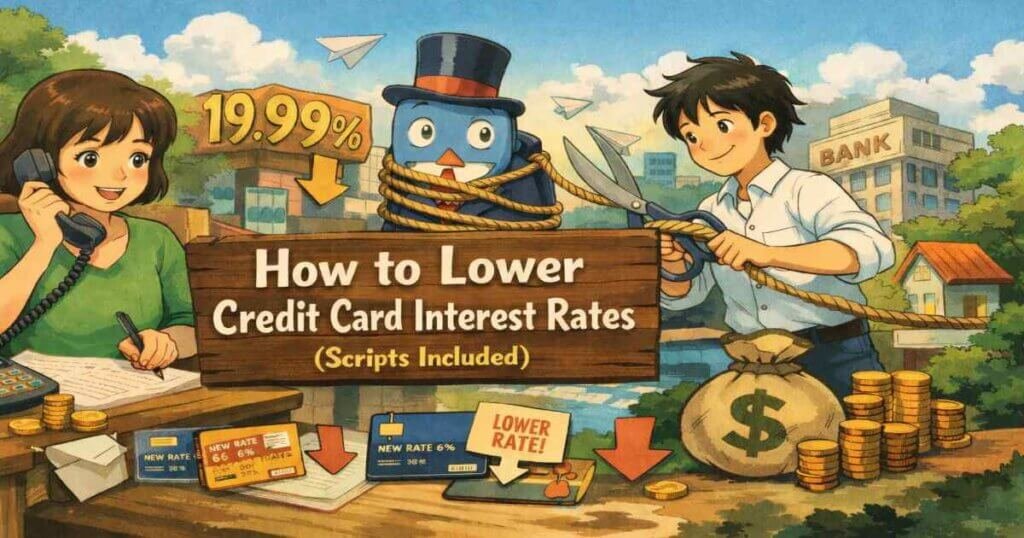
Lower credit card interest is one of the fastest ways to reduce debt costs without changing how much you spend or earn.
If you’re carrying a balance on your credit cards and paying 18%, 22%, or even 29% interest, you need to know this: your credit card interest rate is negotiable, and a single phone call could save you hundreds or even thousands of dollars over the next year. According to the Federal Reserve’s 2024 data, the average credit card interest rate in the United States is approximately 22.63% – the highest it’s been in over two decades. For someone carrying the average credit card balance of $6,360, that 22% interest means paying roughly $1,400 per year just in interest charges if they’re only making minimum payments.
Here’s what most people don’t realize: according to a 2023 survey by LendingTree, 76% of cardholders who asked their credit card company for a lower interest rate received one, with the average reduction being 6 percentage points. That means a significant number of people are paying unnecessarily high interest simply because they haven’t asked for a reduction. The credit card companies aren’t going to volunteer to lower your rate – but if you ask strategically, there’s a good chance they’ll say yes.
But here’s the problem: most people either don’t know they can negotiate their credit card interest rates, are too intimidated to call and ask, don’t know what to say or how to make a compelling case, give up after the first “no” without pushing back, or assume their credit isn’t good enough to qualify for a reduction.
This guide is going to eliminate all those barriers. I’m going to give you word-for-word scripts you can use when calling your credit card company, show you exactly how to prepare before making the call so you have maximum leverage, explain when you have the strongest negotiating position and when to call, teach you how to handle objections and pushback from customer service, walk you through alternative strategies if negotiation doesn’t work, and show you the math behind how much money you’ll actually save.
Whether your interest rate is 18% or 29%, whether your credit is excellent or fair, whether you’ve had the card for 6 months or 6 years, this guide will give you the tools to negotiate a lower rate and keep more of your money.
Plain-English Summary
Lowering your credit card interest rate means negotiating with your credit card company to reduce the annual percentage rate (APR) they charge on your balance. This negotiation happens through a phone call where you make a case for why they should lower your rate, based on factors like your payment history, credit score improvements, competitive offers from other cards, or financial hardship.
A lower interest rate saves you money every single month you carry a balance. If you have a $5,000 balance at 24% APR and you negotiate it down to 18% APR, you’ll save approximately $300 per year in interest charges, and you’ll pay off your balance several months faster if you’re making consistent payments. The savings compound – over two years, that same rate reduction saves you about $600 and gets you out of debt 4-5 months sooner.
The negotiation process requires preparation (knowing your current rate, payment history, credit score, and competitive offers), a strategic phone call (using proven scripts and staying calm and polite), and persistence (being willing to ask for a supervisor or call back if the first representative says no).
In this guide, I’m going to give you everything you need to successfully negotiate a lower interest rate, including exact scripts, timing strategies, and backup plans if negotiation doesn’t work.
Your credit card interest rate costs you real money every month. Let’s get it lowered starting today.
Table of Contents
1. Why Credit Card Interest Rates Are So High
Before we tackle how to lower your rate, let me explain why credit card interest rates are so high in the first place – understanding this helps you negotiate more effectively.
Credit Cards Are Unsecured Debt
Unlike a mortgage (secured by your house) or auto loan (secured by your car), credit cards are unsecured debt. The credit card company has no collateral to claim if you don’t pay. This higher risk to the lender translates to higher interest rates charged to borrowers.
If you default on your mortgage, the bank can foreclose and take your house. If you default on your credit card, the bank can only damage your credit, send the debt to collections, or sue you – all of which are more costly and less certain than repossessing collateral.
The Federal Reserve’s Influence
The Federal Reserve sets benchmark interest rates that influence all lending rates. When the Fed raises rates to combat inflation (as they did dramatically in 2022-2024), credit card companies raise their rates accordingly. When the Fed lowers rates, credit card companies are slower to reduce their rates.
This asymmetry means rates rise quickly but fall slowly – another reason your rate might be higher than necessary.
Risk-Based Pricing
Credit card companies price risk individually. Someone with excellent credit (750+ score) might get 15-18% APR, while someone with fair credit (650-700) might get 22-26% APR on the same card. Your rate is partly determined by your credit profile at the time you opened the account.
Here’s the key insight: if your credit has improved since you opened the card, your rate may not have been adjusted downward to reflect that improvement. You’re paying yesterday’s rate based on yesterday’s credit profile.
The Profit Motive
Interest charges are how credit card companies make significant profits. According to industry data, the majority of credit card company revenue comes from interest charges on carried balances, not from annual fees or merchant transaction fees.
They have a financial incentive to keep your rate high. But they also have an incentive to keep you as a customer – and that’s your leverage.
Why They’ll Lower Your Rate
Despite the profit motive, credit card companies will lower rates for customers who ask because losing you to a competitor costs them more than reducing your rate, customers who pay consistently (even if slowly) are profitable customers worth keeping, rate reduction requests are cheaper to grant than losing you to balance transfer or consolidation, and retaining existing customers costs less than acquiring new ones.
Your job is to give them a reason to lower your rate that aligns with their business interests.
2. How Much Money a Lower Rate Actually Saves You
Let me show you the real-world financial impact of lowering your interest rate so you understand exactly what you’re negotiating for.
Example 1: $5,000 Balance, 24% to 18% Reduction
Scenario: You have a $5,000 credit card balance at 24% APR. You’re paying $200/month.
At 24% APR:
- Monthly interest charge: ~$100
- Time to pay off: 32 months
- Total interest paid: $1,389
- Total paid: $6,389
At 18% APR (after negotiation):
- Monthly interest charge: ~$75
- Time to pay off: 29 months
- Total interest paid: $1,068
- Total paid: $6,068
Savings: $321 in interest, debt-free 3 months sooner
Example 2: $10,000 Balance, 22% to 16% Reduction
Scenario: You have a $10,000 balance at 22% APR. You’re paying $300/month.
At 22% APR:
- Monthly interest charge: ~$183
- Time to pay off: 49 months
- Total interest paid: $4,644
- Total paid: $14,644
At 16% APR (after negotiation):
- Monthly interest charge: ~$133
- Time to pay off: 42 months
- Total interest paid: $2,593
- Total paid: $12,593
Savings: $2,051 in interest, debt-free 7 months sooner
Example 3: $3,000 Balance, 29% to 20% Reduction
Scenario: You have a $3,000 balance at 29% APR (extremely high rate). You’re paying $150/month.
At 29% APR:
- Monthly interest charge: ~$73
- Time to pay off: 25 months
- Total interest paid: $721
- Total paid: $3,721
At 20% APR (after negotiation):
- Monthly interest charge: ~$50
- Time to pay off: 23 months
- Total interest paid: $425
- Total paid: $3,425
Savings: $296 in interest, debt-free 2 months sooner
The Bigger Picture
Notice that in every scenario, you save hundreds to thousands of dollars and shorten your payoff timeline by several months – all from a single phone call.
The higher your balance and the larger the rate reduction, the more dramatic the savings.
Annual Savings Quick Reference
If you carry an average balance and reduce your rate:
| Balance | Rate Reduction | Approximate Annual Savings |
| $2,000 | 6% (22% to 16%) | $120/year |
| $5,000 | 6% (22% to 16%) | $300/year |
| $8,000 | 6% (22% to 16%) | $480/year |
| $10,000 | 6% (22% to 16%) | $600/year |
| $15,000 | 6% (22% to 16%) | $900/year |
Even a 3-4 percentage point reduction saves significant money over time.
This Is Worth Your Time
A 30-minute phone call that saves you $400+ per year is worth $800+/hour in value. Few activities generate that kind of return on time invested.
3. When You Have the Strongest Negotiating Position
Timing matters in negotiation. Here’s when you have maximum leverage to ask for a rate reduction.
Strong Negotiating Position #1: After 6-12 Months of Perfect On-Time Payments
If you’ve made every payment on time for the past 6-12 months, you’ve proven you’re a reliable customer. This is one of your strongest negotiating points.
The credit card company values consistent payers. You’re demonstrating responsible behavior that reduces their risk.
Script leverage: “I’ve made every payment on time for the past [X] months and I’ve been a responsible customer. I’m requesting a rate reduction as a reflection of my consistent payment history.”
Strong Negotiating Position #2: Your Credit Score Has Improved
If you opened the card when your credit score was 650 and it’s now 720, you’re a much lower-risk borrower than when they initially set your rate.
Check your credit score (free through Credit Karma, your credit card issuer, or your bank). If it’s improved by 50+ points since opening the card, you have strong grounds for requesting a better rate.
Script leverage: “When I opened this account, my credit score was approximately [lower score]. It’s now [current higher score]. I’d like my interest rate adjusted to reflect my improved creditworthiness.”
Strong Negotiating Position #3: You Have Competitive Offers
If you’ve received balance transfer offers, credit card offers with lower rates, or personal loan offers at better rates, these are powerful leverage.
Credit card companies don’t want you to transfer your balance elsewhere – they’d rather reduce your rate and keep you.
Script leverage: “I’ve received several balance transfer offers at 0% APR for 18 months from competitors. Before I transfer my balance, I wanted to see if you could offer me a competitive rate reduction.”
Strong Negotiating Position #4: You’re a Long-Time Customer
If you’ve had the card for 3+ years and maintained good standing, your tenure gives you leverage. Long-time customers cost less to retain than new customers cost to acquire.
Script leverage: “I’ve been a customer since [year], and I value our relationship. I’m requesting a rate reduction in recognition of my long-standing loyalty.”
Strong Negotiating Position #5: They Recently Raised Your Rate
If your credit card company raised your rate in the past 6-12 months (perhaps due to Fed rate increases or account review), you can push back on this increase.
Script leverage: “My rate was increased from [old rate] to [new rate] recently. Given my consistent payment history and improved credit profile, I’m requesting this increase be reversed.”
Weaker Negotiating Positions (Still Worth Trying)
Even if you don’t have the strongest leverage, you can still ask:
You’ve had the card less than 6 months: Less leverage, but if you’ve made perfect payments, still worth asking.
You’ve missed a payment in the past year: Significantly weakens your position, but if it was a one-time mistake and you’ve been perfect since, explain that.
Your credit score hasn’t improved: You can still argue based on competitive offers or customer loyalty.
Timing Within the Year
Best times to call:
- After receiving your annual account review notice
- When you receive a rate increase notice
- After making a large payment
- When you’re considering a balance transfer (creates urgency for them)
Avoid calling:
- Immediately after missing a payment
- Right after maxing out your card
- During the holidays when call centers are swamped (slower service, rushed representatives)
4. What to Gather Before You Call
Preparation is the difference between a weak negotiation and a strong one. Here’s exactly what to have ready before picking up the phone.
Information to Gather
1. Your current interest rate
Log into your account online or check your most recent statement. Find the APR (Annual Percentage Rate). Write it down.
Current APR: _______%
2. Your account opening date
How long have you been a customer? This information is usually on your statement or in your online account profile.
Customer since: __________
3. Your payment history
Have you made every payment on time? Check your last 12 months of statements. If you’ve been perfect, that’s powerful leverage.
Payments in last 12 months: ____ on time, ____ late
4. Your current credit score
Get your score from Credit Karma, your bank app, or your credit card issuer (many provide free scores). If your score has improved since opening the card, note both scores.
Current credit score: _____ Score when opened (if you remember): _____
5. Competitive offers you’ve received
Check your mail or email for:
- Balance transfer offers (especially 0% promotional rates)
- New credit card offers with lower APRs
- Personal loan offers
Write down the best offers:
- Offer 1: _____ from _____ at _____%
- Offer 2: _____ from _____ at _____%
6. Your current balance
Know exactly how much you owe. This helps if they ask about your situation.
Current balance: $__________
7. Your desired rate
What rate are you asking for? Be specific. If you’re at 24%, asking for 18% is reasonable. Asking for 10% is probably unrealistic.
Target rate: _______%
Your Negotiation Prep Checklist
RATE REDUCTION PREP CHECKLIST
□ Current APR: _______%
□ Account age: _____ years/months
□ Payment history: Perfect / Near-perfect / Some issues
□ Current credit score: _____
□ Credit score improvement: Yes / No / Unknown
□ Competitive offers: Yes (list them) / No
□ Current balance: $__________
□ Target rate: _______%
□ Reason for request: (Check all that apply)
□ Perfect payment history
□ Credit score improved
□ Competitive offers available
□ Long-time customer
□ Recent rate increase
□ Financial hardship
Mental Preparation
Be calm and polite. Customer service representatives respond better to respectful requests than demands or anger.
Be confident. You’re asking for something reasonable that benefits both parties.
Be persistent. If the first person says no, ask for a supervisor. If they still say no, call back in a month.
Have time. Don’t call when you’re rushed. Allocate 20-30 minutes for the call in case you need to wait on hold or speak with multiple people.
5. The Basic Interest Rate Negotiation Script
Here’s a simple, effective script that works for most situations. Use it as-is or adapt it to your specific circumstances.
Opening (After reaching customer service)
“Hi, I’m calling about my account ending in [last 4 digits of card number]. I’d like to discuss my current interest rate and request a reduction. Can you help me with that, or should I speak with someone else?”
Why this works: You’ve clearly stated your purpose, identified your account, and asked if they’re the right person (shows you’re prepared to escalate if needed).
When they ask why you’re requesting a reduction:
“I’ve been a customer since [date/year], and I’ve made every payment on time for the past [X months/years]. I’m carrying a balance and working to pay it off, and a lower interest rate would help me pay down my balance more quickly. My current rate is [X%], and I’m requesting a reduction to [target rate] to reflect my responsible payment history.”
Why this works: You’ve provided three key points – your tenure as a customer (loyalty), your perfect payment history (low risk), and a specific rate target (clear ask).
If they say they’ll review your account:
“Thank you, I appreciate you looking into this.”
[Wait while they review]
If they offer a reduction:
“Thank you, I appreciate that. Can you confirm the new rate will be [X%] and when it will take effect?”
[Get confirmation in writing – ask them to send an email or check your next statement]
If they offer a smaller reduction than you requested:
“I appreciate the offer to reduce it to [their offer], but I was hoping for [your target]. Is that possible? I have balance transfer offers at [competitive rate] and I’d prefer to keep my balance with you if we can get closer to that rate.”
Why this works: You’re acknowledging their offer (polite) but pushing for more (assertive), and you’re introducing competitive pressure.
If they say no or can’t help:
“I understand. Is there a supervisor or retention specialist I could speak with about this? I really would like to work this out and remain a customer, but the current rate is making it difficult for me to make progress on my balance.”
Why this works: You’re escalating politely, and you’re introducing the possibility that you might leave (which they want to avoid).
Closing (after getting a reduction or being told no):
“Thank you for your time. Can you send me written confirmation of [the new rate / our conversation] to my email on file?”
Complete Call Flow Example
You: “Hi, I’m calling about my account ending in 4782. I’d like to discuss my current interest rate and request a reduction. Can you help me with that?”
Rep: “Sure, I can help. What’s your concern?”
You: “I’ve been a customer since 2020, and I’ve made every payment on time for the past 18 months. My current rate is 23.99%, and I’m requesting a reduction to 18% to reflect my responsible payment history and improved credit profile.”
Rep: “Let me review your account… I see you have been making consistent payments. I can offer you a reduction to 21.99%.”
You: “I appreciate that, but I was hoping for 18%. I have a balance transfer offer at 15.99% from another company. Is 18% possible so I can keep my balance with you?”
Rep: “Let me check with my supervisor… [pause] … I can get approval for 19.99%. That’s the best I can do.”
You: “I can accept 19.99%. Thank you. Can you confirm when that rate takes effect and send me written confirmation?”
Rep: “It will take effect with your next billing cycle. You’ll see it reflected on your next statement.”
You: “Perfect. Thank you for working with me on this.”
Result: You negotiated from 23.99% to 19.99% – a 4-point reduction that will save you hundreds of dollars over the next year.
6. Script for Strong Credit and Good Payment History
If your credit score has improved significantly or you have an excellent payment history, use this script to emphasize your creditworthiness.
Strong Credit Script
“Hi, I’m calling to request an interest rate reduction on my account ending in [last 4 digits]. When I opened this account in [year], my credit score was approximately [lower score]. Since then, I’ve worked hard to improve my credit, and my current score is [higher score]. I’ve also made every single payment on time for [X months/years] without exception.
Given my improved creditworthiness and perfect payment history, I’m requesting my interest rate be reduced from [current rate] to [target rate] to reflect my current credit profile rather than my profile from when I opened the account. This would allow me to pay down my balance more quickly while remaining a loyal customer.
Can you help me with this?”
Why this script works:
It tells a story of improvement. You’re demonstrating positive behavior change, not just asking for a favor.
It shows you’ve been responsible. Perfect payment history is the single strongest argument for rate reduction.
It’s specific. You’re providing exact numbers – old score, new score, current rate, target rate.
It frames the request as mutual benefit. You’re emphasizing that you’ll remain a customer (they keep your business) while paying down your balance faster (they get paid sooner).
Variation for Excellent Credit (720+)
“Hi, I’m calling about my account ending in [last 4 digits]. I have excellent credit – my current score is [score above 720] – and I’ve maintained perfect payment history with you for [X months/years]. I’m currently at [current rate], which is significantly higher than the rates I’m being offered on new cards with excellent credit tiers, which are typically in the [lower range]% range.
I’d like to request a rate reduction to [target rate] to align with my credit profile. I value our relationship and would prefer not to transfer my balance elsewhere, but the rate difference is substantial.”
Why this variation works: If you have truly excellent credit (720+), you can be more assertive. You’re eligible for better rates and you know it.
7. Script for Competitive Offers from Other Cards
If you’ve received balance transfer offers or new credit card offers with lower rates, this is powerful leverage.
Competitive Offer Script
“Hi, I’m calling about my account ending in [last 4 digits]. I’ve been receiving balance transfer offers from [Company A] offering 0% APR for 18 months and [Company B] offering [X%] ongoing APR, which are both significantly lower than my current rate of [your rate].
Before I transfer my balance to one of these offers, I wanted to give you the opportunity to match or beat these rates. I’ve been your customer since [year] and I’d prefer to keep my balance with you if we can work out a competitive rate.
Can you offer me a rate reduction that would make it worthwhile for me to stay?”
Why this script works:
Competitive pressure. You’re making it clear you have alternatives and you’re prepared to use them.
Urgency. The phrase “before I transfer” creates a sense that they might lose your business soon.
Loyalty framing. You’re emphasizing you prefer to stay (which is true and which they want to hear).
Specific alternatives. Naming actual competitors and their rates shows you’ve done research.
Important Note on Balance Transfer Offers
When mentioning balance transfer offers, be honest. If you actually have these offers, great. If you don’t, you can still research what’s available and say: “I’ve been researching balance transfer options and I’m seeing offers for 0% APR for 15-18 months from several companies.”
Don’t lie about having offers you don’t have, but do research what’s available in the market.
Following Up on Competitive Leverage
If they ask which companies are offering you these rates:
“I’ve received offers from [Chase/Discover/Capital One – whoever actually sent you something] at [rate]. I’m happy to keep my business with you if you can offer me a competitive rate.”
If they offer a reduction but it’s still higher than the competitive offer:
“I appreciate the reduction to [their offer], but that’s still significantly higher than the [competitive rate] I can get elsewhere. Can you get closer to [competitive rate]?”
8. Script for Financial Hardship Situations
If you’re experiencing genuine financial hardship (job loss, medical emergency, income reduction), credit card companies often have hardship programs that can temporarily reduce your rate.
Hardship Script
“Hi, I’m calling about my account ending in [last 4 digits]. I’m experiencing financial hardship due to [job loss / medical emergency / income reduction / specific situation], and I’m struggling to keep up with the interest charges on my account.
I’ve been a customer since [year] and I’ve always paid my bills on time until now. I want to continue paying, but my current interest rate of [X%] is making it very difficult to make meaningful progress on my balance.
Do you have a hardship program or temporary rate reduction that could help me through this difficult period? I’m committed to paying off this debt, but I need some assistance to make that realistic.”
Why this script works:
Honesty about hardship. You’re being upfront about your situation rather than hiding it.
Emphasis on wanting to pay. You’re making it clear you’re not trying to avoid paying – you’re trying to make paying possible.
Past responsibility. If you’ve been a good customer until the hardship hit, emphasize that.
Specific ask. You’re asking about hardship programs, which many credit card companies have specifically for these situations.
What Hardship Programs Typically Offer
If they have a hardship program, you might receive:
- Temporarily reduced interest rate (often to 0-6% for 6-12 months)
- Waived late fees and over-limit fees
- Reduced minimum payment
- Structured payment plan
Important Note: Entering a hardship program may:
- Close your account (you can’t make new charges)
- Be noted on your credit report
- Require documentation of your hardship
But if you’re genuinely struggling, these trade-offs are worth it to get manageable terms.
Hardship Script Variation for Medical Debt
“Hi, I’m calling about my account ending in [last 4 digits]. I recently had an unexpected medical emergency that resulted in significant medical bills, and I’m trying to manage my finances responsibly during recovery.
I’ve been your customer for [X years] and I’ve maintained good standing. Given the extraordinary circumstances, I’m requesting a temporary interest rate reduction or hardship program that would help me continue making payments while I recover financially.
What options are available to help customers in my situation?”
9. Script for Long-Time Customers
If you’ve had your card for several years and maintained reasonably good standing, your loyalty gives you leverage.
Long-Time Customer Script
“Hi, I’m calling about my account ending in [last 4 digits]. I’ve been a customer since [year – emphasize if it’s 3+ years], and I’ve valued our relationship over that time.
As a long-standing customer, I’m requesting a review of my interest rate. My current rate is [X%], and I believe a reduction to [target rate] would be appropriate given my tenure and payment history.
I’ve remained loyal to your company, and I’m hoping you can offer me a competitive rate that reflects my value as a long-term customer. Can you help me with this?”
Why this script works:
Loyalty emphasis. Companies value customer retention and long-time customers cost less to maintain than new customers cost to acquire.
Reciprocity. You’ve been loyal to them – you’re asking for loyalty in return.
Gentle pressure. The implication is that without a rate reduction, you might take your business elsewhere after all these years.
Variation for Customers with Multiple Products
If you have multiple accounts with the same bank (checking account, multiple credit cards, auto loan, etc.), mention this:
“Hi, I’m calling about my credit card ending in [last 4 digits]. I’ve been a customer since [year], and I currently have [list products: checking account, savings account, two credit cards, auto loan] with your company.
As a customer with multiple products and a long relationship, I’m requesting a rate reduction on my credit card from [current rate] to [target rate]. I value the convenience of consolidating my financial products with one company, but I need to see competitive rates to justify that loyalty.
Can you offer me a rate reduction?”
Why this works: Customers with multiple products are more valuable (they generate more revenue) and less likely to leave (switching costs are higher). Use this to your advantage.
10. Script for Recent Rate Increases
If your credit card company raised your rate in the past 6-12 months, you can push back on that increase.
Rate Increase Pushback Script
“Hi, I’m calling about my account ending in [last 4 digits]. My interest rate was recently increased from [old rate] to [new rate], and I’m calling to request that this increase be reversed.
Since the rate increase, I’ve continued to make all my payments on time and I’ve maintained good standing on my account. My credit score is currently [score], which is [same as / higher than] it was before the increase.
Given that my risk profile hasn’t changed – in fact, I’ve proven my reliability by continuing to pay on time – I believe the rate increase wasn’t warranted. I’m requesting my rate be reduced back to [old rate] or lower.
Can you help me with this?”
Why this script works:
You’re challenging the justification. If your behavior hasn’t changed, why did the rate increase?
You’re providing evidence. Continued on-time payments and stable/improved credit score show you’re not a higher risk.
Specific request. You’re asking for a return to the old rate, which is reasonable since nothing changed on your end.
Understanding Why Rates Increase
Credit card companies raise rates for several reasons:
- Federal Reserve rate increases (affects all customers)
- Account review found increased risk (specific to you)
- Default rate triggered by late payment
- Promotional rate expired
If the increase was due to a late payment (default rate), acknowledge it and explain what’s changed:
“I understand my rate was increased to [default rate] after I missed a payment in [month]. That was a one-time situation due to [reason], and I’ve since made [X] consecutive on-time payments. I’m requesting the default rate be removed and my rate reduced to [standard rate] in recognition of my return to good standing.”
11. How to Handle Common Objections and Pushbacks
Credit card representatives will sometimes say no or give you reasons why they can’t lower your rate. Here’s how to respond to common objections.
Objection #1: “I’m sorry, but we can’t lower your rate at this time.”
Your response: “I understand. Can you tell me specifically why? Is it related to my account history, my credit profile, or company policy? I’d like to understand what I can do to qualify for a rate reduction in the future.”
Why this works: You’re asking for information that might reveal opportunities. They might say “Your payment history is good, but you’ve only been a customer for 5 months” – now you know to call back after 6 months.
Objection #2: “Your rate is based on your credit profile when you opened the account.”
Your response: “I understand that’s how it was initially set, but my credit has improved significantly since then. My score has increased from approximately [lower score] to [higher score]. I’m requesting the rate be adjusted to reflect my current creditworthiness, not my profile from [X years] ago.”
Why this works: You’re acknowledging their point but providing a valid reason why the rate should be reevaluated.
Objection #3: “This is the best rate we can offer for your credit tier.”
Your response: “I appreciate that information. However, I’m receiving offers from competitors for [competitive rate], which suggests my credit profile qualifies for better rates in the market. Is there a way to review my tier classification or make an exception given my payment history with you?”
Why this works: Competitive pressure. If other companies will offer you better rates, they might reconsider their tier classification.
Objection #4: “You need to have been a customer for at least a year before requesting a rate reduction.”
Your response: “I understand there may be a typical timeframe, but I’ve demonstrated responsible behavior by making every payment on time since opening my account. Is there flexibility on this policy, or can you make a note that I’d like a rate review as soon as I reach the one-year mark?”
Why this works: You’re acknowledging the policy while asking for an exception or at least setting up a future call.
Objection #5: “We recently lowered your rate / You already received a rate reduction.”
Your response: “I appreciate that previous reduction. However, given [my continued perfect payment history / further improvement in my credit score / competitive offers I’m receiving], I believe an additional reduction is warranted. Can we discuss what’s possible?”
Why this works: A past reduction doesn’t preclude a current one if circumstances have changed further.
Objection #6: “I don’t have the authority to change your rate.”
Your response: “I understand. Who does have that authority? Can I speak with a supervisor or retention specialist who can review my request?”
Why this works: Direct escalation. Don’t waste time with someone who can’t help you.
The “Soft No” vs. “Hard No”
Soft no: “I’m sorry, we can’t do that” without explaining why, or “That’s not our policy” without specifics.
Response: Keep pushing. Ask for specifics, ask for a supervisor, or ask what would qualify you.
Hard no: “I’ve reviewed your account with my supervisor and we cannot offer a rate reduction at this time because [specific reason].”
Response: Accept it for now, ask when you can request a review again, note the date, and call back then.
11A. Common Mistakes That Hurt Your Chances to Lower Credit Card Interest Rates
When you attempt to lower your credit card interest rate, certain mistakes can sabotage your efforts before you even speak with credit card companies. Understanding what hurts your negotiating position helps you avoid paying interest at unnecessarily high rates. Many cardholders unknowingly damage their chances to get a lower interest rate on your credit card through common errors that affect your credit standing and negotiating leverage.
The goal when you negotiate a lower credit card interest rate is presenting yourself as a valued customer who deserves better terms. When credit card companies evaluate your request for a lower rate, they assess risk, loyalty, and your overall value as a customer. Making these common mistakes signals that you’re a high interest rate candidate rather than someone who should qualify for lower rates.
Critical Mistakes That Prevent You From Getting a Lower Interest Rate
Mistake #1: Requesting a Rate Reduction While Carrying High Balances
Credit card companies see high interest customers with maxed-out card balances as high-risk. When your credit utilization exceeds 50-70%, lenders worry about your ability to pay your credit card debt. If you pay interest on balances representing 80-90% of your credit limit, you look financially stressed. The interest rate on your credit card reflects this perceived risk.
Solution: Before you ask for a lower interest rate, work to reduce balances below 30% of limits. Even paying down to 50% significantly improves your credit profile. This demonstrates you can manage credit card debt responsibly, making issuers more willing to offer lower rates. Keeping your credit utilization low is perhaps the single most important factor in asking for a lower interest rate successfully.
Mistake #2: Making Late Payments Before Requesting a Rate Reduction
Your payment history directly affects your credit score and your leverage when you ask your credit card company for better terms. If you’ve made late payments in the past 6-12 months, issuers will refuse your request for a lower rate on your credit card. They view late payments as evidence you’re high interest-worthy rather than deserving a lower rate.
Solution: Establish 6-12 months of perfect on-time payments before you negotiate a lower credit card rate. Set up automatic payments for at least minimums to ensure you pay your credit card bill on time every month. This credit history of reliability strengthens your position when you ask for lower interest rates and demonstrates you’re less risky than your current APR suggests.
Mistake #3: Having Poor Credit Scores Without Taking Steps to Improve
Your credit score determines whether you can get a lower credit card interest rate. If your score dropped significantly, credit card companies won’t offer a lower rate until you demonstrate improvement. Calling to reduce your interest rate with a 580 credit score when you started with 720 won’t succeed—the issuer sees increased risk, not decreased.
Solution: Before you ask for a temporary or permanent lower interest rate, focus on actions that improve your credit score: pay down credit card balances, dispute credit report errors, and maintain perfect payment history for 6+ months. Once your score rises 30-50 points, you have legitimate grounds to negotiate a lower credit card apr. The combination of higher credit scores and responsible usage creates powerful leverage to lower credit card apr effectively.
Mistake #4: Threatening to Close Your Account
Many people believe threatening to close their account gives them negotiating power to lower your interest rate. This approach backfires with credit card companies. Issuers know that closing an account can impact your credit negatively by reducing available credit and credit utilization ratios. They also know most people won’t actually close accounts with existing balances because they’d still owe the money and lose charging privileges.
Solution: Instead of threats, emphasize loyalty and competitive offers. Mention you’d prefer to keep your credit relationship with them but note that another card or competing issuer has offered you a card with a lower rate. Frame your request as wanting to maintain the relationship while getting terms comparable to what you qualify for lower rates elsewhere. This positions you as a valued customer looking for a lower rate rather than an antagonistic account holder.
Mistake #5: Calling When You’re Already Delinquent or in Collections
Once your account becomes severely delinquent or enters collections, your ability to negotiate a lower credit card interest rate essentially disappears. At this stage, issuers focus on recovering the principal rather than adjusting rates. The interest on a credit card in default status isn’t negotiable through standard rate reduction requests.
Solution: If you’re struggling financially, contact your issuer proactively before missing payments. Ask for credit counseling referrals or hardship programs that can reduce your interest rate and create affordable payment plans. A credit counseling agency can sometimes negotiate a lower APR on your behalf as part of a formal debt management plan. This preserves your ability to avoid interest at punitive rates while staying current on obligations.
12. When to Ask for a Supervisor
Sometimes the first customer service representative can’t or won’t help you. Here’s when and how to escalate.
When to Escalate
The representative says they can’t help but won’t explain why. If they give you a “no” without any justification or explanation, ask for a supervisor who can provide more detail.
The representative offers a token reduction that’s not meaningful. If you’re at 24% and they offer 23.5%, that’s not worth accepting. Ask for a supervisor who can offer a more significant reduction.
You have strong leverage they’re not acknowledging. If you have excellent credit, perfect payment history, and competitive offers, but the rep is dismissing your request, escalate.
The representative seems rushed or disinterested. If you sense they’re just trying to get you off the phone without seriously considering your request, ask for someone else.
You’ve been explicitly told “only a supervisor can approve that.” If they mention that rate changes require supervisor approval, save time and ask for the supervisor immediately.
How to Ask for a Supervisor (Politely but Firmly)
“I appreciate your time, but I’d like to speak with a supervisor or someone who has the authority to review rate reduction requests. Can you transfer me, please?”
Why this works: You’re being polite but clear. You’re not angry, you’re just asking for the next level of decision-making authority.
If they resist:
“I understand you’re trying to help, but I’d really like to discuss this with someone who can review my account and make an exception if warranted. Please transfer me to a supervisor.”
What to Say to the Supervisor
Start fresh with the supervisor – give them the full context:
“Hi, thank you for taking my call. I’m requesting an interest rate reduction on my account ending in [last 4 digits]. Here’s my situation: [summarize your strongest points – payment history, credit score, competitive offers, tenure, etc.].
The representative I spoke with wasn’t able to help, so I’m hoping you can review my account and consider my request. My current rate is [X%] and I’m requesting [target rate].”
Supervisors Have More Authority
Supervisors can often approve reductions that frontline representatives can’t. They can make exceptions to policies, override system limitations, and access retention budgets specifically designed to keep customers.
Don’t be afraid to escalate. It’s not rude – it’s smart negotiation.
13. What to Do If They Say No
Even with perfect preparation and strong leverage, sometimes the answer is no. Here’s what to do next.
Ask When You Can Request Again
“I understand you can’t offer a reduction today. When would be an appropriate time to request a rate review again? In 6 months? After my next account review?”
This accomplishes two things: it shows you’re persistent (they might reconsider), and it gives you a timeline for when to try again.
Get the Reason in Writing
“Can you send me written confirmation of why my request was denied? I’d like to understand what criteria I need to meet to qualify for a rate reduction in the future.”
Having this in writing helps you address the specific issues before your next request.
Document the Call
Write down:
- Date and time of call
- Representative’s name (and supervisor’s name if you escalated)
- Reason given for denial
- Any commitments made (like “call back in 6 months”)
Call Back in 30 Days
Here’s something most people don’t know: calling back and speaking to a different representative can yield different results. Each rep has some discretion, and company policies can change.
Wait 30 days, then call again with the same request. You might get a different person who’s more willing to help or a different day when supervisors are more generous with approvals.
Try a Different Approach
If your first request emphasized payment history and it was denied, try again in a month emphasizing competitive offers instead. Different leverage points resonate differently with different representatives.
Consider Alternative Solutions
If they absolutely won’t reduce your rate, pivot to alternatives:
Balance transfer to 0% promotional card (covered in next section)
Debt consolidation loan at lower rate
Hardship program if you’re struggling
Debt settlement if you’re seriously behind (last resort)
Accept It and Improve Your Situation
If they won’t budge and you don’t have other options right now:
- Focus on improving your credit score over the next 6 months
- Pay down your balance to reduce total interest even if the rate stays the same
- Build 6+ months of perfect payment history
- Call back with stronger leverage
The “Escalation Letter” Strategy
If phone calls fail, write a formal letter to the company’s customer retention department:
[Your Name]
[Address]
[City, State ZIP]
[Date]
[Credit Card Company Name]
Customer Retention Department
[Company Address]
Re: Request for Interest Rate Reduction – Account #XXXX-XXXX-XXXX-[last 4 digits]
Dear Sir or Madam,
I am writing to formally request a review and reduction of the interest rate on my account ending in [last 4 digits].
I have been a customer since [date], and I have maintained [perfect/excellent] payment history by making all payments on time. My current credit score is [score], which represents a [improvement/strong profile].
Despite my positive history and creditworthiness, my current interest rate of [X%] is significantly higher than rates I’m being offered by competitors. I am receiving balance transfer offers at [competitive rate] and new card offers at [competitive rate].
I value my relationship with [Company Name] and would prefer to keep my account with you. However, I need to see a meaningful rate reduction to justify continuing to carry a balance at the current rate.
I am requesting my interest rate be reduced to [target rate]. I believe this rate is fair given my payment history, credit profile, and competitive market rates.
Please contact me at [phone] or [email] to discuss this request.
Sincerely,
[Your Signature]
[Your Printed Name]
Send this via certified mail. Sometimes formal written requests get routed to retention specialists who have more authority than phone representatives.
13A. How Often You Can Request Rate Reductions to Lower Your Credit Card Interest
Understanding the proper timing to ask for a lower interest rate protects your relationship with credit card companies while maximizing opportunities to lower credit card interest rates. Requesting too frequently annoys issuers and damages your credibility. Waiting too long means you continue to pay interest at unnecessarily high rates when you could have secured better terms months earlier.
When you successfully get a lower interest rate, the rate on your credit card reduction typically represents a permanent change rather than temporary relief. However, the frequency with which you can ask for lower rates depends on several factors including your account history, credit score changes, and how recently you made previous requests. Credit card companies track these interactions, so strategic timing matters when attempting to lower your credit card interest rate effectively.
Optimal Timing for Rate Reduction Requests
The general guideline for how often you can negotiate a lower credit card interest rate is every 6-12 months, depending on circumstances. If you were declined, wait at least 6 months before you ask your credit card company again. This gives you time to improve your credit profile through consistent payments, lower balances, or credit score increases.
Specific Timing Scenarios:
After Being Approved for a Lower Rate
If you successfully get a lower credit card interest rate, wait 12-18 months before requesting another reduction. This timing shows appreciation for the concession while allowing sufficient time to demonstrate continued responsible usage. During this period, focus on paying interest on a credit card at the new reduced rate while maintaining perfect payment history to strengthen your case for future reductions.
After Being Declined
When credit card companies deny your request to lower your interest rate, ask specifically why and what would need to change for reconsideration. If the reason involves credit score, work on that factor for 6 months then reapply. If the reason involves high credit utilization, pay down balances then request again in 6 months. The interest rate by calling repeatedly without addressing the underlying issues wastes everyone’s time.
After Significant Credit Score Improvements
If your credit score increases by 50+ points, you can ask for a lower rate even if only 3-6 months have passed since your last request. This represents a material change in your credit profile. When you pay off your credit card balances and your score jumps, this creates legitimate grounds to negotiate a lower credit card interest rate sooner than the standard 12-month interval.
After Receiving Competitive Offers
When you receive pre-approved offers for new credit cards with significantly lower interest rates (4+ percentage points), you can immediately contact your current issuer regardless of previous request timing. The offer to secure a lower rate from a competitor provides fresh leverage to negotiate a lower credit card APR. Simply reference the card with a lower interest rate offer and ask if they can match or come close.
Following Federal Reserve Rate Changes
When the Federal Reserve lowers the prime rate, credit card aprs typically follow since most cards use variable rates tied to the prime. However, issuers don’t always pass savings to existing customers automatically. After significant Fed rate cuts, you can ask your credit card company to adjust your APR accordingly. This represents a policy change rather than a personal request, making it appropriate timing regardless of previous inquiries.
13B. Protecting Your Lower Rate Long-Term After You Lower Credit Card Interest
Successfully negotiating to lower your credit card interest rate represents only half the battle. Protecting that lower rate long-term requires ongoing discipline and strategic account management. Credit card companies can increase rates for various reasons, potentially erasing the benefit you worked to secure a lower rate. Understanding how to maintain your lower interest rate permanently keeps you from returning to high interest status.
The interest rate on your credit card isn’t guaranteed forever. Variable rates fluctuate with the prime rate, and issuers can increase rates for cause or through proper notification for no cause. When you get a lower credit card interest rate, protecting this achievement requires proactive strategies that improve your credit profile continuously while avoiding triggers that prompt issuers to reverse concessions.
Essential Strategies to Maintain Lower Credit Card Interest Rates
Strategy #1: Never Miss a Payment After Rate Reduction
The fastest way to lose your lower interest rate on your credit card is missing even one payment after receiving the reduction. Credit card companies include clauses allowing them to implement penalty APRs (often 29.99%) following late payments. A single 30-day delinquency can immediately reverse your lower apr and impact your credit score simultaneously.
Solution: Set up automatic payments for at least the minimum amount immediately after you get a lower interest rate. Better yet, automate payments above the minimum to steadily pay off your credit card balance. This ensures you pay your credit card bill on time every single month, preserving your lower credit card interest rate indefinitely. The discipline that helped you secure a lower rate initially must continue permanently.
Strategy #2: Keep Balances Low Relative to Your Credit Limit
High credit utilization signals financial stress even after you get a lower credit card interest rate. If you maintain balances consistently above 70-80% of your credit limit, issuers may increase rates at next review period or when offering rate adjustments. The goal after you lower your credit card interest rate is demonstrating that you’re using credit responsibly rather than maximizing available credit.
Solution: Maintain credit utilization below 30% of total limits across all cards. If you received a lower rate specifically to help you pay off your credit card balances more effectively, use that savings to accelerate payoff rather than increasing purchases. This approach not only improves your credit score but also makes it easier to avoid paying interest at any rate by reducing principal faster. The combination of lower credit card interest rate and aggressive payoff creates powerful debt elimination momentum.
Strategy #3: Monitor Your Card’s Terms and Conditions
Credit card companies must notify you 45 days before implementing most rate increases. However, they can increase variable rates when the prime rate rises without specific notification. Monitoring your credit card’s terms regularly helps you spot potential credit card apr increases before they occur. This advance warning lets you negotiate a lower rate again or consider transferring your balance to another card with better terms.
Solution: Review monthly statements carefully, noting your current APR. Set a calendar reminder quarterly to verify your interest rate on your credit card hasn’t changed. If you notice an increase notice, immediately contact the issuer to ask for lower rates or inquire about the introductory rate on balance transfer offers. Being proactive about monitoring interest rates prevents surprises and gives you time to explore alternatives before you start paying interest on a credit card at higher rates.
Strategy #4: Regularly Improve Your Credit Profile
Your ability to maintain and potentially further lower your credit card interest rate depends on continuous credit profile improvement. As your credit score increases and your credit history strengthens, you qualify for lower rates periodically. This positions you to negotiate a lower credit card APR every 12-18 months based on ongoing improvements.
Solution: Continue actions that improve your credit score even after you get a lower interest rate: pay all obligations on time, keep credit utilization low, maintain older accounts, and diversify your credit mix responsibly. Every 50-point credit score increase creates opportunities to ask for a lower interest rate again. The goal is creating an upward trajectory where you periodically lower credit card interest rates through documented credit improvement rather than hoping issuers offer lower rates voluntarily.
14. Alternative Strategy: Balance Transfer Cards
How Balance Transfers Work
You apply for a credit card offering 0% APR on balance transfers for a promotional period (typically 12-21 months). Once approved, you transfer your high-interest balance to the new card. During the promotional period, 100% of your payment goes to principal – no interest. You pay a one-time balance transfer fee (typically 3-5% of the transferred amount).
The Math of Balance Transfers
Let’s say you have $8,000 at 22% APR.
Without balance transfer: If you pay $350/month:
- Interest over 2 years: ~$2,100
- Time to pay off: 29 months
With balance transfer to 0% for 18 months:
- Transfer fee (3%): $240
- Interest during promo: $0
- If you pay $458/month for 18 months, you pay it off completely
- Total cost: $8,240 (original + fee)
- Savings: ~$1,860
That’s substantial savings for a one-time $240 fee.
Best Balance Transfer Cards (2026)
Look for cards offering:
- 18-21 months at 0% APR on balance transfers
- 3% transfer fee (some charge 5% – avoid those if possible)
- No annual fee
Popular options include Chase Slate Edge, Citi Simplicity, Discover it Balance Transfer, and Wells Fargo Reflect Card.
Balance Transfer Rules for Success
Rule 1: Calculate required payment before transferring
Balance ÷ Promotional months = Required monthly payment
If you can’t commit to that payment, don’t transfer.
Rule 2: Set up autopay
Automate the required payment. Missing even one payment can cancel your 0% promo.
Rule 3: Don’t use the card for new purchases
Purchases typically don’t get the 0% rate – only transferred balances do.
Rule 4: Don’t close your old card
Keep it open (but unused) to maintain your available credit and credit age.
Rule 5: Have a plan for the end of the promo
What happens if you don’t pay it off before 0% ends? Have a plan (another transfer, aggressive payoff, etc.).
When Balance Transfer Makes More Sense Than Negotiation
Consider balance transfer over negotiation if your current rate is 20%+ and you can get 0%, you have good credit (670+) to qualify for the best transfer cards, you’re disciplined enough to pay it off during the promo period, or your credit card company refused your negotiation request.
15. Alternative Strategy: Debt Consolidation Loans
Another alternative to negotiating your credit card rate is consolidating your credit card debt into a personal loan at a lower fixed rate.
How Debt Consolidation Works
You take out a personal loan for the amount of your credit card debt. You use that loan to pay off your credit cards completely. Now you have one loan payment at a fixed rate instead of multiple credit card payments at variable rates.
Example:
You have:
- Card A: $3,000 at 24% APR
- Card B: $5,000 at 21% APR
- Card C: $4,000 at 19% APR Total: $12,000 in credit card debt
You get a personal loan for $12,000 at 11% APR and 4-year term. Monthly payment: $310.
Credit cards (if paying $310/month total):
- Time to pay off: ~56 months
- Total interest: ~$5,400
Personal loan at 11%:
- Time to pay off: 48 months
- Total interest: ~$2,880
- Savings: ~$2,520 and 8 months sooner
16. When Consolidation Loans Make Sense
You have good to excellent credit (640+) to qualify for a competitive rate (under 15%), you’re consolidating high-interest credit card debt (18%+), you’re disciplined enough not to run up the credit cards again after paying them off, or you prefer the simplicity of one fixed payment.
Consolidation Loan Providers
- Banks and credit unions (often best rates for members)
- Online lenders: SoFi, LightStream, Marcus by Goldman Sachs, Discover
- Peer-to-peer lenders: LendingClub, Prosper
Important: Don’t Fall Into the Consolidation Trap
The biggest danger with consolidation: you consolidate $12,000 of credit card debt into a loan, your credit cards now show $0 balances, you slowly start using the cards again, 18 months later you have the personal loan AND $6,000 in new credit card debt.
Solution: If you consolidate, either close the paid-off credit cards or lock them away and commit to not using them.
16. Frequently Asked Questions
Q: How often can I request an interest rate reduction?
A: You can request a rate review every 6-12 months. If they say no, ask when you can request again and note that date. Some people call every 6 months until they get a yes.
Q: Will requesting a rate reduction hurt my credit score?
A: No. This is not a credit application – it’s a request for better terms on an existing account. No hard inquiry is made and your credit score is not affected by asking.
Q: What if I’ve missed payments in the past year?
A: Your leverage is much weaker, but you can still try. Acknowledge the missed payment, explain it was a one-time situation, emphasize any streak of on-time payments since then, and ask for consideration.
Q: Should I mention I’m considering closing my account?
A: Generally no. Threats often backfire. Instead, mention competitive offers (factual) rather than threatening to leave (emotional). Let them infer that you might leave rather than explicitly threatening it.
Q: Can I negotiate the rate on a promotional 0% APR card before the promo ends?
A: Yes, absolutely. Call 2-3 months before your promotional rate expires and request an extension or a lower standard rate when the promo ends. This is a perfect time to negotiate because they know you’re about to face a rate increase.
Q: What’s a reasonable rate reduction to ask for?
A: Aim for 3-6 percentage points. If you’re at 24%, asking for 18% is reasonable. Asking for 10% is probably unrealistic unless you have exceptional leverage.
Q: Do I need good credit to get a rate reduction?
A: Not necessarily. Good credit (700+) gives you strong leverage, but even with fair credit (650-700) you can negotiate based on payment history, tenure, or competitive offers. Below 650, it’s harder but still possible, especially if you emphasize hardship or loyalty.
Q: What if they offer a reduction but it’s very small (like 1%)?
A: A 1% reduction does save money (about $10 per month per $1,000 balance), but it’s not meaningful. Politely decline and ask if they can do better: “I appreciate the offer, but 1% doesn’t significantly change my situation. Is there flexibility to reduce it further?”
Q: Can I lower my interest rate on a credit card?
Yes, you can lower your credit card interest rate through several methods. The most direct approach is calling your credit card companies to ask for a lower rate based on good credit history, competitive offers, or loyalty. If you have good credit score improvements (50+ point increase), consistent on-time payments for 12+ months, or competing offers with lower interest rates, you have strong leverage to negotiate a lower credit card apr.
Alternative methods to get a lower interest rate include: (1) Opening a balance transfer card offering 0% introductory rate for 12-21 months and transferring your credit card balance to avoid paying interest during the promotional period, (2) Debt consolidation through a personal loan at lower interest rates to pay off your credit card balances, (3) Enrolling in a credit counseling program where a credit counseling agency negotiates lower credit card interest rates on your behalf (often to 8-12% or even 0%).
Your success in asking for a lower interest rate depends on demonstrating you qualify for lower rates through improved credit standing. Credit card companies offer a lower rate when you show reduced risk through higher credit score, lower credit utilization, and perfect payment history. If one issuer declines, you can transfer your balance to another card with better terms, effectively achieving your goal to lower credit card interest rate even without approval from the original issuer.
Q: What is the 15 3 credit card trick?
The 15/3 credit card trick refers to making two payments per month—one 15 days before your statement closing date and another 3 days before—rather than the traditional single monthly payment. The theory suggests this strategy improves your credit score by reducing the balance reported to credit bureaus, thereby lowering your credit utilization ratio. Since utilization accounts for 30% of your credit score, keeping your credit utilization low theoretically helps you improve your credit score faster.
However, the effectiveness of this trick for credit score improvement is overstated. What actually matters is your statement balance—the amount showing when your credit card bill closes and gets reported to bureaus. If you make payments before the statement closes, you reduce the reported balance and credit utilization. But making payments on specific days (15 and 3 days before) isn’t magical—any payment that lowers your balance before the statement date helps improve your credit.
The real benefit relates to interest charges rather than credit score. Making multiple payments throughout the month reduces your average daily balance, which directly reduces the interest on your credit card if you carry a balance. This helps you avoid paying interest unnecessarily and can help you pay off your credit card faster by reducing interest on a credit card that compounds daily. If your goal is to lower credit card interest costs rather than just affect your credit score, making multiple payments monthly definitely helps, regardless of specific timing.
Q: Will interest rates ever go down to 3% again?
Credit card interest rates returning to 3% is extremely unlikely. Even during the unprecedented near-zero Federal Reserve prime rate environment of 2008-2015, credit card aprs averaged 12-15%. Credit cards are unsecured debt, meaning no collateral backs the loans. This inherent risk requires credit card companies to charge substantially higher rates than secured products like mortgages or auto loans.
The rate on your credit card consists of the prime rate (currently 8.50% in late 2024) plus a margin typically 10-20 percentage points. Even if the Fed lowered rates dramatically and the prime rate dropped to 3%, your credit card apr would still be 13-23% due to this margin. Credit card companies set margins based on risk assessment, profit requirements, and loss rates from fraud and defaults. These factors ensure interest rates on credit cards remain substantially higher than the prime rate.
Rather than waiting for 3% interest rates, focus on strategies you control to lower your credit card interest rate: (1) Improve your credit score to qualify for lower rates on new cards or negotiate current rates down, (2) Use balance transfer cards offering 0% introductory rate periods to completely avoid interest for 12-21 months, (3) Pay off your credit card balances in full monthly to avoid paying interest at any rate, (4) Transfer your balance to another card with lower interest if approved. These strategies let you effectively get a lower interest rate or eliminate interest on your credit card entirely without waiting for macroeconomic rate changes that may never materialize at those levels.
17. Conclusion: Your Rate Reduction Action Plan
You now know exactly how to negotiate a lower credit card interest rate, including word-for-word scripts, when to call, and how to handle objections. But knowledge without action doesn’t save you any money. Let me give you a clear action plan for this week.
This Week: Preparation
Day 1: Gather your information. Log into your credit card account and write down your current APR, account opening date, and payment history. Check your credit score (free through Credit Karma, your bank, or your card issuer).
Day 2: Research competitive offers. Check your mail for balance transfer offers. Search online for “balance transfer credit cards 2026” and note the best offers available. This is your leverage.
Day 3: Decide your target rate. If you’re at 24%, targeting 18% is reasonable. Write down your specific ask.
Day 4: Choose your script. Based on your situation, pick the script that fits best: strong credit, competitive offers, long-time customer, or financial hardship.
Next Week: The Call
Day 5: Block out 30 minutes when you can call without interruption. Take a deep breath, stay calm and polite, and dial the number on the back of your card.
Day 6: If they said yes, verify the new rate and when it takes effect. Ask for written confirmation. Celebrate – you just saved yourself hundreds of dollars.
Day 7: If they said no, note the reason and when you can call back. Mark your calendar to try again in 30-60 days.
The Simple Truth About Negotiation
Most people never ask for a lower rate because they assume the answer will be no or they’re intimidated by the process. But 76% of people who ask receive some reduction. You’re leaving money on the table by not asking.
The worst they can say is no – and you’re no worse off than you are right now. The best they can say is yes – and you could save $500+ per year.
A 30-minute phone call for $500+ savings is worth $1,000+ per hour in value. That’s the best hourly rate you’ll ever earn.
Make the call this week. Use the scripts in this guide. Stay calm and polite. Ask for what you want.
Your credit card interest rate is costing you real money every single month. Lower it today.
18. About FinanceSwami & Important Note
FinanceSwami is a personal finance education site designed to explain money topics in clear, practical terms for everyday life.
Important note: This content is for educational purposes only and does not constitute personalized financial advice.
19. Keep Learning with FinanceSwami
If this guide helped you, there’s so much more I want to share with you.
I regularly write detailed, beginner-friendly guides like this one on topics like saving, investing, paying off debt, building credit, and planning for big life goals. You can explore all of those articles on the FinanceSwami blog.
If you prefer to listen or watch, I also explain personal finance topics in my own voice on my YouTube channel. Sometimes it helps to hear someone walk through these concepts out loud, and I’d love for you to check out the videos if that’s more your style.
This isn’t about selling you anything. It’s about giving you more ways to learn, more tools to build your financial confidence, and more support as you take control of your money.
Financial freedom is possible, and I’m here to help you get there – one clear explanation at a time.
— FinanceSwami