
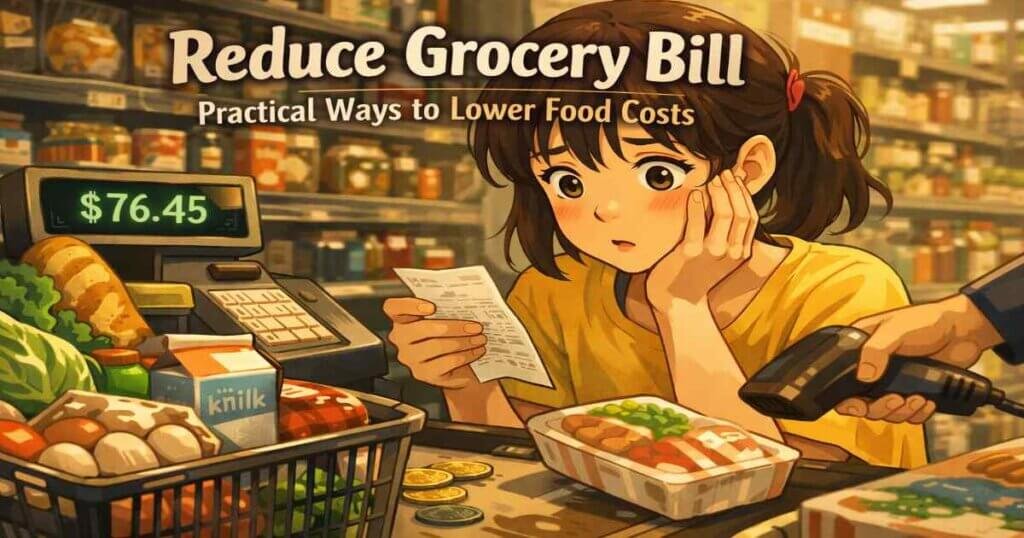
Reduce grocery bill pressure starts with understanding where your money is quietly leaking each month.
You’re spending way too much on groceries, and you know it. Every time you check out at the store, the total is higher than you expected. You tell yourself you’ll spend less next time, but then next time rolls around and it happens again. The cart fills up, the total climbs, and you walk out wondering how you just spent $200 when you only needed a few things.
The strategies to reduce grocery bill expenses outlined here work for any family size and income level.
According to the USDA’s 2024 Food Cost Report, the average American household spends between $779 and $1,244 per month on food, depending on household size and eating habits. For a family of four, that’s roughly $9,348 to $14,928 per year. And that’s just the average-many families spend significantly more, especially when factoring in dining out and food waste.
Understanding how to reduce grocery bill spending starts with knowing your baseline costs and where money actually goes.
But here’s what most people don’t realize: you can cut your grocery bill by 30-50% without eating worse food, sacrificing nutrition, or living on ramen. The difference isn’t about buying lower-quality food-it’s about shopping smarter, planning better, and eliminating waste.
Families discover that learning to reduce grocery bill spending creates financial breathing room for other priorities.
Proven methods to reduce grocery bill totals consistently save families $200-500 monthly without deprivation.
This guide will show you exactly how to slash your grocery spending while still eating well. You’ll learn practical strategies for meal planning, smart shopping, reducing waste, and making strategic choices that save hundreds of dollars every month without feeling deprived.
The proven techniques to reduce grocery bill expenses work because they address psychology and systems, not just prices.
When you reduce grocery bill costs strategically, nutrition improves because planning eliminates impulse junk purchases.
Whether you’re feeding yourself, a partner, or an entire family, these strategies work at any income level and any family size.
Plain-English Summary
Reduce grocery bill spending by changing habits, not by lowering food quality.
Cutting your grocery bill in half doesn’t mean eating poorly or going hungry. It means being intentional about what you buy, how you shop, and how you use the food you have.
Whether you reduce grocery bill costs by 20% or 50% depends on your current habits and consistency of implementation.
Families consistently working to reduce grocery bill expenses report the effort becomes easier after initial habit formation.
Families who successfully reduce grocery bill expenses report it takes 4-6 weeks for new habits to feel automatic.
Most grocery overspending comes from four main problems: lack of planning (shopping without a list), food waste (buying things that spoil before you use them), impulse purchases (grabbing things you didn’t plan to buy), and not shopping strategically (paying full price when cheaper options exist).
The most effective way to reduce grocery bill spending addresses all four problems simultaneously rather than fixing one.
In this guide, I’m going to show you how to fix all four problems with practical, realistic strategies you can implement immediately. You’ll learn how to meal plan without spending hours, how to shop strategically to get the best prices, how to eliminate food waste, and how to make smart substitutions that save money without sacrificing quality or nutrition.
These practical approaches to reduce grocery bill costs work in real life with busy families, not just in theory.
This isn’t about couponing for 20 hours a week or driving to five different stores. It’s about making smarter decisions that compound into massive savings over time.
You can reduce grocery bill totals substantially without extreme couponing or driving to multiple stores weekly.
Table of Contents
1. Why Grocery Bills Get So High (The Real Culprits)
Before we talk about solutions, let’s understand why grocery bills get so expensive in the first place.
Culprit #1: No meal planning
You walk into the store without a plan. You grab things that look good or seem useful. You checkout thinking you have “food for the week,” but you don’t actually have coherent meals. So you end up shopping again mid-week or ordering takeout.
Impulse purchases and unplanned spending prevent most families from successfully working to reduce grocery bill totals.
Understanding the psychology behind impulse purchases helps families reduce grocery bill spending substantially.
This reactive shopping pattern prevents families from being able to reduce grocery bill expenses no matter how hard they try.
The cost: You overbuy some things, under-buy others, and waste money on items you don’t use.
Culprit #2: Shopping without a list
Even if you vaguely know what you need, if you don’t have a written list, you’ll forget things and grab extra things. Research shows that 60-70% of grocery purchases are unplanned.
Shopping with detailed lists represents a foundational habit to reduce grocery bill spending that enables all other strategies.
The cost: Impulse purchases add $50-$100+ to every shopping trip.
Culprit #3: Food waste
The USDA estimates that American households waste approximately 30-40% of the food they purchase. That’s literally throwing money in the trash.
The cost: If you spend $600/month on groceries and waste 35%, you’re throwing away $210/month-$2,520 per year.
Tracking spending for 30 days before attempting to reduce grocery bill costs provides essential baseline data for measuring progress.
Culprit #4: Buying convenience foods
Pre-cut vegetables, pre-made meals, individually packaged snacks-you’re paying a massive premium for convenience.
The cost: Convenience foods cost 200-400% more than buying whole ingredients and preparing them yourself.
Culprit #5: Always buying name brands
You buy name-brand products out of habit, even though store brands are often identical quality (sometimes made in the same factories).
The cost: Name brands typically cost 20-50% more than generic equivalents.
Culprit #6: Not shopping sales or using coupons
You buy whatever you need at full price, never checking sales or planning purchases around what’s on sale.
The cost: You pay 30-50% more than necessary on many items.
Culprit #7: Shopping when hungry
Studies consistently show that hungry shoppers buy 30-50% more food than non-hungry shoppers, and most of it is impulse junk food.
The cost: Extra $30-$75 per trip in unnecessary purchases.
Culprit #8: Expensive proteins
You buy premium cuts of meat, seafood, or specialty proteins without considering cheaper alternatives.
The cost: Protein is typically the most expensive category-choosing expensive options can double your grocery bill.
The good news: All of these problems are fixable with simple behavioral changes and better strategies.
The first step to reduce grocery bill expenses involves honestly assessing current spending without judgment.
2. The Math: How Much Should You Actually Spend?
Let’s establish realistic targets so you know what you’re aiming for.
USDA Food Plans (2024 monthly costs per person):
The USDA provides four food plan levels based on age and household size. Here are approximate monthly costs:
| Household | Thrifty Plan | Low-Cost Plan | Moderate Plan | Liberal Plan |
| Single adult (19-50) | $245-$290 | $320-$370 | $395-$460 | $480-$580 |
| Couple (19-50) | $500-$580 | $650-$750 | $800-$920 | $980-$1,160 |
| Family of 4 (2 adults, 2 kids) | $780-$900 | $1,010-$1,150 | $1,250-$1,430 | $1,520-$1,770 |
These estimates include groceries only, not dining out
Families committed to reducing their grocery bill discover that small consistent changes compound into substantial annual savings.
Your target: Cut current spending by 30-50%
Step 1: Calculate what you currently spend.
Look at your last 3 months of grocery receipts and credit card statements. Add up everything spent on groceries (not dining out-just groceries).
Average monthly grocery spending: $________
Step 2: Calculate your target.
50% reduction: Current spending × 0.50 = $________
40% reduction: Current spending × 0.60 = $________
30% reduction: Current spending × 0.70 = $________
Example:
- Current spending: $800/month
- 50% reduction: $400/month
- 40% reduction: $480/month
- 30% reduction: $560/month
Start with a 30% reduction goal. That’s realistic and achievable without extreme measures.
What cutting your bill in half actually means:
| Current Monthly Spending | 50% Reduction Target | Annual Savings |
| $400 | $200 | $2,400 |
| $600 | $300 | $3,600 |
| $800 | $400 | $4,800 |
| $1,000 | $500 | $6,000 |
| $1,200 | $600 | $7,200 |
These are real, life-changing savings.
3. The Foundation: Meal Planning That Actually Works
Meal planning is the single most impactful thing you can do to cut your grocery bill. It prevents waste, eliminates impulse purchases, and ensures you only buy what you’ll actually use.
Systematic meal planning creates the framework that allows families to reduce grocery bill costs by 25-40% consistently.
But most people overcomplicate it. Let me show you simple meal planning that works.
Systematic approaches to reduce grocery bill expenses create sustainable savings rather than temporary reductions.
Simple meal planning method (15-30 minutes per week):
Step 1: Pick your planning day.
Choose one day per week (Sunday works for most people) to plan meals for the next 7 days.
Step 2: Check what you already have.
Before planning anything new, check your fridge, freezer, and pantry. What needs to be used up? What’s about to expire? Build meals around those items first.
Using existing inventory first helps reduce grocery bill totals by preventing duplicate purchases and food waste.
Step 3: Plan your dinners first.
Dinner is typically the most expensive meal and the one people struggle with most. Focus on planning 5-7 dinners per week.
Keep it simple:
- 2-3 meals you’ve made before and know work
- 1-2 new or different meals
- 1-2 flexible meals (pasta, stir-fry, tacos-things you can adapt based on what’s on sale)
Example week:
- Monday: Chicken and rice with roasted vegetables
- Tuesday: Spaghetti with meat sauce and salad
- Wednesday: Bean and cheese burritos with rice
- Thursday: Stir-fry with whatever vegetables are on sale
- Friday: Homemade pizza
- Saturday: Slow cooker chili
- Sunday: Leftovers or simple meal
Step 4: Plan breakfasts and lunches.
Breakfasts: Keep these simple and repetitive. Most people are fine eating the same 2-3 breakfasts all week.
Examples:
- Oatmeal with fruit
- Eggs and toast
- Yogurt with granola
- Peanut butter toast and banana
Lunches: Leftovers from dinner, or simple assembled meals.
Examples:
- Last night’s dinner leftovers
- Sandwiches with fruit and veggies
- Salads with protein
- Simple soups with bread
Step 5: Make your grocery list based on your meal plan.
List the ingredients you need for each planned meal. Only buy what’s on the list.
Meal planning principles that save money:
Build meals around what’s on sale. Check store ads before planning. If chicken is on sale, plan chicken-based meals.
Use ingredients in multiple meals. If you buy a whole chicken, use it in 2-3 different meals (roast chicken, chicken tacos, chicken soup from the carcass).
Ingredient efficiency across multiple meals helps reduce grocery bill expenses while reducing cooking time.
Plan for leftovers. Intentionally make extra and eat leftovers for lunch or another dinner.
Keep a rotation of 10-15 go-to meals. You don’t need infinite variety. Most families eat the same 10-15 meals on rotation.
Theme nights make planning easier. Meatless Monday, Taco Tuesday, Pasta Wednesday, etc. Having themes narrows decision-making.
3A. Meal Planning Template
Use this simple template to plan your weekly meals:
WEEKLY MEAL PLAN
Week of: ______________
ITEMS TO USE UP THIS WEEK:
(Check fridge, freezer, pantry for things expiring soon)
1. ______________
2. ______________
3. ______________
WHAT’S ON SALE THIS WEEK:
(Check store ads)
– Proteins: ______________
– Produce: ______________
– Other: ______________
DINNERS:
Monday: ______________
Ingredients needed: ______________
Tuesday: ______________
Ingredients needed: ______________
Wednesday: ______________
Ingredients needed: ______________
Thursday: ______________
Ingredients needed: ______________
Friday: ______________
Ingredients needed: ______________
Saturday: ______________
Ingredients needed: ______________
Sunday: ______________
Ingredients needed: ______________
BREAKFASTS (Keep simple/repetitive):
Option 1: ______________
Option 2: ______________
Option 3: ______________
LUNCHES:
Monday: ______________
Tuesday: ______________
Wednesday: ______________
Thursday: ______________
Friday: ______________
Saturday: ______________
Sunday: ______________
GROCERY LIST (Based on meal plan):
Proteins:
– ______________
– ______________
– ______________
Produce:
– ______________
– ______________
– ______________
Dairy/Eggs:
– ______________
– ______________
Grains/Bread:
– ______________
– ______________
Pantry Staples:
– ______________
– ______________
Other:
– ______________
– ______________
ESTIMATED COST: $______________
ACTUAL COST: $______________
DIFFERENCE: $______________
4. Strategic Shopping: How to Buy Smarter
How you shop matters as much as what you shop for.
Strategy #1: Shop once per week (or less)
Every time you enter a store, you’re vulnerable to impulse purchases. Reduce shopping trips.
One big shop per week is ideal. If you absolutely need something mid-week, send one person in for that one item only.
Savings: Reducing trips from 3-4/week to 1/week can cut impulse spending by $100-$200/month.
Smart shopping habits that reduce grocery bill totals include shopping alone without hungry children, using lists rigidly, and avoiding middle aisles where processed foods live.
Strategy #2: Never shop hungry
This isn’t a myth-it’s backed by research. Hungry shoppers buy significantly more food, especially high-calorie junk food.
Solution: Eat a meal or substantial snack before shopping. Every single time.
Strategy #3: Use a list and stick to it religiously
Write down everything you need based on your meal plan. In the store, buy only what’s on the list.
If you see something not on your list that you think you need, write it down for next week. If you still want it next week, add it to that list.
Exception: If a staple you use regularly is on sale for a great price, stock up (we’ll cover this more later).
Families who implement systematic meal planning discover they can reduce grocery bill costs by 25-35% compared to their previous reactive shopping patterns.
Strategy #4: Shop the perimeter first
Grocery stores are designed with fresh foods (produce, meat, dairy) around the perimeter and processed foods in the middle aisles.
Shop the perimeter first for whole foods, then hit only the specific aisles you need for pantry staples.
Store brand quality testing helps reduce grocery bill totals by identifying which generics match your standards.
This reduces exposure to impulse-buy items.
Strategy #5: Compare unit prices, not package prices
The shelf tags show unit price (price per ounce, pound, or unit). Always compare unit prices, not total package prices.
Example:
- Brand A: $4.99 for 16 oz ($0.31 per oz)
- Brand B: $3.49 for 10 oz ($0.35 per oz)
Brand A is cheaper per ounce even though it costs more upfront.
Strategy #6: Check high and low shelves
The most expensive items are placed at eye level. Cheaper options are often on top or bottom shelves.
Look up and down, not just straight ahead.
Strategy #7: Avoid “convenience” areas
Skip the endcaps, checkout displays, and special “featured” sections. These are impulse traps with items that aren’t on sale-they just want you to notice them.
Avoiding strategic product placement helps reduce grocery bill spending by preventing unplanned impulse purchases.
Strategy #8: Use cash if you tend to overspend
Psychological research shows people spend less when using cash than cards. If you consistently overspend, use cash only.
Withdraw your weekly grocery budget in cash. When it’s gone, you’re done shopping for the week.
4A. Maximizing Your Grocery Budget: Ways to Save Money on Groceries
Understanding how to save money on groceries requires recognizing that your monthly grocery bill represents 10-15% of most household budgets. When you commit to reduce grocery bill expenses systematically, the strategies compound—cutting 20-30% from your grocery budget creates $200-400 monthly savings for typical families.
Navigating Grocery Stores: Understanding Pricing and Store Selection
Smart grocery stores selection significantly impacts your ability to reduce grocery bill totals. Different grocery chains employ varying pricing strategies, with discount stores offering 20-40% lower prices than traditional grocery stores. When you compare prices across stores in your area and identify which one works best, you’ll save a lot more than shoppers loyal to expensive local grocery store locations out of habit.
Store Price Comparison Table
| Store Type | Price vs Baseline | Best For |
| Discount Stores | 30-40% below | Staples, bulk items |
| Walmart/Target | 15-25% below | One-stop shopping |
| Regional Chains | Baseline (100%) | Sales, quality |
| Premium Markets | 40-60% above | Specialty items |
| Convenience | 50-100% above | Emergency only |
Creating Effective Shopping Lists and Meal Plans
Learning to make a list before shopping represents the single most impactful habit for families wanting to save money on groceries. When you plan your meals for the week and create a shopping list based on actual planned recipes, you’ll avoid buying expensive ingredients you won’t actually eat. The discipline to make a list and stick to your budget prevents impulse purchases.
Understanding Grocery Prices and Taking Advantage of Sales
Monitoring grocery prices and food prices over time helps you recognize genuine sales versus artificial discounts. Understanding typical food prices for items you buy regularly enables smart decisions about when to take advantage of sales. Tracking egg prices, meat prices, and produce costs seasonally reveals patterns that inform smarter buying.
Managing Your Food Budget and Monthly Grocery Bill
Determining an appropriate food budget requires calculating baseline spending and setting realistic reduction targets. The cost of groceries for an average family of four ranges from $800-1,200 monthly. To reduce your grocery bill to reasonable levels, calculate your current monthly grocery bill by tracking three months of spending, then set a target 20-30% lower.
5. The Power of Generic Brands (Quality Without the Premium)
This is one of the easiest ways to cut 20-30% off your grocery bill immediately.
The truth about store brands:
Most generic/store brand products are identical or nearly identical to name brands. In many cases, they’re literally made in the same factories by the same manufacturers and just packaged differently.
Generic brand adoption across most categories can reduce grocery bill costs by $75-150 monthly.
Quality comparison studies consistently show:
- 70-80% of consumers cannot tell the difference in blind taste tests
- Nutritional content is typically identical
- Ingredients are often identical or nearly identical
Where generic brands save you money:
| Category | Name Brand Cost | Generic Cost | Savings |
| Milk (gallon) | $4.50 | $3.20 | 29% |
| Bread (loaf) | $3.99 | $1.99 | 50% |
| Pasta (1 lb) | $2.49 | $1.00 | 60% |
| Rice (2 lb) | $4.99 | $2.49 | 50% |
| Canned beans | $1.49 | $0.89 | 40% |
| Cheese (8 oz) | $4.99 | $2.99 | 40% |
| Cereal (12 oz) | $4.99 | $2.49 | 50% |
| Eggs (dozen) | $4.99 | $3.49 | 30% |
| Butter (1 lb) | $5.99 | $4.49 | 25% |
| Flour (5 lb) | $4.49 | $2.99 | 33% |
Average savings: 30-50% across most categories
Where to always buy generic:
Staples: Flour, sugar, rice, pasta, oats, beans
Dairy: Milk, butter, cheese, yogurt (plain)
Canned goods: Vegetables, beans, tomatoes, broth
Frozen vegetables: Identical quality, half the price
Baking supplies: Baking soda, baking powder, vanilla extract
Condiments: Ketchup, mustard, mayonnaise
Household items: Trash bags, aluminum foil, plastic wrap
Where name brands might be worth it:
Some people have strong preferences for certain items. That’s fine-but be strategic.
If you genuinely prefer a name brand for something, buy that one thing. But switch everything else to generic.
Example: You love a specific brand of peanut butter and can taste the difference. Buy that brand. But buy generic bread, generic jelly, generic milk, etc.
Identifying which name brands truly matter to your family helps reduce grocery bill totals without feeling deprived.
The 80/20 rule: If 80% of your cart is generic and 20% is name brand items you truly value, you’ll still save 25-35% overall.
How to test generic brands:
Pick 5 staple items you buy regularly. This week, buy the generic version instead.
Do a blind taste test at home (if applicable). Use the product and assess quality.
If you honestly can’t tell the difference or don’t mind the generic, switch permanently.
If you hate it, go back to the name brand for that one item.
Most people find they can switch 80-90% of purchases to generic without noticing quality differences.
6. Protein on a Budget: Getting Nutrition Without Breaking the Bank
Protein is typically the most expensive part of groceries, but it doesn’t have to be.
Cost per serving comparison:
| Protein Source | Cost per lb | Cost per 25g protein | Value Rating |
| Dried beans | $1.50 | $0.15 | BEST |
| Lentils | $2.00 | $0.18 | BEST |
| Eggs | $3.50/dozen | $0.30 | EXCELLENT |
| Canned tuna | $1.00/can | $0.35 | EXCELLENT |
| Whole chicken | $1.29/lb | $0.40 | VERY GOOD |
| Chicken thighs | $1.99/lb | $0.50 | VERY GOOD |
| Ground turkey | $3.99/lb | $0.65 | GOOD |
| Pork shoulder | $2.49/lb | $0.70 | GOOD |
| Ground beef (80/20) | $4.99/lb | $0.80 | GOOD |
| Chicken breast | $3.99/lb | $0.85 | OKAY |
| Pork chops | $4.49/lb | $1.00 | ACCEPTABLE |
| Salmon | $9.99/lb | $1.80 | EXPENSIVE |
| Steak | $12.99/lb | $2.50+ | VERY EXPENSIVE |
Budget protein strategies:
Strategy #1: Embrace beans and lentils
Dried beans and lentils are the cheapest protein source available. They’re nutritious, filling, and incredibly versatile.
One pound of dried beans:
- Costs $1-$2
- Makes 6-7 cups cooked
- Provides 12-14 servings of protein
- Cost per serving: $0.10-$0.15
How to use them:
- Bean burritos or tacos
- Chili
- Soups and stews
- Hummus
- Bean salads
- Red beans and rice
Time-saving tip: Use a pressure cooker or Instant Pot to cook dried beans in 30-40 minutes, or use canned beans (still cheap at $0.89/can).
Store brand adoption across pantry staples represents low-hanging fruit to reduce grocery bill costs immediately.
Strategy #2: Buy whole chickens, not parts
Whole chickens cost $1.29-$1.79/lb.
Chicken breasts cost $3.99-$5.99/lb.
You’re paying 3x more for breasts just because someone cut the chicken for you.
What to do with a whole chicken:
- Roast it for dinner (feeds 4-6 people)
- Use leftovers for sandwiches, salads, tacos
- Make chicken soup from the carcass
- One $7 chicken = 3-4 meals for a family
Strategy #3: Buy chicken thighs instead of breasts
If you don’t want to deal with whole chickens, chicken thighs are half the price of breasts and more flavorful.
Chicken breasts: $3.99-$5.99/lb
Chicken thighs: $1.99-$2.99/lb
Thighs are harder to overcook and more forgiving in recipes.
Strategy #4: Eggs are your friend
Eggs are one of the cheapest, most versatile proteins available.
$3.50 for a dozen eggs = $0.29 per egg = $0.60 for a 2-egg serving
How to use eggs beyond breakfast:
- Fried rice
- Egg salad sandwiches
- Shakshuka
- Frittatas
- Ramen with soft-boiled eggs
- Egg drop soup
- Breakfast for dinner
Seasonal bulk buying combined with freezing helps reduce grocery bill spending year-round.
Strategy #5: Buy cheaper cuts of meat
Expensive cuts: Ribeye, filet mignon, chicken breast, pork tenderloin
Cheap cuts: Chuck roast, pork shoulder, chicken thighs, ground meat
Cheaper cuts often taste better when cooked properly (slow cooker, braising, roasting).
Example: A $25 pork shoulder slow-cooked provides 10-12 servings of pulled pork ($2-$2.50 per serving).
Strategy #6: Stretch meat with vegetables and grains
You don’t need 8 oz of meat per person.
Instead of:
- 1 lb ground beef for 4 people (4 oz each)
Do this:
- 1/2 lb ground beef + 1 cup cooked lentils or black beans + vegetables
You just cut meat costs in half while adding nutrition.
Strategy #7: Have meatless meals 2-3 times per week
You don’t need meat every day.
Meatless meals using beans, lentils, eggs, or cheese are:
- Significantly cheaper
- Still nutritious
- Often faster to prepare
Meatless meal ideas:
- Black bean tacos
- Lentil soup
- Pasta with marinara and vegetables
- Bean and cheese burritos
- Egg fried rice
- Vegetable stir-fry with tofu
- Chickpea curry
Savings: Replacing 2-3 meat-based dinners per week with plant-based proteins saves $30-$60/month.
7. Produce Strategies: Fresh Food Without Waste
Smart shopping techniques to reduce grocery bill expenses include comparing unit prices, using store apps for digital coupons, and shopping sales strategically rather than buying items at full price.
Buying protein on sale and freezing portions immediately helps reduce grocery bill expenses while ensuring adequate nutrition.
Fruits and vegetables are essential for health, but they’re also where a lot of waste happens.
Strategy #1: Buy what’s in season
In-season produce is:
- 30-50% cheaper
- Better quality
- More flavorful
Learn what’s in season when:
| Season | What’s Cheap |
| Spring | Asparagus, strawberries, lettuce, peas, radishes |
| Summer | Tomatoes, corn, zucchini, berries, stone fruits (peaches, plums) |
| Fall | Apples, squash, sweet potatoes, Brussels sprouts, pumpkins |
| Winter | Citrus (oranges, grapefruits), kale, cabbage, root vegetables (carrots, turnips) |
Out-of-season produce is shipped from far away and costs 2-3x more.
Strategy #2: Buy frozen vegetables
Frozen vegetables are:
- Just as nutritious as fresh (often more, since they’re frozen at peak ripeness)
- 40-60% cheaper than fresh
- Zero waste (use what you need, freeze the rest)
- Already prepped (no chopping)
Best frozen vegetables to stock:
- Broccoli
- Green beans
- Peas
- Corn
- Mixed vegetables
- Spinach
- Stir-fry blends
When to buy fresh vs. frozen:
Buy fresh: Items you’ll eat raw (salads, snacks) or that don’t freeze well (lettuce, cucumbers, tomatoes for slicing)
Buy frozen: Items you’ll cook (stir-fries, soups, side dishes)
Strategy #3: Buy “ugly” or imperfect produce
Many stores now sell “imperfect” produce at 30-50% off-fruits and vegetables that are cosmetically imperfect but perfectly edible.
A misshapen bell pepper tastes the same as a perfect one.
Strategy #4: Buy whole, not pre-cut
Pre-cut vegetables and fruits cost 200-400% more than whole.
Example:
- Whole butternut squash: $1.29/lb
- Pre-cut butternut squash: $4.99/lb
You’re paying $3.70/lb for someone to spend 2 minutes cutting it.
Protein strategies including beans, eggs, and sale meat help reduce grocery bill spending without nutritional compromise.
Yes, it takes time to prep vegetables. But it saves massive money.
Strategy #5: Plan produce usage carefully
Delicate produce (berries, lettuce, herbs): Use within 2-3 days
Moderate produce (broccoli, peppers, zucchini): Use within 4-7 days
Hearty produce (carrots, potatoes, apples, cabbage): Lasts 1-3 weeks
Plan meals so you use delicate produce early in the week and hearty produce later.
Strategy #6: Store produce properly
Proper storage extends life and reduces waste:
Refrigerate: Berries, lettuce, broccoli, carrots, peppers
Counter: Tomatoes, bananas, avocados (until ripe, then refrigerate)
Cool, dark place: Potatoes, onions, garlic
Wrap in damp paper towel: Leafy greens, herbs
Strategy #7: Freeze produce before it spoils
If produce is about to go bad and you can’t use it:
Freeze it:
- Berries: Freeze on a tray, then bag (use for smoothies)
- Bananas: Peel, freeze in bags (use for smoothies or banana bread)
- Peppers and onions: Chop, freeze in bags (use for cooking)
- Herbs: Chop, mix with olive oil, freeze in ice cube trays
Frozen produce is better than wasted produce.
8. The Pantry Principle: Building a Foundation That Saves Money
A well-stocked pantry means you can make meals from what you have, reducing trips to the store and impulse purchases.
Pantry staples that save money:
Grains and carbs:
- Rice (white, brown, or both)
- Pasta (several shapes)
- Oats
- Flour
- Bread (store extra loaves in freezer)
Proteins:
- Dried beans (black, pinto, kidney)
- Lentils
- Canned tuna
- Peanut butter
Canned goods:
- Tomatoes (diced, crushed, sauce)
- Beans (black, pinto, chickpeas)
- Chicken or vegetable broth
Oils and condiments:
- Olive oil
- Vegetable oil
- Soy sauce
- Hot sauce
- Vinegar
- Ketchup, mustard, mayonnaise
Spices and seasonings:
- Salt and pepper
- Garlic powder
- Onion powder
- Chili powder
- Cumin
- Paprika
- Italian seasoning
- Cinnamon
Baking basics:
- Sugar
- Brown sugar
- Baking soda
- Baking powder
- Vanilla extract
How a stocked pantry saves money:
With these staples, you can make:
- Pasta with marinara
- Fried rice
- Bean burritos
- Pancakes
- Chili
- Soup
- Stir-fry (add fresh vegetables)
- Oatmeal
- Sandwiches
You reduce “I have nothing to eat” takeout orders by 80%.
Build your pantry over time:
Don’t try to buy everything at once. Each week, add 2-3 pantry staples to your regular shopping.
In 6-8 weeks, you’ll have a fully stocked pantry.
9. Elimination of Food Waste: The Hidden Money Drain
Remember: Americans waste 30-40% of food purchased. Eliminating waste is like giving yourself a 30-40% raise on your grocery budget.
How to eliminate food waste:
Strategy #1: First In, First Out (FIFO)
When you buy groceries, move older items to the front and put new items in back.
Use older food first before it expires.
Strategy #2: Do a weekly “eat what we have” meal
Once a week, designate one dinner as “use up leftovers and random ingredients night.”
Example: “Fridge clean-out Friday”-make a stir-fry, soup, or casserole from whatever needs to be used.
Strategy #3: Prep produce immediately
When you get home from shopping, wash and prep produce right away.
Washed lettuce in a container is more likely to get eaten than a head of lettuce that requires washing.
Chopped vegetables are more likely to get used.
Strategy #4: Make “use it up” lists visible
Keep a list on your fridge of what needs to be used soon.
When planning meals or looking for snacks, check the list first.
Strategy #5: Repurpose leftovers creatively
Don’t just reheat the same meal. Transform leftovers into something new:
- Roast chicken becomes chicken tacos
- Cooked rice becomes fried rice
- Roasted vegetables become frittata or soup
- Stale bread becomes croutons or bread pudding
Strategy #6: Freeze before it’s too late
If something is about to go bad and you can’t use it today, freeze it for later.
Almost everything freezes:
- Bread
- Meat
- Cooked meals
- Vegetables
- Fruit
- Cheese (texture changes but fine for cooking)
- Milk (shake well after thawing)
Strategy #7: Compost or repurpose scraps
Vegetable scraps become vegetable broth
Chicken carcass becomes chicken broth
Stale bread becomes breadcrumbs or croutons
What can’t be eaten can become compost (if you compost), feeding future plants.
Waste reduction saves real money:
If you currently waste 35% of food:
Spending $600/month, wasting $210/month
- Reducing waste to 10%, wasting $60/month
- Savings: $150/month or $1,800/year
Without buying a single thing differently, just by using what you already buy.
9A. Strategic Bulk Buying and Selecting Bulk Items Wisely
Learning when to buy in bulk separates families who save money through bulk purchasing from those who waste money buying quantities they can’t use. Bulk items save money only when you’ll actually consume them before expiration. Calculate cost per serving for bulk items versus regular packages to ensure genuine savings.
9B. Optimizing Fresh Produce Purchases and Reducing Wasted Food
Strategic fresh produce buying requires understanding seasonality, storage, and consumption patterns. Preventing wasted food saves substantial money—the average family wastes $150-200 monthly on spoiled food. Proper storage extends produce life and when you reduce food waste systematically, these savings directly lower your monthly grocery bill.
9C. Money-Saving Shopping Strategies for Maximum Impact
The great way to save money at the grocery store combines multiple money-saving tactics applied consistently. Never shop hungry, always shop alone when possible, and stick to your budget by using cash. Compare prices per unit systematically. Finding ways to reduce costs involves questioning every deal rather than accepting marketing claims. This analytical approach helps save money on food consistently.
9D. Reducing Your Food Bill: Lower Price Strategies and Store Brands
Store brands offer identical quality to name brands for most products at lower price points 15-30% below branded equivalents. This lower price doesn’t indicate lower quality. Testing store brands systematically helps identify where switching reduces costs without quality compromise. This selective approach helps lower your grocery bill strategically.
10. Strategic Bulk Buying (When It Works and When It Doesn’t)
Bulk buying can save money-or waste money if done wrong.
Learning to reduce grocery bill spending on produce involves buying in-season and preserving surplus.
When bulk buying makes sense:
Non-perishables you use regularly:
- Toilet paper
- Paper towels
- Laundry detergent
- Dish soap
- Trash bags
- Rice, pasta, flour
- Canned goods
Criteria for bulk buying:
- You WILL use all of it before it expires
- You have storage space
The unit price is significantly cheaper (at least 20-30% less)
- It’s something you buy every single week/month anyway
When bulk buying is a trap:
Perishables you can’t finish:
- Giant containers of fresh produce that spoil
- 5 lbs of meat you can’t freeze properly
- Large quantities of bakery items that go stale
Things you don’t actually use much:
- “Good deal” on something you rarely buy
- Bulk spices that will sit for years and lose flavor
- Trial of a new product in bulk size
When storage is a problem:
- No space in pantry, fridge, or freezer
- Items stored improperly and ruined
Warehouse club membership: Worth it or not?
Costco/Sam’s Club memberships cost $60-$120/year.
You break even if you save:
- $5-$10/month (for $60 membership)
- $10-$20/month (for $120 membership)
Most families who shop strategically save $30-$75/month at warehouse clubs.
Best buys at warehouse clubs:
- Gas (often 10-20 cents cheaper per gallon)
- Toilet paper and paper products
- Laundry detergent
- Diapers (if you have kids)
- Cheese (freezes well)
- Meat (portion and freeze immediately)
- Nuts and nut butters
- Coffee
- Baking supplies
What NOT to buy at warehouse clubs:
- Produce (unless you have a large family and will use it all)
- Fresh bakery (unless you freeze immediately)
- Anything you’re “trying out”
Bulk buying strategy:
Buy in bulk once a month or less.
Focus on:
- Household products
- Pantry staples
- Freezer-friendly proteins
Avoid:
- Impulse bulk purchases
- Perishables you can’t realistically finish
- Anything you don’t already buy regularly
11. Store Strategy: Where and When to Shop
Where and when you shop affects how much you spend.
Store comparison:
| Store Type | Pros | Cons | Best For |
| Aldi/Lidl | Cheapest overall; quality generics; fast shopping | Limited selection; mostly store brands | Budget-conscious families |
| Walmart | Low prices; one-stop shopping; wide selection | Can encourage impulse buying; quality varies | Families needing variety |
| Costco/Sam’s Club | Bulk savings; quality products; cheap gas | Membership fee; requires storage space; bulk quantities | Larger families; bulk buyers |
| Trader Joe’s | Unique products; good prices on specialty items; fun shopping | Limited basics; can be pricey for staples | Specialty items; smaller households |
| Kroger/Safeway/Regional chains | Good sales with loyalty card; digital coupons; convenient | Higher base prices; sales-dependent | Coupon users; sale shoppers |
| Whole Foods/Sprouts | Quality organic/natural; good produce | Most expensive option | Specialty diets; high budget |
| Ethnic grocery stores | Cheapest spices, rice, produce; authentic ingredients | May not carry American staples | Adventurous cooks; specific cuisines |
Where to shop to maximize savings:
Primary shopping: Aldi or Walmart for 80% of groceries
Secondary: Costco (if you have membership) for bulk household items and proteins
Supplemental: Ethnic grocers for spices, rice, and produce
Occasional: Regular grocery store only for specific items on sale
When to shop:
Best days: Wednesday and Thursday (new sales start, shelves are stocked)
Worst days: Saturday and Sunday (crowded, picked-over, tempting to impulse buy)
Best times: Early morning (7-9 AM) or late evening (8-9 PM)-fewer crowds, clearer thinking
Sales cycles:
Most grocery stores run sales in 6-12 week cycles.
Track when your staples go on sale. When they do, stock up.
Example: Pasta goes on sale every 8 weeks. When it’s $0.88/box instead of $1.49, buy 10-15 boxes.
12. The Psychology of Grocery Shopping (Avoiding Traps)
Grocery stores are designed to make you spend more. Understanding the psychology helps you resist.
Trap #1: Shopping cart size
Larger carts make you feel like you need to fill them. A half-empty cart feels wrong psychologically.
Solution: Use a basket if you’re only getting a few things. Or shop with a mental “half-cart” rule-never fill the cart more than halfway.
Trap #2: Eye-level placement
The most expensive brands are placed at eye level. Cheaper options are on top and bottom shelves.
Solution: Always look up and down. Train yourself to check all shelf levels.
Trap #3: Endcap displays
Items on endcaps (ends of aisles) look like they’re on sale. Often they’re not-they’re just featured.
Solution: Check the price. Compare to similar items. Don’t assume endcap = sale.
Trap #4: “Buy more, save more” deals
“Buy 3 for $10!” makes you think you need 3. Often you can buy just 1 for $3.33.
Solution: Read the fine print. If you can buy one at the sale price, only buy what you need.
Comprehensive inventory systems support efforts to reduce grocery bill costs by preventing overbuying.
Trap #5: Free samples
Free samples make you feel obligated to buy. They also make you hungry, leading to more impulse purchases.
Solution: Politely decline samples, or accept but don’t feel obligated to buy.
Trap #6: Music and scent
Stores play slow music to make you browse longer. Bakery smells make you hungry.
Solution: Awareness is half the battle. Shop with a list, stay focused, get in and out.
Trap #7: Checkout lane impulse items
Candy, magazines, drinks-all designed to grab you while you wait.
Solution: Don’t even look. Stare at your phone, chat with your kids, anything but looking at checkout displays.
13. Meal Prep: The Ultimate Money and Time Saver
Meal prep means preparing meals or meal components in advance.
It saves money by:
- Preventing “nothing to eat” takeout orders
Using bulk-cooked ingredients efficiently
- Reducing food waste
It saves time by:
Cooking once, eating multiple times
- Eliminating daily “what’s for dinner” stress
Simple meal prep strategies:
Strategy #1: Batch cook proteins
Sunday afternoon:
- Roast a whole chicken
- Cook 2 lbs ground beef or turkey
- Bake chicken thighs
- Hard boil a dozen eggs
Use throughout the week:
- Monday: Chicken and rice
- Tuesday: Ground beef tacos
- Wednesday: Chicken salad sandwiches
- Thursday: Ground beef pasta
- Friday: Baked chicken thighs with vegetables
Strategy #2: Prep vegetables once
When you get home from shopping:
- Wash and chop all vegetables
- Store in containers
- When cooking, just grab and use
Time saved: 10-15 minutes every dinner
Strategy #3: Make double batches
When cooking dinner, make double.
Eat half tonight, freeze half for next week.
In one month, you have 8-10 frozen meals ready to reheat on busy nights.
Strategy #4: Breakfast and lunch prep
Overnight oats: Mix oats, milk, and toppings in jars. Make 5 at once. Grab and go.
Sandwiches: Make 3-4 sandwiches at once, wrap individually, refrigerate. Lunch for the week.
Food preservation skills including proper freezing and storage techniques reduce grocery bill waste substantially.
Snack packs: Portion nuts, crackers, cheese, fruit into containers. Grab-and-go snacks.
Strategy #5: Slow cooker/Instant Pot meals
Dump everything in the morning, dinner is ready at night.
Budget slow cooker meals:
- Pulled pork (feeds 8-10 for $20-$25)
- Chili (feeds 6-8 for $15-$20)
- Chicken and rice
- Beef stew
- Lentil soup
One slow cooker meal = 2-3 nights of dinner for a family
14. Smart Substitutions: Cheaper Alternatives That Work
Small substitutions add up to big savings.
Expensive item → Cheaper alternative:
| Expensive Item | Cheaper Alternative | Savings |
| Beef ($6/lb) | Ground turkey ($4/lb) or beans ($1/lb) | 30-80% |
| Chicken breast ($5/lb) | Chicken thighs ($2/lb) | 60% |
| Fresh herbs ($3/pack) | Dried herbs ($2-$4 for months’ worth) | 70% |
| Pre-shredded cheese ($4/8oz) | Block cheese, shred yourself ($3/8oz) | 25% |
| Flavored yogurt ($1/cup) | Plain yogurt + fruit ($0.40/cup) | 60% |
| Name-brand cereal ($5/box) | Store-brand cereal ($2.50/box) | 50% |
| Almond milk ($4/half gallon) | Make your own ($1/half gallon) | 75% |
| Salad mix ($4/bag) | Buy lettuce head, chop it ($1.50) | 62% |
| Coffee shop coffee ($5/cup) | Home-brewed ($0.50/cup) | 90% |
| Bottled water ($5/case) | Tap water + reusable bottle ($0.002/glass) | 99% |
| Lunch meat ($8/lb) | Roast your own meat ($3/lb) | 62% |
| Pasta sauce jar ($4) | Canned tomatoes + spices ($1.50) | 62% |
Strategic freezer usage combined with sales shopping reduces grocery bill expenses throughout the year.
Cooking from scratch vs. convenience:
| Meal | Convenience Version | From Scratch | Savings |
| Pizza | Delivery ($25) | Homemade ($6) | 76% |
| Burrito bowl | Chipotle ($12) | Homemade ($3) | 75% |
| Salad | Restaurant ($14) | Homemade ($3) | 78% |
| Soup | Canned/prepared ($5) | Homemade ($2) | 60% |
| Pancakes | Restaurant ($10) | Homemade ($1.50) | 85% |
The substitution strategy:
Pick 3-5 substitutions per month.
Example:
- Month 1: Switch to chicken thighs, store-brand cereal, block cheese
- Month 2: Make own salad dressing, buy dried herbs, brew coffee at home
- Month 3: Make pizza instead of ordering, use canned tomatoes for sauce
Each substitution becomes habit, compounding savings over time.
15. Dining Out vs. Cooking: The Real Cost Comparison
Let me show you the actual numbers.
Cost per meal comparison:
| Meal Type | Restaurant/Takeout | Homemade | Difference |
| Breakfast (2 people) | $20-$30 | $3-$5 | Save $17-$25 |
| Lunch (1 person) | $10-$15 | $2-$4 | Save $8-$11 |
| Dinner (family of 4) | $50-$80 | $10-$20 | Save $40-$60 |
| Coffee/drink | $5-$7 | $0.50-$1 | Save $4.50-$6 |
Monthly impact:
Scenario: Family of 4 currently eats out 3x/week
Current spending:
- 3 dinners out per week × $60 average = $180/week
- $180/week × 4 weeks = $720/month on dining out
If you reduce to 1x/week:
- 1 dinner out × $60 = $60/week
- 2 home-cooked dinners × $15 = $30/week
- Total: $90/week × 4 weeks = $360/month
Savings: $360/month or $4,320/year
The occasional dining out rule:
I’m not saying never eat out. Eating out should be occasional and intentional, not default.
Strategy:
- Cook at home 90% of the time
- Dine out for special occasions, socializing, or true convenience need
- Budget a specific amount for dining out (like $100-$150/month)
- When that’s gone, you’re cooking
16. Real-Life Examples: What Cutting Your Bill in Half Looks Like
Let me show you what this actually looks like in practice.
Example 1: Single person, currently spending $400/month
Before:
- Shopping 3-4 times/week without a list
- Buying mostly convenience foods and name brands
- Eating out lunch daily ($10/day = $200/month)
- Wasting 40% of fresh produce
Changes made:
- Meal planning every Sunday
- Shopping once per week with a list
- Switched 80% of items to store brands
- Bringing lunch from home 4 days/week (save $160/month)
- Buying whole chickens instead of breasts
- Eliminated produce waste through better planning
After:
- Groceries: $180/month (was $400)
- Savings: $220/month or $2,640/year
Example 2: Couple, currently spending $800/month
Before:
- No meal planning, shopping whenever
- Buying expensive proteins (salmon, steak, chicken breasts)
- Lots of pre-cut vegetables and convenience foods
- Dining out 2-3 times per week ($180/month)
Buying all name brands
Changes made:
- Weekly meal planning and one big shop
- Protein rotation: beans 2x/week, chicken thighs 2x/week, eggs 1x/week, cheaper cuts 2x/week
- Buying whole vegetables and prepping at home
- Dining out reduced to 1x/week ($60/month)
- Switched to 90% store brands
- Started buying seasonal produce and frozen vegetables
After:
- Groceries: $340/month (was $800)
- Savings: $460/month or $5,520/year
Example 3: Family of 4, currently spending $1,200/month
Before:
- Shopping 4-5 times per week, lots of impulse buys
- Buying kid-focused convenience foods (Lunchables, pre-packaged snacks)
- Expensive proteins and all name brands
- Takeout/delivery 3-4 times per week ($300/month)
- Massive food waste (50%+)
Changes made:
- Strict meal planning with kids involved
- One major shop per week at Aldi, monthly Costco trip
- Batch cooking on Sundays (one chicken provides 3 meals)
- Switched to store brands except 3-4 items kids really care about
- Making own snack packs instead of pre-packaged
- Takeout reduced to 1x/week max ($80/month)
- FIFO system and weekly fridge cleanout eliminated most waste
After:
- Groceries: $520/month (was $1,200)
- Savings: $680/month or $8,160/year
These are real, achievable results. The strategies work.
17. Common Mistakes That Keep Grocery Bills High
Let me help you avoid the pitfalls.
Mistake #1: Thinking you’re too busy to meal plan
“I don’t have time to meal plan.”
Reality: Meal planning takes 15-30 minutes per week. Without it, you spend hours dealing with “what’s for dinner” stress, extra shopping trips, and waiting for delivery.
The time investment to reduce grocery bill expenses through planning pays for itself within the first shopping trip.
You’re not too busy. You’re just prioritizing differently.
Mistake #2: Shopping at multiple stores to “get the best deals”
Driving to three different stores to save $5 wastes gas, time, and exposes you to triple the impulse purchases.
Families serious about efforts to reduce grocery bill totals adopt batch cooking, freezer meals, and ingredient-flexible recipes that prevent expensive last-minute purchases.
Better strategy: Pick one or two stores, shop there consistently, know their patterns.
Mistake #3: Buying bulk without a plan
You see a great deal on 10 lbs of strawberries. You buy them. Half go bad before you can use them.
Solution: Only buy bulk if you have a specific plan for using it or can freeze it immediately.
Mistake #4: Throwing away leftovers
Leftovers feel boring. So you let them sit in the fridge until they’re inedible, then throw them out and cook something new.
Solution: Transform leftovers into new meals, or designate one night as “leftover buffet night” where everyone picks what they want to reheat.
Mistake #5: Not tracking actual spending
“I think I spend about $600/month on groceries.”
You actually spend $950.
Solution: Track every grocery purchase for one month. Know your baseline before trying to reduce it.
Mistake #6: Extreme restriction that leads to rebellion
You cut the grocery budget so severely that you feel deprived. Two weeks in, you rebel and spend $300 on takeout and snacks.
Solution: Gradual reduction. Cut 10-15% first, stabilize, then cut more. Build sustainable habits.
Mistake #7: Not involving the household
You’re the only one trying to save money. Everyone else in the house keeps requesting expensive items or complaining about changes.
Solution: Involve everyone in meal planning and explain why you’re making changes. Get buy-in.
18. Frequently Asked Questions About Cutting Grocery Costs
Q: Can I really cut my grocery bill in half without eating poorly?
A: Yes, absolutely. The strategies in this guide focus on buying smarter (generics, sales, bulk), reducing waste, choosing cheaper protein sources, and cooking from scratch. None of that means lower quality food-it means eliminating inefficiency and waste. Most people can cut 30-50% without any noticeable decrease in food quality or nutrition.
These strategies to reduce grocery bill spending maintain nutrition and satisfaction while cutting costs substantially.
Learning basic cooking skills and expanding recipe repertoires helps reduce grocery bill totals by making cheap ingredients actually appealing.
Q: How long does it take to see results?
A: You’ll see immediate results the first week you meal plan and shop with a list. Most people save $50-$150 on their very first strategic shopping trip. Full results (40-50% reduction) typically happen within 2-3 months as you refine your system and build better habits.
Families implementing these methods to reduce grocery bill expenses typically save $40-80 the very first week.
Q: What if my family refuses to eat beans, lentils, or cheaper proteins?
Families successfully working to reduce grocery bill spending balance frugality with maintaining quality of life.
A: Start small. Don’t announce “we’re eating beans now.” Instead, incorporate them into familiar dishes: add black beans to taco meat, add lentils to spaghetti sauce, make chili with beans and meat. Most families don’t even notice. Also, chicken thighs taste better than breasts to most people-they just don’t know to try them. Gradual introduction works better than sudden overhaul.
Gradual changes help reduce grocery bill totals sustainably rather than creating rebellion from drastic overnight shifts.
Q: Is it worth driving to a cheaper store if it’s 20 minutes away?
A: Do the math. If you save $40/week by shopping at Aldi instead of your regular store, that’s $160/month. If you’re driving 40 minutes round trip once a week, that’s 160 minutes (2.7 hours) per month. You’re saving $60/hour of your time. For most people, that’s worth it. If you save less than $20/week, probably not worth it.
Calculate whether driving farther to reduce grocery bill spending actually saves money after gas and time costs.
Q: What about organic produce? Isn’t that better but more expensive?
A: Organic produce is more expensive (30-50% on average). If you can afford organic and it’s important to you, prioritize the “Dirty Dozen” (produce with highest pesticide residues when grown conventionally): strawberries, spinach, apples, grapes, etc. Buy organic for those, conventional for everything else. Or buy frozen organic vegetables, which are often cheaper than fresh organic.
Prioritizing where to buy organic helps reduce grocery bill costs while focusing organic spending on highest-impact items.
Q: How do I meal plan when my schedule is unpredictable?
A: Plan flexible meals that can be made quickly or moved to different days. Keep 2-3 “emergency meals” in your pantry/freezer (pasta with jarred sauce, frozen pizza, canned soup). On your meal plan, label 2-3 meals as “flexible” and 2-3 as “quick.” This gives you room to adapt without abandoning the plan entirely.
Long-term sustainability of plans to reduce grocery bill expenses requires balance between savings and family satisfaction.
Flexibility in meal planning helps reduce grocery bill spending by preventing waste when schedules change unexpectedly.
Q: What if I genuinely hate cooking?
A: Focus on the simplest possible meals. You don’t need to be a chef. Basic meals that require minimal cooking: sandwiches, quesadillas, pasta with jarred sauce, rotisserie chicken with bagged salad, scrambled eggs and toast, canned soup with grilled cheese. Also, invest in a slow cooker-dump everything in the morning, dinner is done at night with zero active cooking.
Simple cooking skills are sufficient to reduce grocery bill expenses substantially without gourmet expertise.
Q: Can I cut my grocery bill if I have dietary restrictions (gluten-free, dairy-free, etc.)?
A: Yes, but it’s harder. Specialty products are expensive. Focus on naturally compliant whole foods: rice, beans, potatoes, vegetables, fruits, meat. These are cheaper than specialty packaged products. Shop at stores like Aldi or Trader Joe’s that have cheaper specialty items. Buy staple specialty items (gluten-free flour, dairy-free milk) in bulk online.
Q: What is the 3-3-3 rule for groceries?
A: The 3-3-3 rule suggests shopping every 3 days, buying only 3 days worth of food, and planning 3 meals ahead. While this helps reduce food waste, it conflicts with the FinanceSwami strategy to reduce grocery bill costs through weekly shopping to minimize store exposure and impulse purchases. Shopping every 3 days increases gas costs and impulse buying opportunities. Instead, plan your meals for a full week, shop once weekly with a detailed list, and properly store fresh produce. This modified approach helps save money on groceries more effectively by reducing both food waste and shopping-related impulse spending.
Q: How to significantly reduce grocery bill spending?
A: To significantly reduce grocery bill expenses requires implementing multiple strategies simultaneously: (1) Plan your meals for the week before shopping. (2) Shop at discount grocery stores for staples, saving 30-40%. (3) Buy in bulk for non-perishables. (4) Switch to store brands where quality differences are minimal. (5) Buy proteins on sale and freeze. (6) Reduce food waste through proper storage. (7) Avoid buying expensive ingredients or convenience foods. (8) Take advantage of sales by stocking up when grocery prices drop 30%+. Families implementing these strategies typically reduce their grocery spending by $200-500 monthly.
Q: Can you live on $200 a month for food?
A: Living on $200 monthly for food ($50 weekly) is extremely challenging but possible for a single person willing to make significant compromises. This food budget requires eating mostly rice, beans, pasta, eggs, and seasonal produce; zero restaurant meals; no convenience foods; buying only cheapest proteins; shopping exclusively at discount stores; eliminating all food waste; and cooking everything from scratch. Most nutrition experts consider this inadequate for optimal health long-term. For an average family, $200 monthly is impossible. Focus instead on realistic targets: reduce your grocery bill by 30% from current spending rather than aiming for unrealistic minimums.
Q: Is $300 a month on food a lot?
A: Whether $300 monthly grocery bill constitutes a lot depends entirely on household size and location. For a single person, $300 monthly is moderate. For a couple, $300 monthly is tight but manageable. For a family of four, $300 monthly is extremely low and difficult to maintain while providing adequate nutrition. To reduce your grocery spending to sustainable levels, calculate your current monthly grocery bill, identify your household size, compare to USDA guidelines, then target 20-30% reduction. Aim for realistic budgets that maintain nutrition rather than unsustainable minimums.
Q: How can I save money on food without sacrificing nutrition or taste?
A: Saving money on groceries while maintaining nutrition requires strategic choices rather than deprivation. Buy proteins on sale and freeze. Incorporate beans and lentils for plant-based proteins. Buy fresh produce in season and supplement with frozen vegetables. Make a list focused on whole foods. Cook larger batches and use leftovers intentionally. These approaches help reduce your grocery bill by 30-40% while actually improving nutrition compared to diets heavy in expensive processed foods.
Q: What’s the most effective way to save money at the grocery store?
A: The single most effective way to save money at the grocery store is meal planning combined with list-based shopping. Plan your meals for the week, check ingredients you already have, create a detailed shopping list, and stick to your budget by buying nothing not on your list. This prevents the $30-75 in impulse purchases that destroy grocery budgets. Never shop when hungry. Shop alone when possible. These foundational habits enable all other money-saving strategies like comparing prices, buying store brands, and taking advantage of sales.
Q: How do I compare prices effectively across different stores in your area?
A: To effectively compare prices across grocery stores: (1) Select 20-30 items your family buys every week. (2) Record unit prices for these items at 3-4 stores in your area over 2-3 weeks. (3) Calculate total basket cost at each store. (4) Identify patterns. (5) Develop a primary store for most shopping with a secondary store for specific categories. Calculate whether driving to multiple stores saves more money than gas cost and time. For most families, shopping primarily at one low-price store with occasional targeted trips provides optimal balance to reduce grocery bill spending.
19. Conclusion: Your Grocery Budget Action Plan
You now have everything you need to cut your grocery bill in half. Let me bring it all together.
Here’s what you’ve learned:
You understand why grocery bills get high: lack of planning, shopping without lists, food waste, convenience foods, name brands, not shopping strategically, shopping hungry, and expensive proteins.
Implementing multiple strategies together produces the best results when working to reduce grocery bill totals permanently.
You know how much you should realistically spend based on household size and food plan level, and you’ve calculated your 30-50% reduction target.
You’ve learned the foundation of grocery savings is meal planning-15-30 minutes per week to plan meals, check what you have, and create a shopping list.
You understand strategic shopping: shop once per week, never when hungry, stick to your list, shop the perimeter, compare unit prices, check all shelf levels, and avoid impulse traps.
You know that generic brands save 30-50% with identical or nearly identical quality to name brands, and you should switch 80-90% of purchases to store brands.
You’ve learned budget protein strategies: beans and lentils are cheapest, whole chickens beat chicken parts, thighs beat breasts, eggs are versatile and cheap, and meatless meals 2-3 times per week save $30-$60/month.
You understand produce strategies: buy in-season, use frozen vegetables, buy whole not pre-cut, plan usage carefully, store properly, and freeze before spoiling.
You know that eliminating food waste can save 30-40% of your grocery budget through FIFO systems, weekly clean-out meals, proper storage, and freezing.
These comprehensive approaches to reduce grocery bill expenses work together synergistically—implementing multiple strategies simultaneously produces better results than applying any single technique in isolation.
You’ve learned when bulk buying makes sense (non-perishables you use regularly) and when it’s a trap (perishables you can’t finish, things you don’t actually use).
You understand where to shop (Aldi/Walmart for basics, Costco for bulk), when to shop (Wednesday/Thursday mornings), and how stores manipulate you psychologically.
You’ve seen real-life examples showing that cutting your grocery bill by 40-50% is achievable without sacrificing quality or nutrition.
Your action plan:
This week:
- Calculate your current grocery spending (last 3 months average)
- Set your reduction target (start with 30%)
- Do one meal planning session for next week using the template
- Make a shopping list based on your meal plan
- Identify 5 items to switch from name brand to generic
This month:
- Track every grocery purchase to see where money actually goes
- Shop once per week with your list
- Try 2-3 budget protein sources (beans, chicken thighs, eggs)
- Implement one waste-reduction strategy (FIFO, weekly cleanout meal, or freezing)
- Calculate your savings
This quarter:
- Build a stocked pantry over 8-12 weeks
- Establish a meal planning routine that feels natural
- Reduce dining out by 50-75%
- Try meal prepping on weekends
- Fine-tune your system based on what works for your family
This year:
- Reach your 40-50% reduction target
- Build sustainable habits that don’t feel like sacrifice
- Save thousands of dollars ($3,600-$7,200+ depending on starting point)
- Use those savings for emergency fund, debt payoff, or other goals
Remember these core principles:
Plan before you shop. Meal planning prevents waste and impulse purchases.
Shop strategically. One trip per week, with a list, at the right stores, never hungry.
Switch to generics. 80-90% of items have no quality difference.
Choose cheaper proteins. Beans, lentils, eggs, whole chickens, thighs instead of breasts.
Eliminate waste. Use what you buy. FIFO. Freeze before spoiling. Transform leftovers.
Cook from scratch. Even simple cooking saves 60-80% vs. convenience foods and dining out.
Sustainable plans to reduce grocery bill expenses balance cost savings with maintaining foods your family actually likes eating regularly.
Track your progress. You can’t improve what you don’t measure.
The bottom line:
Cutting your grocery bill in half isn’t about deprivation. It’s about intention. It’s about stopping the leaks-the waste, the impulses, the unnecessary premiums you’re paying.
Every dollar you save on groceries is a dollar you keep. That compounds into real, life-changing money over time.
You can do this. Start with one change this week. Build from there. In three months, you’ll look back and wonder why you didn’t start sooner.
20. About FinanceSwami & Important Note
FinanceSwami is a personal finance education site designed to explain money topics in clear, practical terms for everyday life.
Important note: This content is for educational purposes only and does not constitute personalized financial advice.
21. Keep Learning with FinanceSwami
If this guide helped you understand how to cut your grocery bill without sacrificing quality, there’s so much more I want to share with you about budgeting, saving money, building financial security, and making your money work harder for you.
I write detailed, beginner-friendly guides on all aspects of personal finance here on the FinanceSwami blog. Every guide is designed to make money topics clear and actionable for real people working toward real financial goals.
If you prefer learning by watching or listening, I also explain these concepts in my own voice on my YouTube channel. Sometimes hearing someone walk through ideas out loud makes everything click.
This isn’t about selling you anything. It’s about giving you the tools, knowledge, and support to take control of your money and build the financial life you want.
You’re not alone in this journey. I’m here to help every step of the way.
Now go do your first meal plan, make your shopping list, and start saving. Your grocery budget is about to change forever.
— FinanceSwami